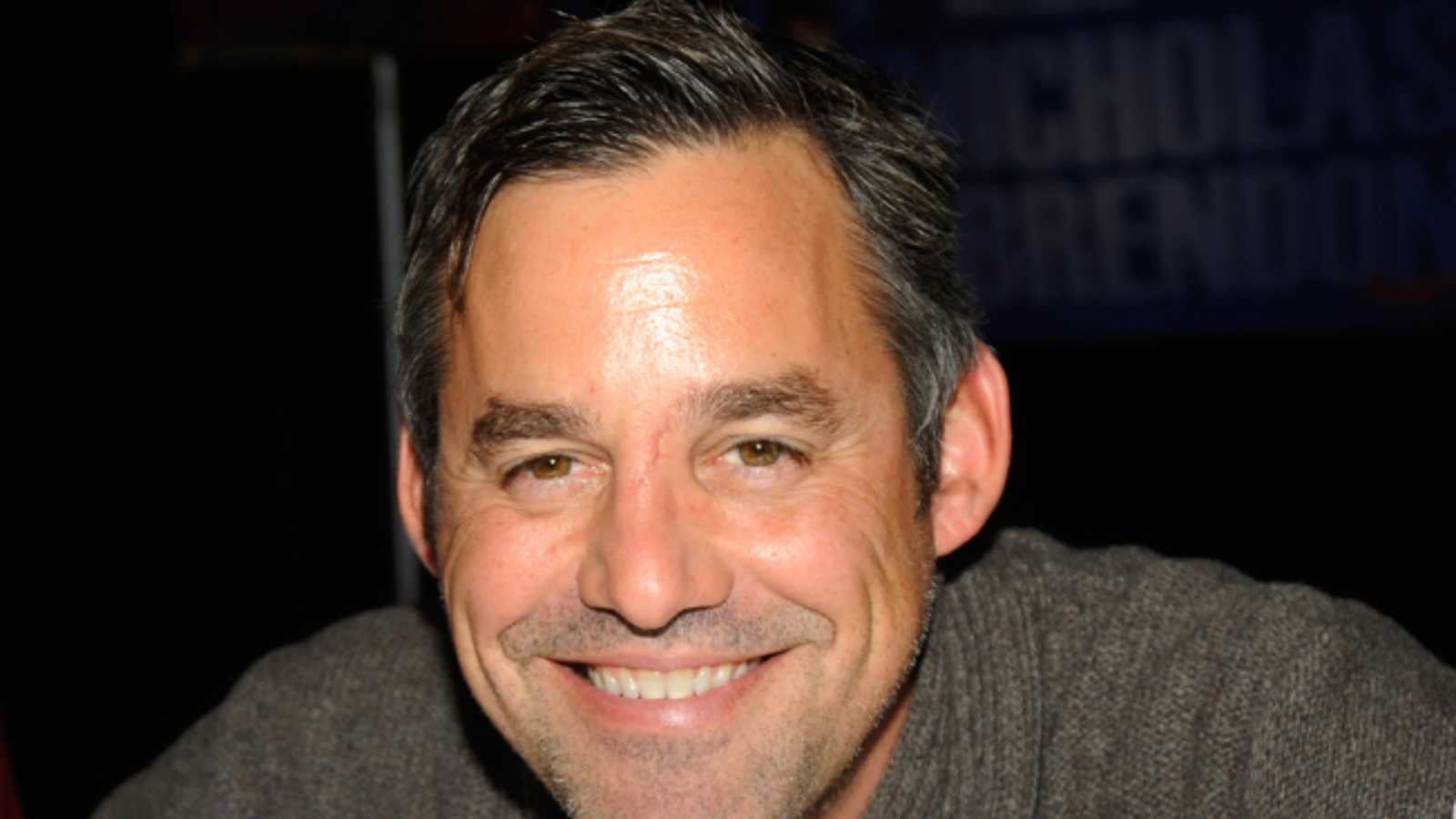
There is a specific kind of silence that follows the death of a “sidekick.” When the hero falls, the world stops; when the loyal best friend goes, the heart just aches a little more quietly. For an entire generation of television fans, Nicholas Brendon wasn’t just an actor; he was Xander Harris, the “guy who sees everything,” the one who didn’t have powers but had a heart big enough to anchor a slayer.
On Friday, March 20, 2026, that heart finally stopped. Nicholas Brendon was found dead in his home in Putnam County, Indiana, at the age of 54.
The details trickling out are as somber as they are surreal. According to reports from the local coroner, “Brendon was found “positioned as if asleep.” There were no signs of a struggle, no chaos, and no foul play.
But perhaps the most poignant detail is that he wasn’t entirely alone in his final hours. A longtime friend had been staying at the house to provide care, a quiet witness to the end of a life that was often lived under the harshest spotlight.
The Man Behind the “Zeppo”

To understand why this feels like a gut punch, you have to look past the Buffy reunions and the Comic-Con panels. Nicholas Brendon’s life was a masterclass in the duality of fame. While his character Xander was redefining the “nerd” archetype and making it cool to be the awkward, funny guy in the room, Brendon himself was battling demons far scarier than anything Joss Whedon ever put in a script.
Most fans know about his public struggles, the arrests, the rehab stints, the raw, uncomfortable 2015 appearances on Dr. Phil. But what many didn’t see was the quiet, artistic renaissance he was experiencing in his final years.
Moving away from the Hollywood grind, Brendon had pivoted almost entirely to painting. His family noted that his art was “one of the purest reflections of who he was.” He wasn’t just a former TV star; he was a man trying to paint his way through the pain, selling his work online and hosting live cooking videos for fans. He was accessible, vulnerable, and, by all accounts, deeply optimistic about what was next.
He had even recently completed work on a romance drama titled Yesterday Is Almost Here. The film’s director, Joston Ramon Theney, recently described Brendon’s performance as his most profound work yet, a “testament to his resilience.” It’s a tragic irony that just as he was finding a new rhythm, his body finally gave out.
The Body’s Rebellion

While the family statement cited “natural causes,” the reality of Brendon’s physical health in recent years was a harrowing list of complications. Many people are unaware that Brendon was living with Cauda Equina Syndrome (CES), a rare and serious spinal condition where the nerve roots in the lumbar spine are compressed. It didn’t just cause pain; it led to temporary paralysis and required multiple invasive surgeries.
Then there was his heart. In 2023, he suffered a significant heart attack and was subsequently diagnosed with a congenital heart defect. For a man who lived with such “intensity and imagination,” his physical frame was increasingly at odds with his spirit.
The “natural causes” reported weren’t a sudden stroke of bad luck, but the final chapter of a long, exhausting battle with a body that had been failing him for years.
Why We Should Stop Calling This a “Tragedy”

Now, here is where we need to have a difficult conversation. The headlines all use the word “tragedy.” They focus on the “what ifs” and the “could have beens.” But is it possible that Nicholas Brendon’s death, as sad as it is, represents something different?
There is a prevailing narrative that every celebrity with a history of substance abuse or legal trouble is a “cautionary tale.” We see in Brendon a man who “lost his way.” But what if we shifted the lens? What if, instead of a tragedy, we saw a successful survival story that simply reached its natural conclusion?
Brendon lived 54 years. In that time, he overcame a severe childhood stutter to become a television icon. He faced down addiction in the most public way possible and, rather than disappearing, he spent his final years creating art and connecting with fans in their living rooms via social media.
He didn’t die in a dark alley or under suspicious circumstances; he died in his sleep, in his own home, under the care of a friend, while “optimistic about the future.” In a culture that demands celebrities either be perfect role models or complete wrecks, Brendon was neither.
He was human. To label his death a “tragedy” based on his past mistakes is to ignore the incredible resilience it took for him to make it to 2026 at all. Maybe the real story isn’t that he’s gone, but that he stayed as long as he did, and that he found a way to be happy before he left.
A Legacy in the Shadows
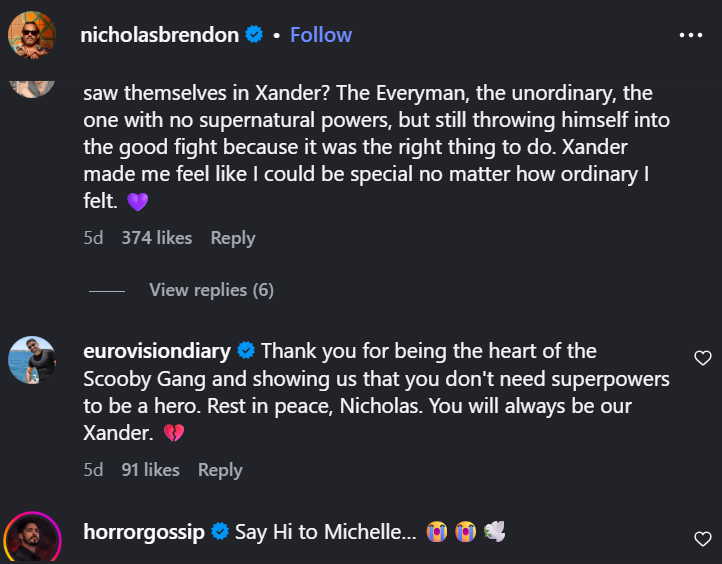
The timing of his passing adds another layer of melancholy for the “Scooby Gang.” Just weeks ago, Sarah Michelle Gellar confirmed that the long-gestating Buffy reboot at Hulu had been officially scrapped. The “New Sunnydale” project was dead, and now, one of the original residents is gone, too.
Gellar’s tribute to Brendon on Instagram was perhaps the most fitting. She quoted a famous Xander line: “They’ll never know how tough it is to be the one who isn’t chosen. To live so near to the spotlight, and never step in it. But I know. I see more than anybody realizes, because nobody’s watching me.”
She added, “I saw you Nicky. I know you are at peace.” Nicholas Brendon spent much of his life in that peculiar space, just outside the brightest spotlight, dealing with the shadows that fame often brings. Whether he was Kevin Lynch on Criminal Minds or the guy holding a paintbrush on a Facebook Live stream, he remained the “guy who sees everything.”
As the autopsy results remain pending, the fan community is left to remember the man who made it okay to be the underdog. He was a twin, a writer, a survivor, and an artist. He was 54, he was tired, and he finally went to sleep.