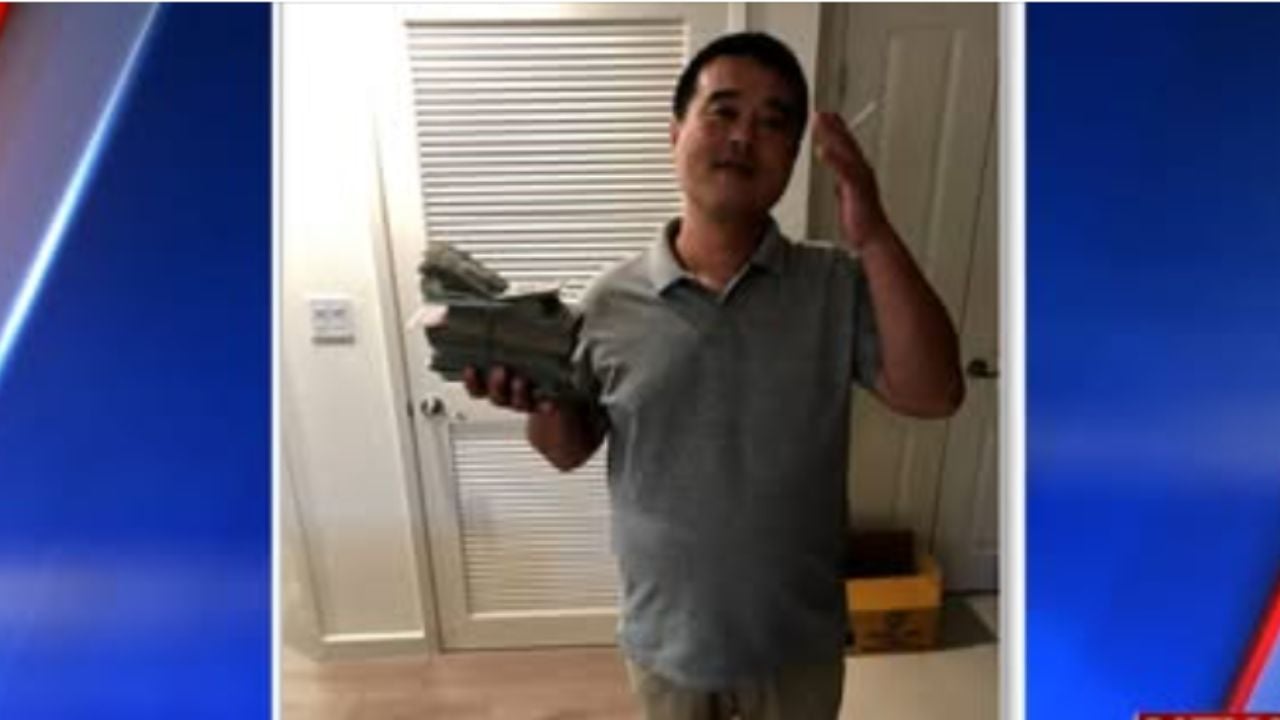
A man accused of helping coordinate a massive elder fraud operation has pleaded guilty in San Diego federal court, admitting his role in a $65 million fraud and money laundering scheme.
Federal prosecutors identified the lead defendant as Hua Wang, 48, of Flushing, New York, according to the U.S. Attorney’s Office for the Southern District of California.
The scheme targeted elderly victims across the United States, including victims in San Diego. Prosecutors said more than 30 defendants have been publicly charged in related indictments.
Wang admitted that he participated from 2019 through 2023 and was responsible for more than 2,000 cash packages sent by elderly victims, with $64 million in victim losses.
Victims Were Told To Hide Cash Inside Packages
Prosecutors said the criminal network worked with India-based scam call centers. Fraudsters posed as technical support agents, government officials, or bank employees, then used scripted claims to convince elderly victims that they needed to send money.
After victims were defrauded, they were told to withdraw large amounts of cash, hide the cash inside packages, and send the packages through express mail carriers.
The packages were addressed to fake names connected to fake identification documents, according to prosecutors. The addresses led to short-term rentals used by members of the conspiracy.
Prosecutors said the group used a hub-and-spoke pattern, booking one rental as a hub for about a week while using nearby locations for shorter stays before moving again.
The San Diego Investigation Started With 11 Packages
The investigation began in December 2020 after an elderly victim contacted an express mail carrier after being tricked into mailing cash.
Investigators then discovered 11 packages containing about $135,000. Each package was addressed to a fake name and sent to a short-term rental in the San Diego area, according to prosecutors.
The case later expanded into a national investigation. In April 2025, Wang was arrested at his residence in Flushing, New York, days after co-defendant Weining Su, also known as “Ning Ma,” was arrested at JFK International Airport while trying to board a one-way flight to China.
Federal agents later carried out a nationwide takedown that included arrests in Southern California, Texas, Michigan, and New York.
YouTube Videos Helped Investigators Identify Defendants
Prosecutors said videos posted by YouTubers from Scammer Payback and Trilogy Media helped law enforcement identify several defendants and understand how the conspiracy operated.
In coordinated sting operations, Scammer Payback and Trilogy Media baited fraudsters, confronted them on camera, and published videos on their YouTube channels.
DOJ said videos posted in 2020 and 2021 helped law enforcement identify Zhiyi Zhang, Dudu Chen, and Huajian Chen, all of whom were named in the indictments.
In one example described by prosecutors, Pierogi from Scammer Payback was told by scammers to send a package of cash to an individual named “Hans Bum” at an address in South San Francisco. Trilogy Media then delivered a decoy package and confronted the person receiving it, who prosecutors said turned out to be Zhiyi Zhang.
Cash Seizures Showed The Money Trail
Federal prosecutors said members of the group laundered the proceeds after victims sent money. In March 2021, Wang and other co-conspirators were operating in Las Vegas.
On March 4, 2021, co-conspirator Xiao Lei Xu was stopped by law enforcement while traveling toward the Los Angeles area with $70,000 in cash from the scheme.
Eight days later, Wang, Xu, and another co-conspirator were stopped while traveling from Las Vegas to Los Angeles. Officers seized $120,860 in fraud proceeds, according to prosecutors.
In addition to Wang, prosecutors said nine co-conspirators pleaded guilty over the past two months. Other defendants were scheduled to plead guilty later, and more than 30 defendants have been publicly charged in related indictments.
Wang Is Scheduled For Sentencing In September
Wang is scheduled to be sentenced September 18, 2026, before U.S. District Judge Todd W. Robinson.
He pleaded guilty to conspiracy counts tied to mail and wire fraud and money laundering, according to prosecutors.
The mail and wire fraud conspiracy charge carries a maximum penalty of 40 years in prison and a maximum $1 million fine. The money laundering conspiracy charge carries a maximum penalty of 20 years in prison and a maximum $500,000 fine or twice the amount of monetary instruments involved in the offense, whichever is greatest.
The case was investigated by Homeland Security Investigations, the FBI, IRS Criminal Investigation, the U.S. Postal Inspection Service, and several local and state law enforcement agencies.
Cash Package Scams Leave A Physical Trail
People who are told to withdraw cash and mail it, ship it, hide it in a package, or send it to a person they have never met should stop before the package leaves their hands.
Common cover stories include fake tech support, fake bank fraud, fake government investigations, mistaken refunds, compromised accounts, or claims that a victim’s money has to be protected from criminals.
No real bank, tech company, or government agency will tell someone to hide cash in a package and send it to a stranger at a rental home, hotel, apartment, or shipping location.
Anyone who already mailed cash should contact the shipping company immediately, ask whether the package can be intercepted, preserve tracking numbers and receipts, contact local police, and report the fraud to the FBI’s Internet Crime Complaint Center at IC3.gov.