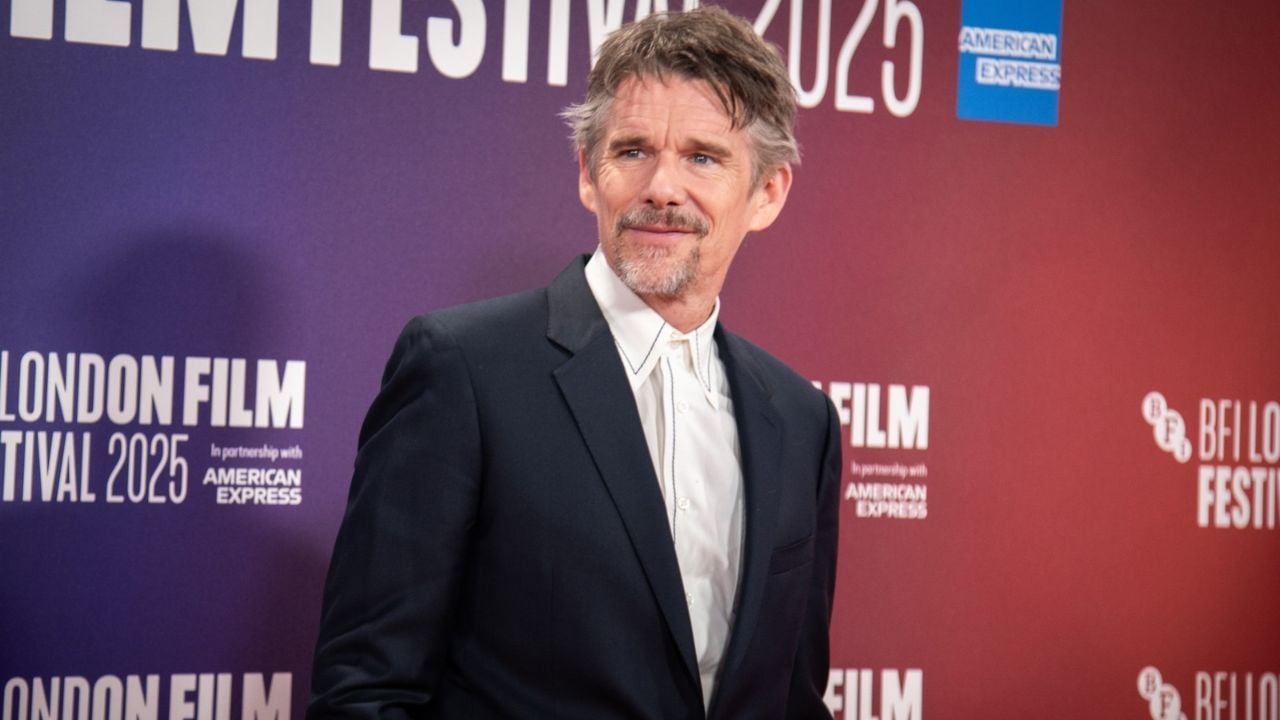
Ethan Hawke is taking aim at the relationship between money and power in entertainment, describing people who believe their wealth lets them control others as “greedy bastards.”
The 55-year-old actor spoke with Zach Baron for GQ’s One More Question series in an interview published Oct. 13. Baron asked whether younger artists were confronting the same world Hawke encountered at the beginning of his career.
Hawke acknowledged that the internet has transformed daily life and attention spans. He argued that the questions people make art about, including love, family, community and justice, remain much the same.
He remembered seeing Slacker and Pulp Fiction when they first appeared and recognizing something that belonged to his generation. Now he wants younger filmmakers and performers to find their own voices.
He Expects New Movements in Music and Live Theater
“I believe in rebellion,” Hawke said. He predicted major movements in music and live theater, along with people finding new reasons to gather together. He rejected the idea that audiences are fundamentally superficial or that the current cultural environment represents a permanent endpoint.
For those who believe money guarantees lasting influence, his assessment was blunt: “they always lose in the end.”
His Favorite Projects Often Come With Smaller Paychecks
Asked about the relationship between meaningful work and compensation, Hawke said that “the more you love a project, the less you get paid.” He described the existence of Blue Moon as a victory in itself, arguing that its appeal was never something an audience-demand calculation would readily identify.
Hawke and director Richard Linklater spent years discussing Robert Kaplow’s screenplay about lyricist Lorenz Hart before seeking the money to make it. The film takes place largely at Sardi’s restaurant on the opening night of Oklahoma!, as Hart confronts the success of his former collaborator Richard Rodgers.
He described a similar beginning for The Lowdown, which grew from his friendship with creator Sterlin Harjo and their enthusiasm for working together. Hawke said many of his recent projects developed through those relationships rather than arriving as finished offers for him to accept.
Blue Moon Reached Production After Years of Readings and Revisions
Sony Pictures Classics shares the official Blue Moon trailer, July 29, 2025
Sony Pictures Classics announced the project in June 2024, with financing from the distributor and Renovo Media Group. Linklater said he, Hawke and Kaplow had been developing the story for more than a decade.
Money was not the only reason they waited. In a February 2026 interview with TheWrap, Linklater and Hawke described revisiting the script through private readings while the director waited for his leading man to grow into the role. The eventual production involved a 15-day shoot on a stage in Dublin.
Linklater also recalled Hawke making a similar choice much earlier in their partnership. When they worked on Before Sunrise, he said, Hawke turned down more lucrative offers to make their dialogue-heavy film in Vienna, despite doubts about whether they could pull it off.
Dead Poets Society Raised His Expectations for Other Film Sets
At a Sept. 28 discussion with Kyle MacLachlan at New York’s Symphony Space, Hawke recalled how much he enjoyed working with Peter Weir on Dead Poets Society. He said he then went about a decade without another experience he considered comparably rewarding, according to PEOPLE.
He had initially assumed that the atmosphere on the 1989 film was typical. Other productions, he said, could be cold, commercially driven and dismissive of actors. The conversation, held for MacLachlan’s memoir Fictional Selves, also covered the trust each actor had found with a longtime collaborator: Linklater for Hawke and David Lynch for MacLachlan.
He Describes Extreme Fame as a Form of Isolation
Hawke also told Baron that celebrity can separate people from ordinary life even while surrounding them with attention. He pointed to Elvis Presley and Michael Jackson while discussing the pressures of extraordinary fame, describing an environment in which constant praise can replace honest relationships.
He recalled the professional success of Training Day giving way to upheaval surrounding his divorce. That period informed his 2021 novel, A Bright Ray of Darkness, about an actor performing in Henry IV on Broadway while his marriage collapses.
Hawke said he draws on his experiences through fictional characters rather than writing direct replicas of himself. He also appreciates the level of recognition he has now: enough to keep working with talented filmmakers, without making ordinary activities such as grocery shopping impossible.
Five Oscar Nominations Have Not Made His Career Familiar to Everyone
Hawke’s Blue Moon performance earned him a 2026 Academy Award nomination for leading actor. His earlier nominations recognized his supporting performances in Training Day and Boyhood and his screenwriting contributions to Before Sunset and Before Midnight.
He told Baron he enjoyed that recognition while resisting the idea that awards should determine artistic worth. He has particularly admired the jury-selected acting prizes at Cannes, Berlin and Venice, which he views differently from the business and publicity surrounding an Oscar campaign.
Some encounters suggest a much narrower view of his career. Hawke recalled a man at an airport asking whether he was still acting, then encouraging him to keep going. Other viewers, he said, know him primarily through one film or genre.
His oldest daughter once showed Before Sunrise to friends who enjoyed it but questioned why Jesse and Celine did not exchange cellphone numbers. Hawke said they had mistaken the absence of phones for a deliberate artistic choice.