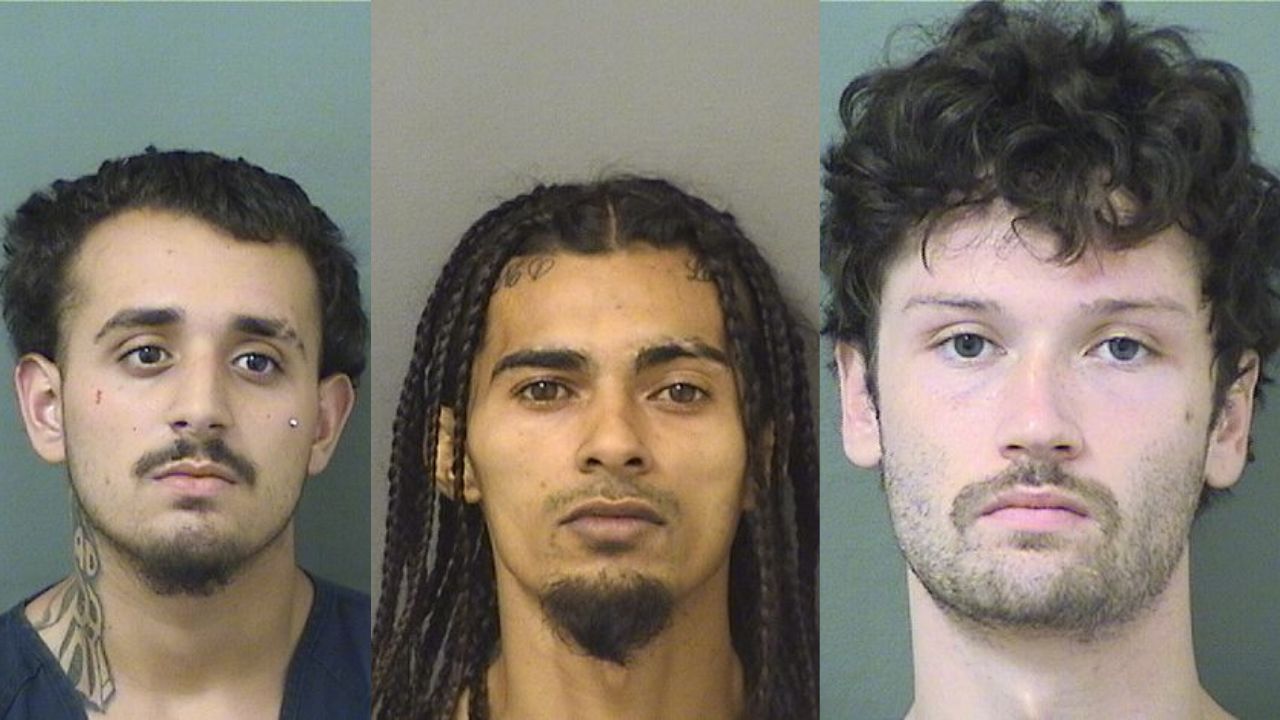
A woman visiting Delray Beach, Florida, from Texas was told to withdraw $9,895 in cash and hand it to a courier after a caller claimed to be investigating fraud for the Federal Deposit Insurance Corporation.
Instead of surrendering the money, she grew suspicious and contacted an acquaintance who alerted police. She continued speaking with the caller on one phone while communicating with a Delray Beach police sergeant on another.
Detectives watched as an unsuspecting Uber driver arrived for the collection and a gray Kia SUV moved around the nearby parking lot. When officers later stopped the Kia on Interstate 95, a phone inside the vehicle rang after they dialed the number used to contact the woman.
Police arrested Ronald Garcia, 19, Edward Patrick Thomas, 29, and Michael Alfonse Rescigno, 23, on Oct. 6, 2026. All three were accused of participating in an organized scheme to defraud. Garcia and Thomas also faced separate firearm and marijuana allegations, respectively.
The Fake FDIC Investigator Told Her to Withdraw $9,895
The woman first received a call on Oct. 5 from a man identifying himself as “Elijah Codwell,” an FDIC investigator. He claimed that her bank accounts had been compromised, according to the Delray Beach Police Department’s sworn investigative account.
She was preparing to travel to Florida from Texas and told him she could not speak at that time. The caller contacted her again the following morning, renewing his warning that fraudulent transactions were occurring on her accounts.
The man initially instructed her to withdraw money from Wells Fargo and Bank of America. She explained that she banked with Chase instead and was directed to visit its branch on South Federal Highway in Delray Beach.
During the conversation, she received a message about an attempted $9,895 wire transfer. The caller instructed her to withdraw the same amount in cash so it could supposedly be transferred into a safe account. A bank courier would arrive to collect it.
She became suspicious and contacted an acquaintance, who alerted the police. Sergeant Christopher Trapasso spoke with her while she maintained contact with the caller. Officers instructed her not to hand over the money or meet with anyone claiming to collect it.
An Uber Driver Arrived at the Bank Without Knowing About the Scam
Detectives responded to the parking lot shared by the Chase Bank and a Carrabba’s restaurant. Several marked Delray Beach Police vehicles were already nearby because officers had been eating at the restaurant.
During the conversation, the caller told the woman he could see marked police vehicles in the parking lot and continued directing her where to park. Investigators believed the caller was monitoring the collection location.
A red Toyota RAV4 arrived near Carrabba’s. The driver explained to officers that he worked for Uber and had been hired to collect a package from a woman before delivering it to a nearby CVS.
The driver showed detectives the pickup and destination information in his app. Investigators treated him as an unwitting courier rather than a participant in the suspected fraud. As officers approached him, the person speaking with the woman abruptly ended the call.
Detectives had also been watching a gray Kia SUV moving between parking spaces. Its driver appeared to be speaking on a phone’s speaker function while observing the parking lot. The vehicle quickly left as officers made contact with the Uber driver.
Police Dialed the Scam Number and a Phone Inside the Kia Rang
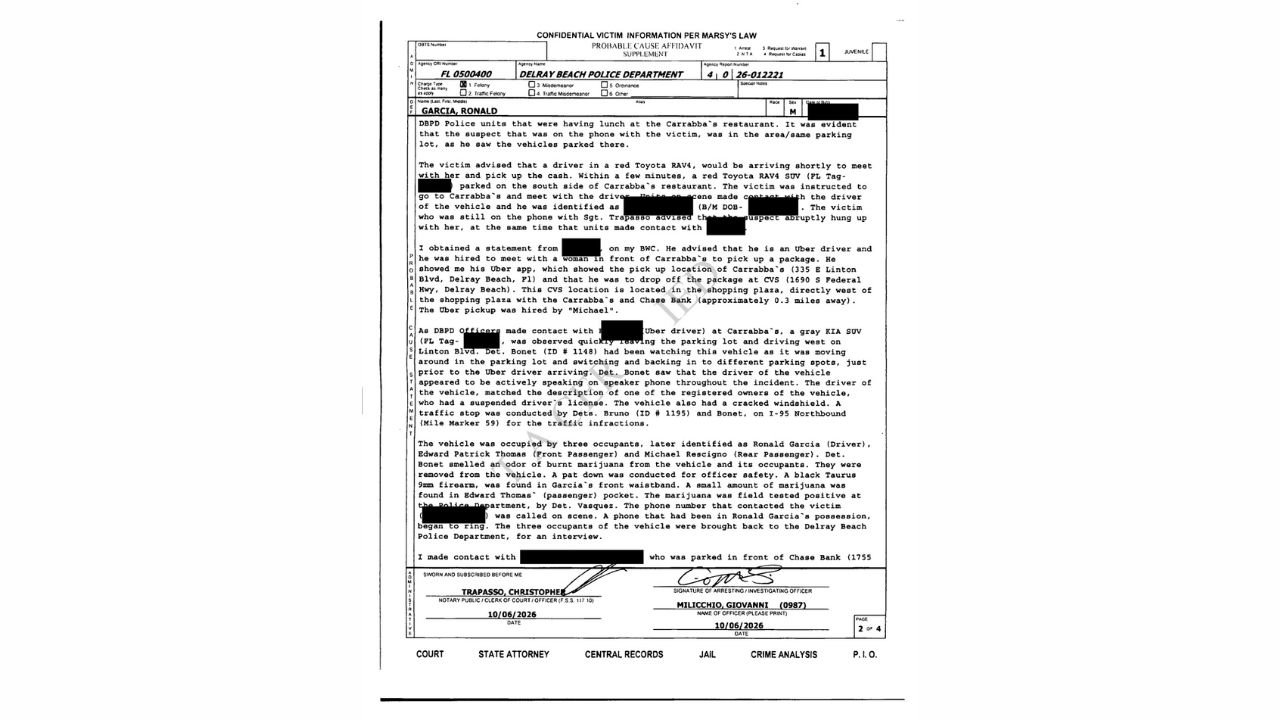
Detectives followed the gray Kia as it traveled toward Interstate 95. Officers stopped it on the northbound highway after observing a cracked windshield and initially believing the driver matched a registered owner whose license was suspended.
According to the police probable-cause affidavit, Garcia was driving, Thomas occupied the front passenger seat, and Rescigno was sitting in the back. Thomas later told investigators that the vehicle belonged to him and that he had asked Garcia to drive because his own license was not valid.
During the stop, detectives reported smelling burnt marijuana. Officers found a loaded Taurus 9mm handgun in Garcia’s waistband and a small amount of marijuana in Thomas’s pocket. The marijuana subsequently tested positive during a police field test.
Investigators then called the telephone number used to contact the woman. A phone that had been in Garcia’s possession began ringing. A subsequent database search associated that number with Garcia, according to the affidavit.
Garcia told investigators that Thomas and Rescigno had come to his home in West Palm Beach before the three traveled to Delray Beach for lunch. He said they had stopped at a pharmacy because someone needed to use the restroom, but he could not identify the business’s location.
Garcia also told detectives that he had not been paying attention to whether anyone in the vehicle was using a phone. Thomas and Rescigno declined to answer further questions without an attorney.
Officers took all three men into custody. The woman still had the $9,895 in an envelope, preventing the intended cash collection from being completed.
Garcia and Thomas Faced Six-Figure Bonds After Their Arrests
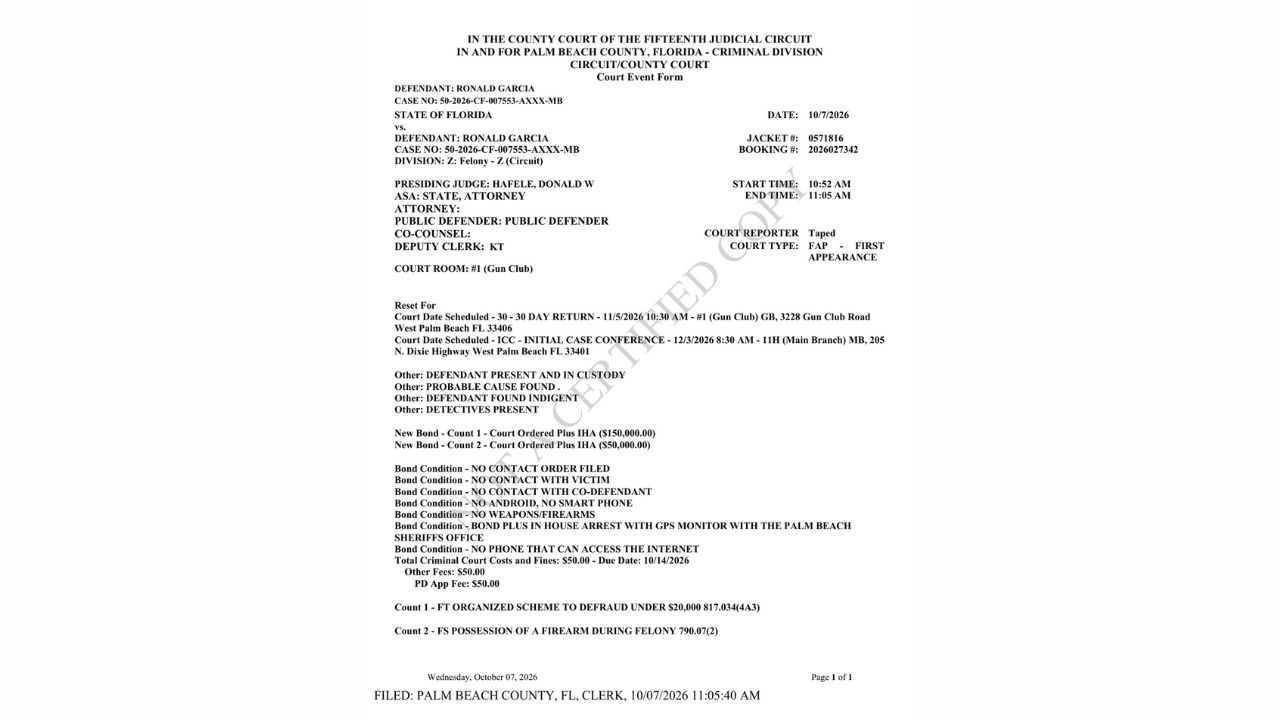
Palm Beach County court records identify separate criminal proceedings against all three men. Each was accused of organized scheme to defraud involving less than $20,000, an offense under Florida’s Communications Fraud Act.
Garcia’s case, 50-2026-CF-007553-AXXX-MB, also includes possession of a firearm during a felony under Section 790.07(2). At his Oct. 7 first appearance, Judge Donald W. Hafele set bond at $150,000 on the organized-fraud allegation and $50,000 on the firearm allegation, totaling $200,000.
The court also imposed conditions that would require GPS-monitored house arrest if Garcia were released on bond. Those included restrictions on contact with the victim and co-defendants, possession of weapons, and access to smartphones or other phones capable of connecting to the internet.
Thomas’s case, 50-2026-CF-007545-AXXX-MB, includes the organized-fraud allegation and a separate misdemeanor allegation of possessing 20 grams or less of marijuana. The court set bonds of $100,000 and $1,000, respectively, totaling $101,000. GPS-monitored house arrest was also included among his release conditions.
The first-appearance records scheduled additional proceedings for Garcia and Thomas on Nov. 5 at 10:30 a.m. and initial case conferences on Dec. 3 at 8:30 a.m.
Rescigno’s separate Palm Beach County case is numbered 50-2026-CF-007556-AXXX-MB. Boca Daily News reported Oct. 8 that he had been released on $5,000 bond, while Garcia and Thomas remained jailed at that time.
The charges against all three men remain allegations. Each is presumed innocent unless proven guilty in court.
The FDIC Will Not Send a Courier to Collect Withdrawn Cash
The FDIC warns that criminals impersonate federal officials through unsolicited calls, text messages and emails. The agency says it does not make unsolicited demands for money or sensitive banking information.
A caller claiming that an account has been compromised and directing someone to withdraw cash for collection by a stranger should be treated as a warning sign. The FDIC does not require consumers to hand money to couriers to protect bank deposits.
Anyone receiving such instructions should stop communicating with the caller and independently contact their bank using a verified telephone number. The FDIC can also be reached at 1-877-ASK-FDIC.
When a courier pickup has already been arranged, victims should contact law enforcement rather than confront the person collecting the package. Preserving telephone numbers, messages, pickup instructions and other records can help investigators identify how the attempted fraud was organized.