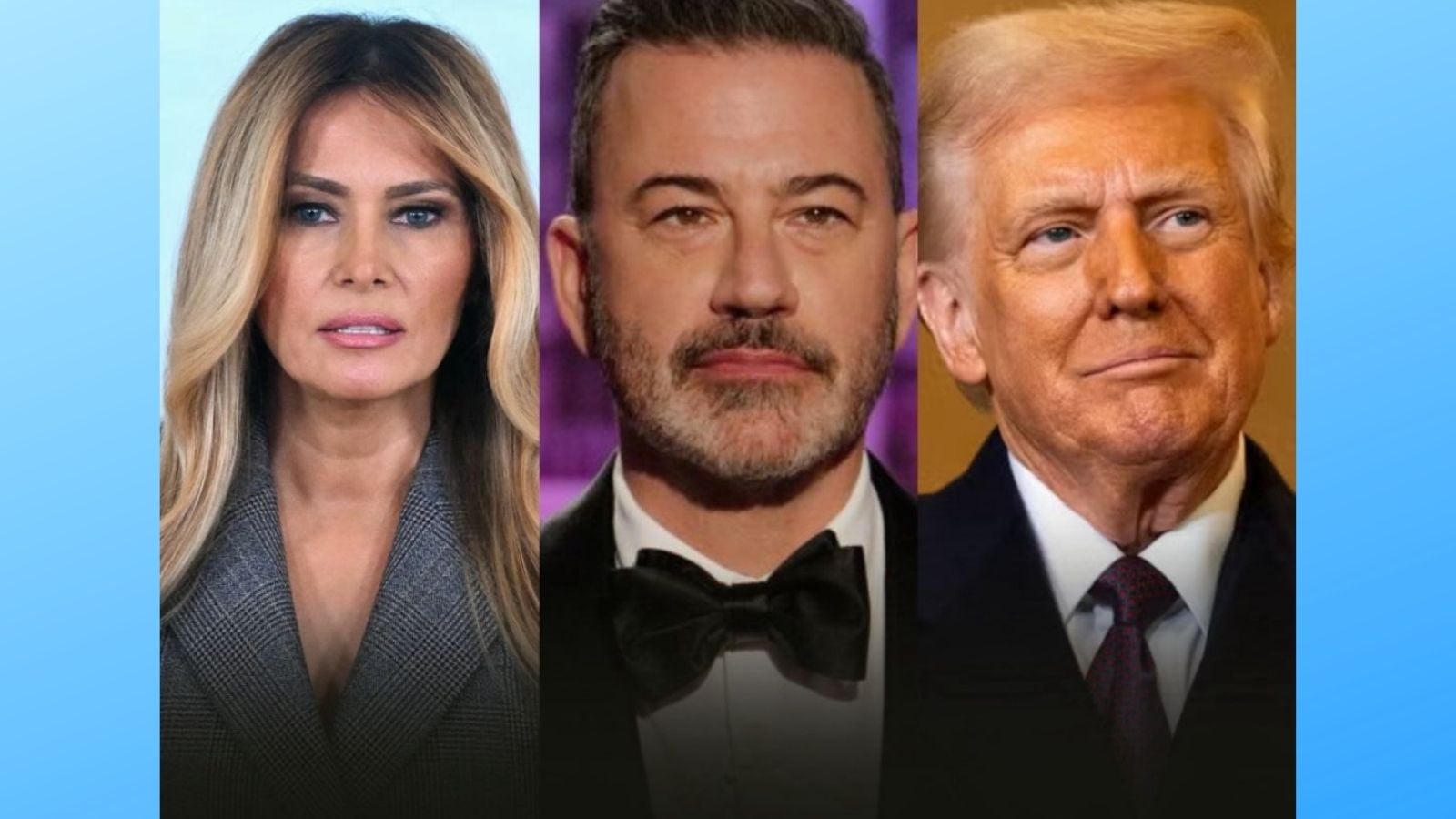
One joke. That is all it took. Jimmy Kimmel threw out a single punchline about Melania Trump, and suddenly the White House was calling for his job, Hollywood was closing ranks, and the internet turned it into a full-blown cultural showdown. What should have been another late-night moment came back louder, messier, and way more political than anyone expected.
Now it is not just about whether the joke landed or crossed a line. It is about power, pressure, and who actually gets to decide when comedy stops being funny and starts being a problem. And with names like George Clooney, Jane Fonda, and Stephen King jumping in, this is officially no longer just TV drama; it is a pop culture fight with real stakes.
The Joke That Started Everything
It all kicked off on a Thursday night on “Jimmy Kimmel Live!” when Kimmel decided to host his own version of the White House Correspondents’ Dinner. That annual event is basically where powerful people sit in a room and pretend they enjoy being roasted, so Kimmel leaned into that energy and did what he does best.
Then came the now-infamous line. Turning to Melania Trump, he complimented her before adding she had “a glow like an expectant widow,” and just like that, a standard late-night punchline turned into a full-on cultural moment once it left the studio and hit the internet.
The joke itself is doing a lot without saying everything outright. It is dark, layered, and a little bit uncomfortable, which is exactly why it landed in the room and exactly why it exploded outside of it.
The Trumps Fire Back and Then Goes Further
Kimmel’s hateful and violent rhetoric is intended to divide our country. His monologue about my family isn’t comedy- his words are corrosive and deepens the political sickness within America.
People like Kimmel shouldn’t have the opportunity to enter our homes each evening to…
— First Lady Melania Trump (@FLOTUS) April 27, 2026
Donald Trump did not take the joke quietly, not even a little. Both he and Melania Trump directly called for ABC to fire Kimmel, making it a public demand rather than a vague complaint.
This is not even new territory. Trump has gone after Kimmel’s show before, criticizing it and pushing for its cancellation on more than one occasion, so there is already history here.
What made this situation hit differently is timing. The joke aired during the same window as a real-world shooting connected to the Correspondents’ Dinner setting, giving the White House an opening to frame it as darker and tied to real violence.
That framing mattered. It shifted the argument from “this joke was rude” to “this joke is dangerous,” and suddenly the pressure on ABC was not just political, it was moral, at least according to that narrative.
And for ABC, this is not a fun position. A sitting president publicly calling for you to fire one of your biggest hosts is the kind of pressure that instantly turns into headlines, especially when the network says little in response.
Jane Fonda’s Committee Draws the Line
Then came Jane Fonda, who is not exactly known for staying quiet when things get political. On Monday, April 27, NBC News reported that the Committee for the First Amendment, which she leads, issued a very direct statement about where it stands.
The group made it clear that the “right to mock, to challenge”, and even “offend those in power, is foundational to democracy.” But that’s not all, they also made a grand opening statement saying: “In America, satire is not a crime.” For them, that is the entire point of satire, and they were not about to let that idea slide quietly.
They went further by calling out what they described as a pattern in Trump’s behavior. According to NBC’s reporting, the Committee argued that these kinds of demands follow a familiar playbook of using government influence to pressure media outlets into silencing speech.
And then came the line that really set the tone. The group said “no”, clearly and directly, and urged ABC not to comply either, reinforcing that they plan to keep exercising their First Amendment rights regardless of the pressure.
#GeorgeClooney is defending Jimmy Kimmel after Trump’s latest call for his firing:
“Jimmy’s a comedian, and I would argue that Karoline Leavitt didn’t mean shots should be fired,” Clooney told Variety at the 51st Chaplin Award Gala, where he was honored for his contributions to… pic.twitter.com/ayxVRPnsbW
— Variety (@Variety) April 28, 2026
George Clooney Takes the Mic at a Gala
Then George Clooney stepped in, because of course he did. While being honored at the 51st Chaplin Award Gala, which is about as glamorous and non-political as it gets, he still found himself answering questions about the Kimmel situation.
His response was simple but sharp. He reminded everyone that “Jimmy’s a comedian”, which, in his view, should already explain the situation.
But he did not stop there. Clooney also referenced a separate controversy involving White House press secretary Karoline Leavitt, saying, “I would argue that Karoline Leavitt didn’t mean shots should be fired,” noting that heated language is everywhere in politics, not just in comedy.
Karoline Leavitt to Fox before the WHCD event: There will be some shots fired tonight pic.twitter.com/vcVfZxYoat
— Acyn (@Acyn) April 26, 2026
And in case you’re wondering what this has to do with Leavitt, well, it will interest you to know that press secretary Karoline Leavitt told Fox News on the red carpet before the White House Correspondents’ Dinner, that “there will be some shots fired tonight in the room.”
That comparison was intentional. He was basically saying, if political figures can speak loosely and dramatically every day, why is a comedian suddenly being treated like a national threat for doing his job?
And because it is Clooney, his comments did not just stay in that room. They were shared widely, making it clear that Hollywood was not sitting this one out.
Stephen King Has Thoughts. He Always Does
Melania Trump says Jimmy Kimmel should be canceled. Last week her husband commented on Robert Mueller’s death: “Good. I”m glad he’s dead.”
Said Pretty much the same about my old friend Rob Reiner.
People who live in glass houses should’t throw shit.— Stephen King (@StephenKing) April 27, 2026
Stephen King also jumped into the conversation, because when has he ever not had thoughts on something like this? He criticized Melania Trump’s push to have Kimmel fired, adding his voice to the growing pile of public opposition.
His response was direct, stating that: “People who live in glass houses shouldn’t throw shit.” A reference to all the time Trump himself has made rather offensive statements about other people.
King’s role here hits differently. He is not speaking as part of an organization or from a red carpet; he is speaking as a private individual with a massive platform and zero hesitation.
He has a long history of publicly clashing with Trump, so his involvement is not surprising, but it does add weight. It shows this is not just an industry issue; it is a broader cultural one pulling in voices from everywhere.
Put together, you have Fonda’s organization, Clooney’s public defense, and King’s outspoken criticism all landing on the same side, which is not exactly a small or quiet coalition.
What This Fight Is Really About
At this point, the joke itself almost feels like background noise. The bigger story is what happens when political power collides directly with entertainment platforms in such a public way.
Fonda’s Committee has already framed it as part of a larger pattern of pressure on media, which takes this far beyond one late-night host and one controversial line.
For ABC, the decision is not simple. Do they push back, stay silent, or fold under pressure? Whatever they do will send a message, not just about this situation, but about how much influence political figures can have over media companies.
Kimmel is still on air, nobody has been fired, and the situation is far from resolved. But one thing is very clear: this is no longer just about a joke; it is about who gets to tell them, who gets to react to them, and who ultimately decides when the laughter stops.