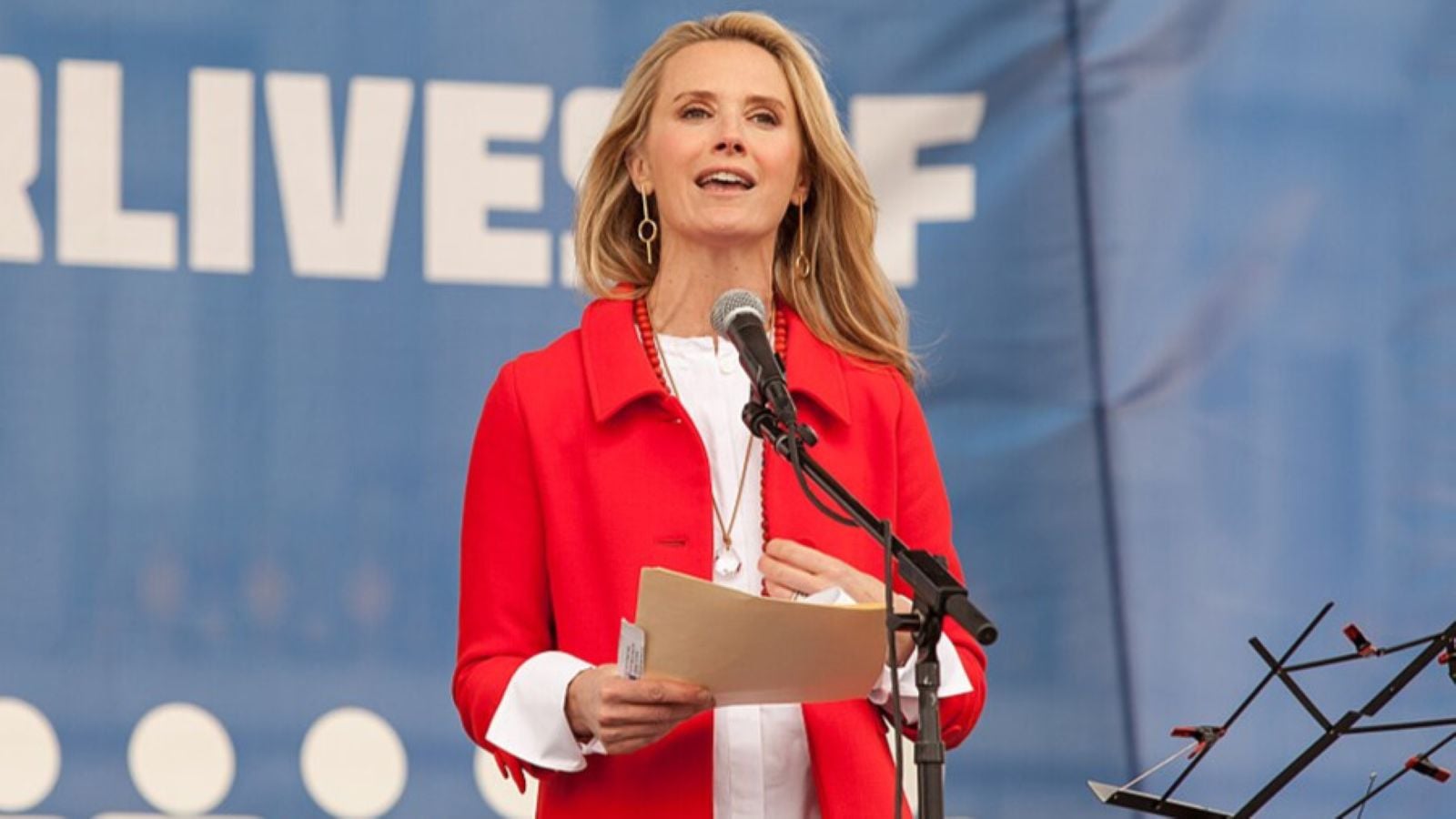
When Jennifer Siebel Newsom arrived in Hollywood at 28, her agent gave her two pieces of advice. Remove the Stanford MBA from her résumé so she doesn’t seem too smart. And lie about her age.
She refused both.
“Those are my values, and I was proud of my Stanford MBA and my Stanford undergraduate,” she told Bloomberg’s Emily Chang in a recent episode of The Circuit. “I didn’t want to pretend to be someone I wasn’t.”
It cost her. She was typecast as a trophy wife, picking up guest roles on Mad Men, Numb3rs, and Life while the industry quietly filed her under decorative. The intelligence she refused to hide was the same intelligence the industry kept penalizing.

So she left acting, made Miss Representation—a Sundance documentary about exactly how Hollywood distorts the portrayal of women in power—and never looked back.
Her husband, California Governor Gavin Newsom, apparently did not get the same memo about performed stupidity.
The Lesson He Learned Differently
On February 22, Newsom was in Atlanta promoting his memoir Young Man in a Hurry, seated alongside Mayor Andre Dickens at the Rialto Center for the Arts. When Dickens asked him about his learning disabilities and “two separate lives,” Newsom reached for vulnerability.
“I’m not trying to impress you,” he said. “I’m just trying to impress upon you I’m like you. I’m no better than you. I’m a 960 SAT guy.”
He paused.
“You’ve never seen me read a speech, because I cannot read a speech. Maybe the wrong business to be in.”
The clip hit X and has been viewed more than 58 million times. It sparked a 48-hour firestorm, captioned by the conservative account End Wokeness as “Gov. Newsom to a black crowd in GA”—a framing that was partly manufactured. Multiple videos of the event show a diverse audience. Newsom never mentioned race.
None of that context stopped the backlash.
Newsom’s spokesperson called it “MAGA-manufactured outrage.” Newsom himself told Sean Hannity to “spare me your fake f***ing outrage” on X. In follow-up interviews, he reframed his dyslexia as a “superpower.” The damage control was swift, but the clip was faster.

The Same Script, Two Outcomes
Hollywood handed Jennifer Siebel Newsom a script that required her to perform as less than she was—less educated, less accomplished, less threatening. She refused the script. She made a documentary about the script. She has spent the subsequent decade arguing publicly that the entertainment industry’s demand for women to hide their intelligence is a systemic problem worth dismantling.
Her husband, a multimillionaire governor with Getty-world connections and a national-profile machine that is widely read as 2028 positioning, sat in Atlanta and performed the same script voluntarily. Not because anyone asked him to. Because he calculated that a low SAT score and an inability to read a speech would make him relatable to the room.
The question isn’t whether Gavin Newsom has dyslexia. He does. The question is: what does it reveal when a man selling a book with tickets priced up to $100 chooses illiteracy-adjacent humility as his bridge to an audience he wants to impress?
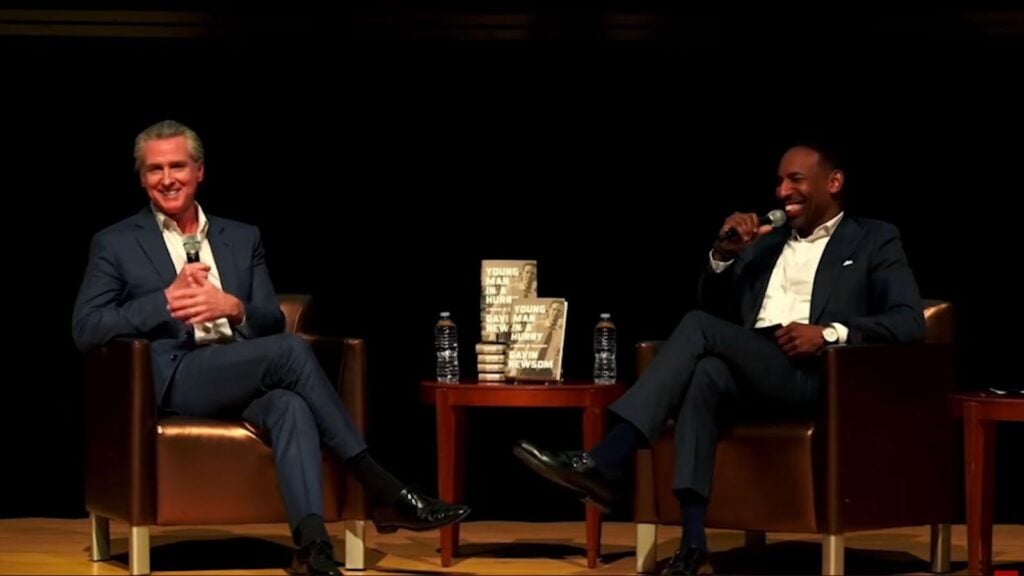
The man sitting across from him, Mayor Andre Dickens, holds two degrees, including a chemical engineering degree from Georgia Tech, and was the first in his family to attend college. Telling that specific person “I’m like you… I cannot read a speech” doesn’t land as vulnerability. It doesn’t land at all.
Jennifer spent years being told her credentials made her unmarketable and chose not to hide them anyway. Gavin spent one evening in Atlanta treating his deficits as credentials—and learned in 54 million views what she already knew. Performed relatability only works if the audience believes it. And the audience, in this case, had receipts.
What the Newsoms Are Actually Fighting

This is not a story about one awkward book tour moment. It’s a story about what the entertainment and political industries have always demanded from the people who want to succeed in them—and what it costs to comply or refuse.
Miss Representation argued in 2011 that Hollywood’s treatment of intelligent women was a cultural crisis with documented consequences. Jennifer Siebel Newsom made that film from personal experience, standing at 28 in a Hollywood office being told her education was a liability.
Fourteen years later, her husband stood in Atlanta and proved that the same logic—dumb yourself down, be less, perform relatability through deficiency—doesn’t just live in Hollywood casting offices. It lives in presidential campaign strategy too.
She walked away from the script. He read from it.
The uncomfortable question the Newsoms together are raising—without meaning to—is whether the demand to perform as less than you are ever actually stops. Or whether it just changes costumes depending on the room.