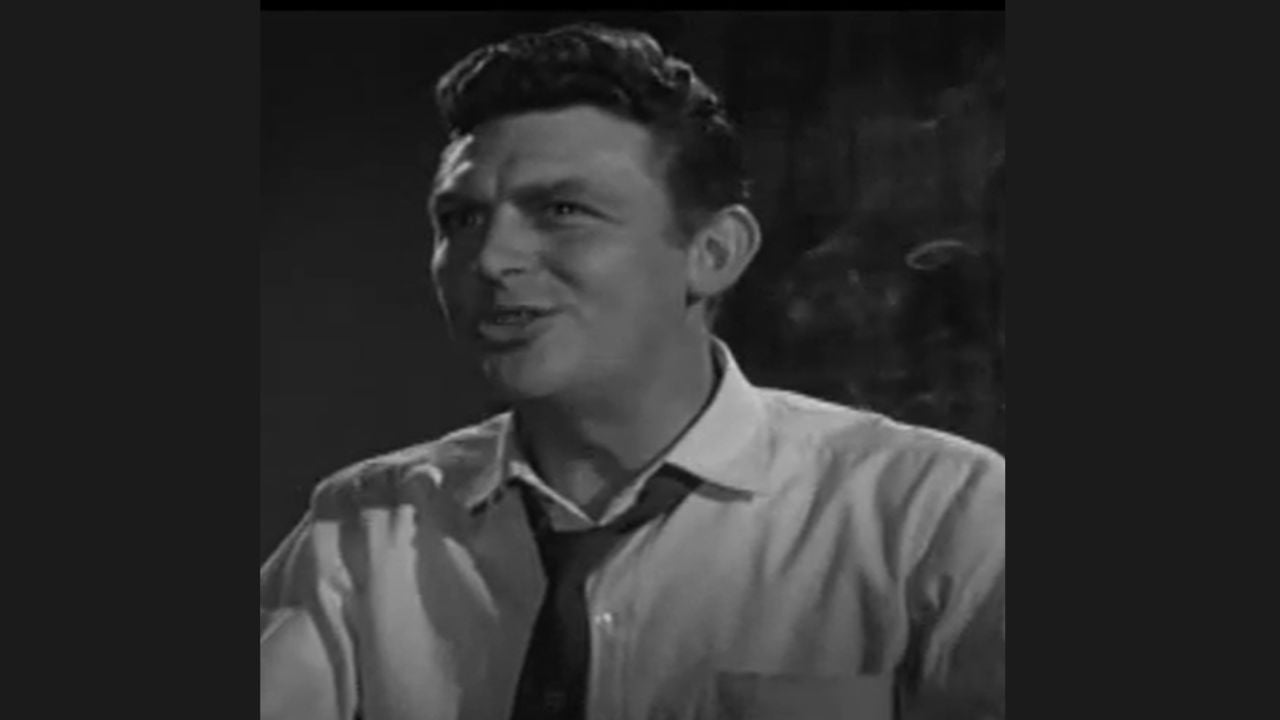
Andy Griffith built one of television’s most reassuring personas as the patient sheriff of Mayberry. Linda Purl remembers hearing a considerably more aggressive story about what he was willing to do decades earlier when he wanted the role that became his feature-film debut.
Purl, who played Griffith’s daughter Charlene during the first season of Matlock, says he once told her about pursuing Larry “Lonesome” Rhodes in Elia Kazan’s 1957 drama A Face in the Crowd. According to her recollection, Griffith became frustrated after struggling to get an opportunity to prove that he could play the volatile character.
Speaking on the Still Here Hollywood podcast, Purl recalled Griffith saying that he went into Kazan’s office, grabbed the director by the shirt collar and put him against a wall. “You don’t understand. I am that man,” Griffith told Kazan, according to Purl’s retelling.
Griffith did get the role, but his own public account of the casting years later described a different encounter involving Kazan and screenwriter Budd Schulberg.
Purl Says Griffith Refused to Keep Waiting for an Audition
Purl shared the story while discussing what surprised her about working with Griffith on Matlock. According to Entertainment Weekly’s account of the interview, Purl said Griffith had been unable to get in front of Kazan and eventually learned that the director was in his office. Rather than continue waiting, Griffith allegedly went inside and confronted him directly.
Purl recalled Griffith telling her that he took Kazan by the collar, pushed him against the wall and insisted that he understood Lonesome Rhodes. In her retelling, the confrontation ended with Griffith getting the part.
She described Griffith as brilliant, funny and intellectual, qualities that complicated the genial, small-town image many viewers associated most strongly with The Andy Griffith Show. Purl appeared as Charlene throughout the show’s first season before leaving the regular cast.
‘A Face in the Crowd’ Revealed a Side of Griffith Mayberry Never Did
Griffith’s determination made sense in light of what the role required. A Face in the Crowd follows Larry “Lonesome” Rhodes, an Arkansas drifter discovered in jail by radio producer Marcia Jeffries, played by Patricia Neal. His homespun charisma propels him from local radio into national television, where fame increasingly exposes his cruelty, manipulation and appetite for power.
The American Film Institute records the movie as Griffith’s feature-film debut and details Rhodes’ progression from entertainer to a television force powerful enough to help reshape the public image of Senator Worthington Fuller. As Rhodes’ influence grows, he begins using his program to promote the senator while becoming increasingly convinced of his own ability to control the audience.
That performance came three years before The Andy Griffith Show premiered in 1960. The Criterion Collection describes Griffith’s screen debut as deliberately sinister, built around the same charm that would later make him enormously likable on television but redirected toward manipulation and demagoguery.
The film’s reputation also changed dramatically after its initial release. Criterion notes that it was not a commercial success in 1957 but grew in stature over subsequent decades, while the Library of Congress added A Face in the Crowd to the National Film Registry in 2008.
Griffith Later Told a Different Story About Convincing Kazan
In a 2005 interview later revisited by the Los Angeles Times, Griffith said Schulberg had seen him starring on Broadway in No Time for Sergeants and initially questioned whether his easygoing persona could translate into someone as ambitious and unpleasant as Rhodes.
Griffith recalled having a beer with Schulberg and arguing that he could handle the material. The following day, he said, he met with Schulberg and Kazan and performed an imitation of evangelist Oral Roberts carrying out a healing. That performance apparently revealed a more unruly quality than either filmmaker had expected from him.
“At that moment, he and Budd could both see that I had a wild side,” Griffith told the Times. He said Kazan subsequently drew on that part of his personality while directing the many darker moods of Lonesome Rhodes.
Griffith Had Already Given Schulberg a Reason to Notice Him
Before Hollywood audiences knew him as Lonesome Rhodes, Griffith had already become a Broadway success. He starred as Will Stockdale in the stage production of No Time for Sergeants, a role he had previously played in a live television adaptation.
Turner Classic Movies notes that the Broadway production ran for 796 performances and earned Griffith a Tony nomination. That performance was what brought him to Schulberg’s attention before A Face in the Crowd, giving the screenwriter a clear view of Griffith’s comic, seemingly innocent persona before asking whether the actor could convincingly turn it into something much darker.