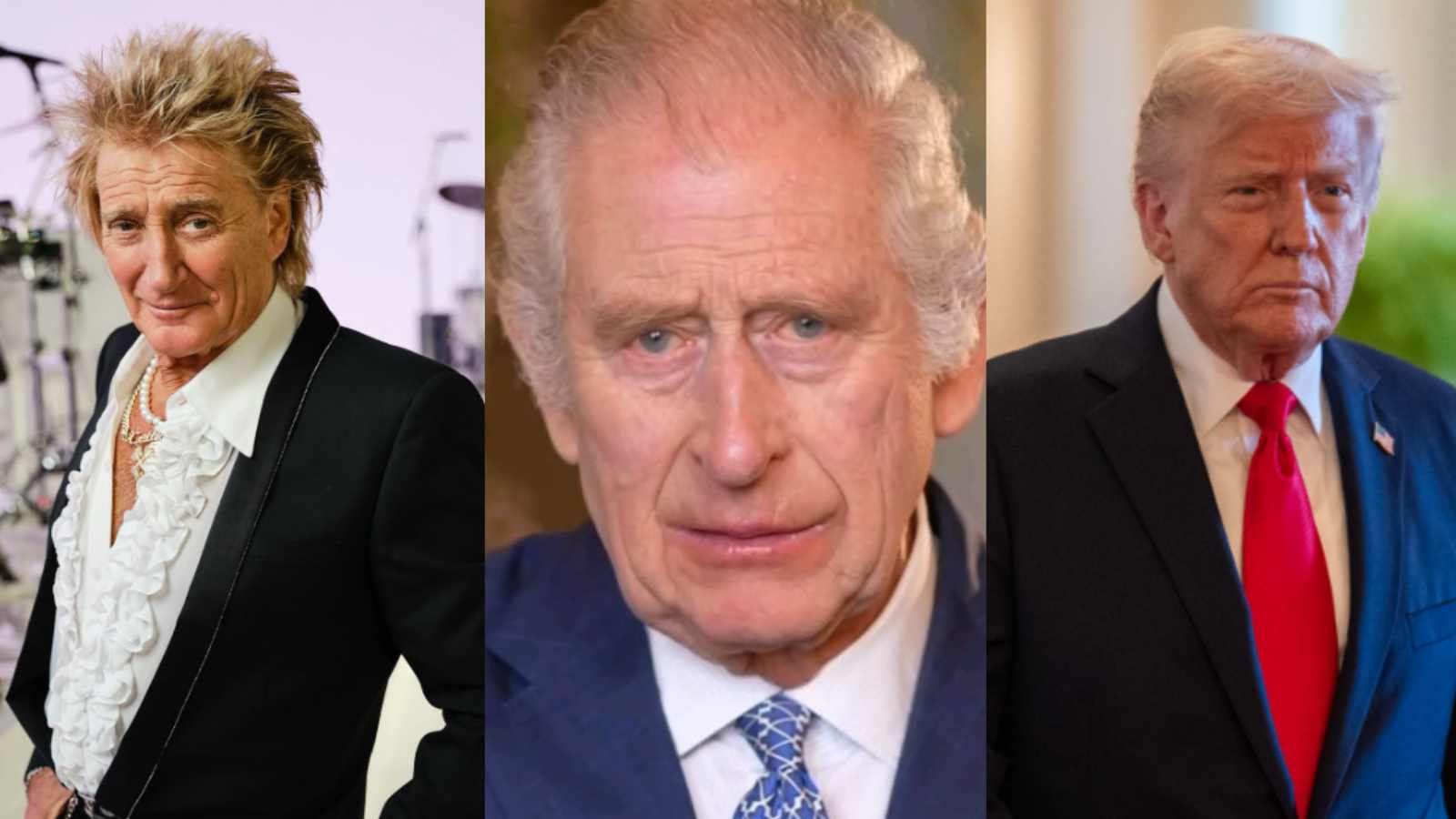
Nobody in that receiving line at the Royal Albert Hall on Monday night was expecting Rod Stewart to turn a milestone charity celebration into a geopolitical commentary session.
And yet, there he was… all 81 years of him, with that signature rasp in his voice and zero visible filter, shaking King Charles’s hand and proceeding to do exactly that.
The setting was The King’s Trust’s 50th Anniversary Celebration, a star-studded, emotionally significant evening honoring five decades of the charity that Charles himself founded in 1976.
Rita Ora was there. Craig David. Anne-Marie. Ronnie Wood, Stewart’s old Rolling Stones pal, was standing close enough to witness what happened next. King Charles and Queen Camilla arrived at a warm red-carpet welcome, hosted by Ant and Dec, and the mood was celebratory, ceremonial, and properly regal.
Then Stewart stepped forward, clasped the King’s hand, looked him square in the eye, and said: “May I say, well done in the Americas. You were superb. Absolutely superb. You put that little rat bag in his place.” The room cracked.
Those nearby laughed. The King, trained from birth to absorb the unexpected without so much as a blink, maintained his composure and did not visibly respond. And somewhere across the Atlantic, the internet lit up like a signal flare.
The “Rat Bag” Nobody Named… But Everyone Understood
View this post on Instagram
The genius and the peril of Stewart’s comment is the very same thing: he never said a name. “That little rat bag” floated in the air without a label attached… yet not a single reporter, royal watcher, or social media user spent more than 3 seconds wondering who he meant.
The reference, widely understood to point to U.S. President Donald Trump, came in the context of Charles’s recently concluded four-day state visit to the United States, a trip that generated enormous coverage and considerable diplomatic chatter across both sides of the Atlantic.
King Charles and Queen Camilla had been received at the White House by President Trump and First Lady Melania Trump at the end of April 2026. King Charles then delivered a historic address to a joint session of Congress, only the second time a reigning British monarch has ever done so, following Queen Elizabeth II’s 1991 appearance.
The speech was widely praised, though notably for reasons that go well beyond polished royal delivery. According to analysts, King Charles used the platform to gently but pointedly push back against several of Trump’s most contentious positions.
He championed NATO cooperation, defending the very alliance Trump had publicly undermined just months earlier. He called for continued support for Ukraine. He defended the Royal Navy, an institution Trump had seen fit to disparage in the weeks before the visit.
He called for checks and balances on executive power at a moment when the American president was openly challenging Congress and the courts. All of it wrapped in the kind of refined, humorous, constitutionally deniable language that only a monarch who has spent a lifetime perfecting diplomatic restraint could pull off.
Trump himself, for his part, admitted he was envious. According to People magazine, he told reporters after the King’s address that Charles had delivered “a great speech” and that he felt “very jealous” of the monarch’s eloquence.
View this post on Instagram
Washington-based royal biographer Sally Bedell Smith noted that politicians of every stripe were beginning to see King Charles in a new, more favorable light.
So when Rod Stewart walked up on May 11 and said what half the world was privately thinking, he was, in his own blunt, rock-star way, narrating a sentiment that had been simmering publicly since the state visit wrapped.
The Man Who Once Lived Half a Mile From Trump
To understand why Stewart’s remark carries as much weight as it does, you have to go back to the friendship and the fallout. Rod Stewart and Donald Trump were not merely acquaintances in the celebrity-political ecosystem. They were, by Stewart’s own account, genuinely close.
In a candid sit-down with Radio Times ahead of his Legends slot at Glastonbury 2025, Stewart laid it all out without sugarcoating. “I’m not a great fan of Trump. I knew him very, very well. I used to go to his house. I live literally half a mile away,” Stewart said, referencing his Florida home.
“We’re both on the beach. I used to go to his Christmas parties. He’s always been a bit of a man’s man. I liked him for that.”
That’s not the kind of familiarity you build over a few polite cocktail-party exchanges. These were men who lived near enough to each other to drop by casually, men who shared a social orbit dense enough to include holiday parties and beach proximity.
Stewart even acknowledged that early Trump had an appeal: a certain old-school masculinity that the singer, born in wartime London in 1945, could understand and respect.
But there was always a caveat. “He didn’t, as far as I’m concerned, treat women very well,” Stewart added in the same Radio Times interview. And when Trump entered the presidency the first time, something shifted. “Since he became President, he became another guy. Somebody I didn’t know,” Stewart told the outlet.
The friendship limped along for a while after that, apparently, but Gaza finished it. “No, I can’t any more,” Stewart said when directly asked whether he still considered Trump a friend.
“As long as he’s selling arms to the Israelis, and he still is. How’s that war ever gonna stop?” The former neighbors, the Christmas party crowd, the beach walks, all of it, gone.
From Private Falling-Out to Very Public Fury
Once the friendship was formally over in Stewart’s mind, the gloves came off publicly, too. In January 2026, Trump made remarks in a Fox News interview from Davos, Switzerland, suggesting that NATO allies had essentially avoided the front lines in Afghanistan.
“You know, they’ll say they sent some troops to Afghanistan, or this or that. And they did… they stayed a little back, a little off the front lines,” Trump said. It was the kind of comment that lands very differently in the United Kingdom, where 457 British troops died in that war… the second-highest death toll among allied nations, nearly matching American numbers proportionally.
Rod Stewart, a knight of the realm born just after World War II and who has performed at the Royal British Legion Festival of Remembrance at the very same Royal Albert Hall, posted a video to Instagram that pulled no punches.
“I may just be a humble rock star. I’m also a knight of the realm, and I have my opinions,” he began. “So it hurts me badly, deeply when I read that the draft dodger Trump has criticized our troops in Afghanistan for not being on the front line. We lost over 400 of our guys. Think of their parents. Think about it.And Trump calls them almost like cowards. It’s unbearable.”
He then directly called on Prime Minister Keir Starmer and Reform UK leader Nigel Farage to compel Trump to apologize to British military families. Trump eventually walked back the NATO remarks, but the relationship between Stewart and the man he once called a friend was well past saving by then.
So when Rod Stewart stood in front of King Charles at the Royal Albert Hall and said, “You put that little rat bag in his place,” it was not the beginning of some new opinion. It was the latest chapter in an increasingly public and increasingly personal rupture that has been building for the better part of two years.
The King’s Protocol Problem, and Why He Handled It Perfectly
The element of this story that royal correspondents and constitutional analysts have latched onto is not the humor of the exchange, but the position it put the King in. The British monarchy operates under one of its most critical and most carefully maintained conventions: political neutrality.
Kings and queens do not endorse politicians, criticize foreign heads of state, or align publicly with any political position. It is not merely tradition; it is arguably the load-bearing wall that keeps the monarchy structurally relevant in a parliamentary democracy.
One visible flinch, one nod, one smirk of agreement, and you have a constitutional incident on your hands.
King Charles, of course, gave them nothing. He maintained his composure entirely, did not visibly react, and let the moment pass with the kind of practiced grace that decades of royal training produce. And in doing so, he handled it exactly right.
But it is worth noting… and let me be real, this is where the story gets genuinely interesting… that the King had himself spent the days prior walking as close to the line as a monarch ever does, without ever quite crossing it.
His Congress speech was diplomatically coded with pushback. His state dinner remarks were carefully calibrated. He was praised by people across the political spectrum precisely because he said difficult things in a way that could not quite be officially labeled as political.
Stewart, standing there at the anniversary gala, essentially narrated what the King’s own speech had communicated in courtly language, just without any of the courtly language.
The Angle Everyone Is Missing
Here is the part of this story that is almost entirely absent from the coverage flooding social media and entertainment sites today: Rod Stewart did not wander in off the street and ambush the King with an improvised political grenade.
Stewart has been a long-standing figure in The King’s Trust universe. He has participated in multiple charity events tied to the organization, appeared at fundraisers, and been a vocal supporter of its mission to support disadvantaged young people.
He was there as part of the official celebration. And Ronnie Wood, his old Rolling Stones bandmate, was standing right beside him when it happened.
View this post on Instagram
This was British music royalty meeting actual royalty, in a room built on decades of shared charitable purpose, and the moment that will define the evening’s coverage is four words: “that little rat bag.”
That’s partly because the remark was genuinely funny. But it’s also because it captured something broader about the mood in the UK right now toward Trump, toward the fragility of the Anglo-American “special relationship,” and toward Charles’s unexpected emergence as a figure capable of projecting soft power on the world stage.
The King’s Trust turned 50 this year. It has helped over a million young people in its lifetime. That is the story that deserved the headlines. Instead, Rod Stewart handed the internet something it couldn’t resist, and here we all are.
A Different Take Worth Sitting With
Step back from the crowd reaction for a moment and consider this: Stewart’s comment, however crowd-pleasing, put King Charles in an impossible position with no warning and no exit.
A comedian roasting a politician at a fundraiser is one thing. A celebrity inserting a pointed remark about a sitting head of state directly into the ear of a constitutionally neutral monarch, in front of cameras, at a formal royal event, is something else entirely.
The King handled it with extraordinary grace. But the fact that he handled it well does not mean Stewart did him any favors. Every single journalist in that room, and every clip-sharing account on the internet, now has footage of the British monarch in a moment adjacent to what reads, in a headline at least, as anti-Trump sentiment.
Buckingham Palace has not commented. They won’t. But behind closed doors, the last thing the palace needs after a delicate state visit that required months of diplomatic threading is a viral clip that can be framed as royal shade thrown at the American president.
Stewart may have said what many were thinking. Whether he should have said it there, in that way, to that person, in front of those cameras, is a question worth asking, even if the answer is considerably less fun.