The phrase “election integrity army” sounds almost noble, doesn’t it? Like something carved into the side of a courthouse or stitched onto a flag.
But when Donald Trump rolled those three words out on Truth Social on Sunday, May 10, 2026, the reaction it triggered from Washington all the way down to everyday voters was anything but ceremonial.
Because here’s the thing about Trump and elections… he doesn’t just talk about them. He turns them into a full-contact sport. And with the 2026 midterms now firmly in his crosshairs, the 79-year-old president is not simply warming up for November.
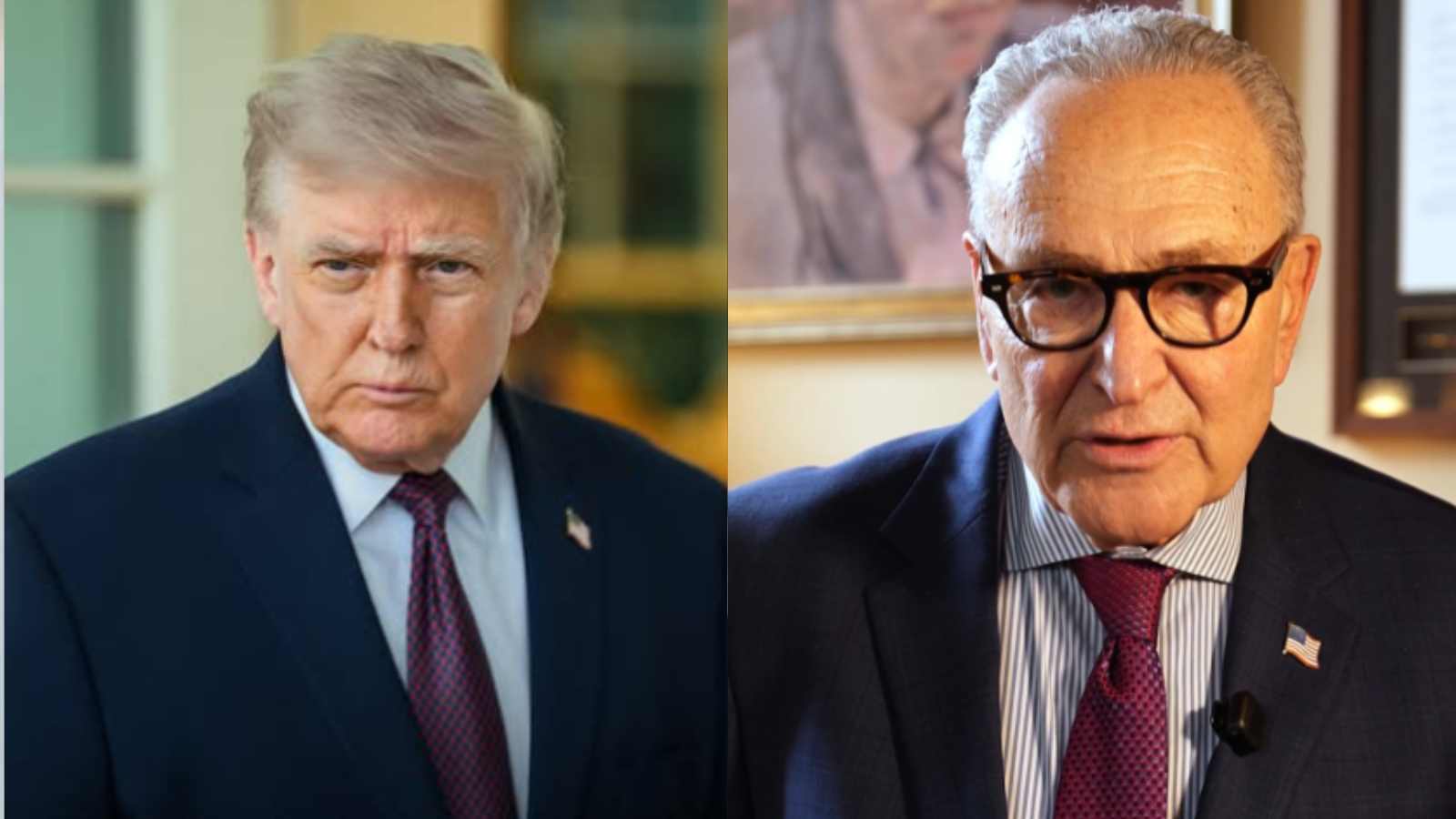
He is building an entire infrastructure around it, one fiery Truth Social post at a time. What happened Sunday was the latest chapter in a months-long, slow-burning confrontation between two of the biggest personalities in American politics: Donald Trump and Senate Minority Leader Chuck Schumer.
Both men are convinced the other is trying to steal something. Both men are betting America will believe their version of the story. And with six months to go before Election Day, this battle is only getting louder, messier, and far more consequential.
What Trump Actually Said… and What He Left Out
Trump made the announcement on Truth Social on Sunday, May 10, responding to the Democrat-led “elections task force” that Senate Minority Leader Chuck Schumer unveiled in late April. In the post, the president did not ease into things. He went straight for the throat.
“Palestinian Chuck Schumer is hiring Eric Holder, famous for handing guns to Mexican cartels under the Barack Hussein Obama administration, as part of a Democrat-led ‘Election Integrity Group’ that will no doubt try to suppress Republican voters, and interfere in our Elections,” Trump wrote.
“Furthermore, Marc Elias, a terrible lawyer with a horrible track record, is also involved. This is the same disgusting individual who was responsible for the fake Russia dossier from a foreign nation to meddle in the 2016 Election, which I won in historic fashion.”
He did not stop there. “During my Historic Election in 2024, when I won every single Swing State, and decisively won both the Electoral and Popular votes by wide margins, the Republicans had an Election Integrity Army in every single State to preserve the sanctity of each legal vote,” Trump wrote.
“We will be doing the same again in 2026, but it will be much bigger and stronger. All Americans should have their voices heard by voting. Be assured, this Election will be fair!”
He wrapped it all up with a gut punch: “The Democrats are totally unhinged and we will not allow them to threaten the integrity of our Elections.”
Now, there is a lot packed into that post. The nickname aimed at Schumer, the recycled swipes at Eric Holder and Marc Elias, the chest-thumping about 2024.
But underneath the noise, the actual announcement was this: Trump is scaling up his Republican poll-watching and election-monitoring operation from 2024, and promising it will dwarf everything that came before. That detail alone should get your attention, because the 2024 version was already massive.
How Chuck Schumer Lit the Match
Before Trump posted anything, it was Schumer who fired the opening shot. The Senate Minority Leader launched what he described as his party’s most expansive effort yet to counter potential interference in the 2026 midterms, arguing there are direct threats from President Donald Trump and Republicans against fair elections.
Standing on the Senate floor, Schumer declared: “So today, I am launching the Democratic Party’s most expansive effort to date to protect the 2026 midterm elections, and to shield them from the direct threats posed by President Trump and MAGA Republicans.”
The task force includes several senior Democratic lawmakers, including Dick Durbin, Maria Cantwell, Mark Warner, and Alex Padilla, as well as independent Sen. Bernie Sanders and others.
Outside legal and policy experts participating in the effort include Eric Holder and Marc Elias, among others, who specialize in election law and voting rights.
Schumer was not vague about who he thinks is the problem. “Donald Trump knows, his party knows, that they’re at risk of losing this election in 2026, which is why they’re working round the clock to tilt the scales unfairly in their favor,” Schumer told reporters.
And in a separate statement that hit like a two-by-four, Schumer charged: “Trump and Republicans are testing how far they can go to undermine free and fair elections because they can’t win on a level playing field. Democrats aren’t going to sit back and hope for the best.”
Schumer also described the task force’s mission as seeking out “election threats,” including actions at the administrative level by the Department of Justice and Department of Homeland Security, attacks on the First Amendment, foreign threats, and what he called the militarization of law enforcement at the polls.
That last point… law enforcement at polling locations has been anything but abstract. Schumer’s April 29 press release specifically cited the potential deployment of ICE agents to polling locations as one of the threats the task force was formed to combat.
For context, Steve Bannon had previously suggested that ICE deployments to airports could be used as a “test run to really perfect ICE’s involvement in the 2026 midterm elections.”
The idea of federal immigration agents standing at polling places is not a fringe concern. It is one that state officials have been preparing responses to for months.
View this post on Instagram
The Pattern That Predates This Week’s Fight
To understand what Sunday’s Truth Social post really means, you need to zoom out. Because this is not Trump waking up one morning and suddenly caring about ballot counters. This is the latest beat in a story that has been building since well before the 2026 campaign season formally kicked off.
Back in February, Trump sat down with NBC News anchor Tom Llamas for an interview that left many people uneasy. Trump told Llamas he would only accept the results of the 2026 midterm elections if they were “honest,” and that if he believed they were not, “something else has to happen.” That phrase “something else has to happen” was not clarified. It was just left there, hanging.
Days before that interview, Trump had called on Republicans to “nationalize” state-managed elections, telling former FBI deputy director Dan Bongino on his podcast: “The Republicans should say, we want to take over, we should take over the voting, the voting in at least many, 15 places. The Republicans ought to nationalize the voting.”
The U.S. Constitution explicitly gives states, not the federal government, authority over how elections are run. But constitutional limits have not slowed Trump’s broader push.
Since returning to the office, he has signed an executive order attempting to restrict mail-in voting, directed the government to create a list of eligible voters, demanded that Congress pass federal voter ID laws, and sought to have Republican-led states redraw congressional maps.
At a conference of Republican lawmakers in March, Trump told his party that passing his prized SAVE America Act, which would require proof of citizenship when registering to vote and photo ID to cast ballots in federal elections, would “guarantee the midterms.”
That is a sitting president explicitly framing election legislation as a tool to win his own party more seats. Trump told Republicans on Truth Social: “If we do these TWO things, we will pick up 100 more seats, and the CROOKED game of politics is over.”
The redistricting side of this story is equally wild. Multiple states have been tearing up and drawing new congressional maps, or waiting for courts to weigh in, creating what analysts describe as unprecedented flux in American democracy just six months before Election Day.
Analysts estimate Republicans could gain a structural advantage equivalent to a four-point edge in the national House vote due to new maps in Southern states, a shift that could allow the GOP to retain control of the House even if Democrats win the popular vote by several points.
Trump also ordered the Department of Justice to investigate ActBlue, the main online fundraising platform for Democratic candidates, while ignoring its GOP counterpart, WinRed.
The DOJ has also demanded detailed voter registration data from states, threatening legal action against some Democratic-led states that have not complied.
The Polling Numbers Neither Side Is Thrilled About
Here is something both camps would rather you did not read too carefully. The national political landscape could hardly look worse for President Trump and Republicans heading into the midterms. Trump’s unpopularity is evident with voter groups that were key pillars of his 2024 presidential success.
Compared to February 2025, white voters without college degrees, parents of children under 18, those who make less than $50,000 a year, and even adults in the South now give Trump a net-negative job approval rating.
Several crossover groups that swung toward Trump in 2024, including millennials, Latinos, and many younger voters, have also heavily moved away from the president.
And 61 percent of Democrats and those who voted for Kamala Harris in 2024 described themselves as “very enthusiastic” to vote in these midterms, compared to 53 percent of Republicans and only 47 percent of Trump voters specifically.
That enthusiasm gap is not nothing. It is actually a big deal. Presidents’ parties have lost, on average, 25 House seats and four Senate seats during midterm elections since World War II.
That number jumps to 33 average House seat losses when the president is below 50 percent approval, which Trump currently is. So when Schumer says the GOP is “worried about their dropping poll numbers,” he is not entirely wrong on the data.
An Uncomfortable Alternative Reading
Here is the take that will get some people fired up, because it cuts both ways. What if both Trump and Schumer are, in their own separate ways, doing exactly the same thing?
Both men are deploying the language of democracy protection to build political armies ahead of an election their side is desperate to win or hold. Trump frames his “Election Integrity Army” as the guardian of every legal vote.
Schumer frames his task force as the last line of defense against authoritarian overreach. Both packages are wrapped in patriotism. Both are financed by political stakes. And both are, at their core, mobilization tools.
The irony is almost too rich to ignore: the Republican National Committee had already recruited thousands of volunteers to assist in poll watching during the 2024 election cycle.
That infrastructure did not disappear after November 2024. It is now being scaled up, professionalized, and rebranded for 2026. Meanwhile, Democrats have Schumer on the Senate floor calling this effort the most expansive election protection push in party history.
If you strip away the press releases and the Truth Social fury, what you are actually watching is two political parties building parallel election armies, each insisting the other is the threat. At some point, the person caught in the middle of all this is the voter, who just wants to show up, cast a ballot, and have it counted.
As one analyst put it, the redistricting war and the broader election fight risk becoming “a race to the bottom” that benefits no one: “This whole attitude of ‘let’s just minimize the voice of our political adversaries,’ if this was the attitude back during the Constitutional Convention, we never would have left with the United States of America.”
Both Trump and Schumer know the stakes. Both men know that whoever controls the House controls the next two years of Trump’s presidency. And right now, neither side is willing to blink.
The “Election Integrity Army” is not just a catchy phrase. It is a preview of a November unlike anything this country has seen at the midterm level… loud, litigated, and watched by an entire nation holding its breath.