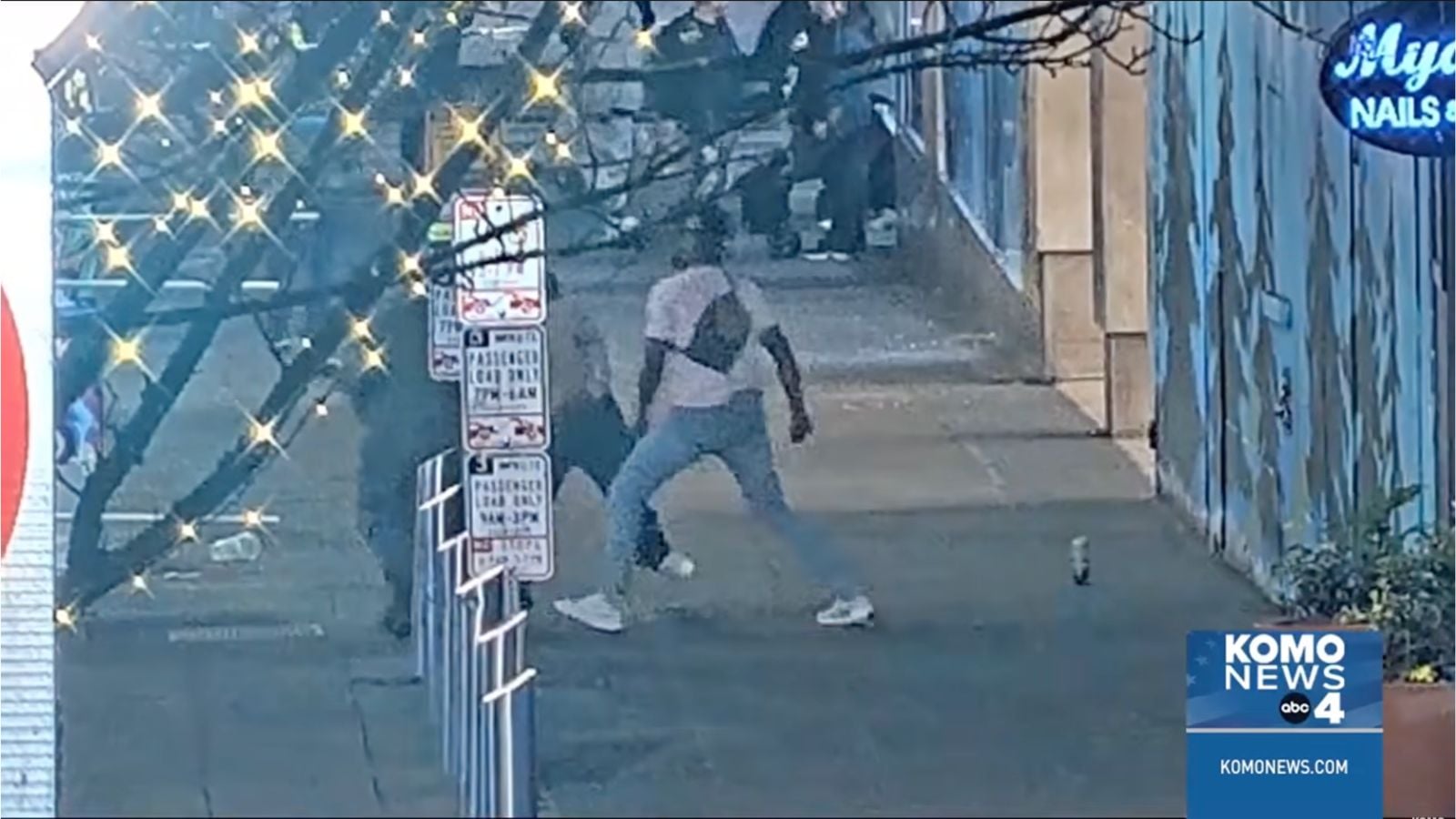
Surveillance footage released just hours ago from downtown Seattle is difficult to watch.
In it, a 77-year-old man is walking slowly down Third Avenue. He has just stepped off a bus. It is a Sunday night in April. He is not talking to anyone. He is not looking at anyone. He is doing the most ordinary thing a person can do. Walking home.
Two men come up behind him. One lunges at his face. The other shoves him from behind. He goes down. One of them lands on top of him and keeps swinging. Then they stand up, cross the street to a McDonald’s, and appear to laugh about it as they walk away.
The man is still on the ground.
People walk past him. Not one person stops. Not one person kneels down. He is curled up and bleeding on a sidewalk in a major American city, and the foot traffic just continues. A security guard calls 911 after hearing the man cry for help. Two full minutes had passed.
He was taken to Harborview Medical Center. Broken arm. Broken knee. A gash above his right eye deep enough for stitches. More than two weeks later, he is still there. He was walking home from a bus stop.
Left to Seattle’s mayor, the cameras that captured this footage would have ceased operations long ago.
The city was already watching
Every second of it was recorded.
Third Avenue is one of three corridors in Seattle monitored by the city’s Real Time Crime Center, a 62-camera surveillance network launched in 2025, specifically placed at locations the city has designated as crime hot spots. The cameras feed directly to civilian operators at the Seattle Police Department. Since going live, they have contributed to over 2,500 investigations and nearly half of the city’s homicide cases. Police Chief Shon Barnes has called them “invaluable.”
The cameras saw the whole thing. They helped police track one of the attackers across the street afterward. What they could not do is stop the man’s arm from being broken.
And for the past two months, whether those cameras should even exist has been one of the most contentious political fights in Seattle.
The mayor who paused the cameras
Ahmed Abdullah Osman beat a 77-year-old in Seattle. Police ID’d him thanks to street video cameras.
Mayor Wilson: “CCTV puts refugees at risk” pic.twitter.com/UeQl7uzGIu
— Sins Of Men (@oliverstacy78) May 5, 2026
Katie Wilson took office in January as Seattle’s new mayor. A democratic socialist who co-founded the Transit Riders Union, she ran on a promise to push back against surveillance. In March, she paused a planned 65-camera expansion, warning that the Trump administration could access the footage and use it to target immigrant and refugee communities. She kept the existing cameras running but pledged to shut all of them off if federal immigration enforcement surged.
Community organizations backed her. CAIR Washington and the Northwest Immigrant Rights Project opposed the expansion. The Transit Riders Union, the organization Wilson co-founded, went further and called for the entire network to come down. At her 100-day mark, protesters rallied at City Hall demanding she go further.
Then, the week before the attack footage went public, Wilson was at a community event at the Yesler Community Center when a shooting broke out nearby. She was rushed away from the scene. When KOMO reporter Chris Daniels later asked whether that violence had changed her views on surveillance cameras, a staffer stepped in and cut her off mid-answer. The clip has been viewed nearly a million times.
Wilson later said cameras “have an important role to play” in public safety. She also said the city needed to make sure the data wasn’t “vulnerable to misuse and abuse” by federal authorities.
The expansion remains paused. The cameras on Third Avenue remain on.
The man they released
Police used the footage to arrest Ahmed Osman, 29, of Bellevue, outside the McDonald’s that same night. As officers walked him to the patrol car, he mentioned Mayor Wilson by name. It is not clear why. His criminal record already included convictions for assault, harassment, and criminal trespass stretching back to 2021. He had two additional pending cases in 2026. Both filed before any of this happened.
He was released without bail two days after breaking an elderly man’s arm.
Prosecutors have since charged him with second-degree assault. He now has a $200,000 warrant out for his arrest. His arraignment is set for May 13. The second attacker gave police only a first name, “Shawn,” and has not been found.
The cameras are still on. The expansion is still paused. The man who was walking home from the bus stop is still at Harborview. The man who put him there is not.