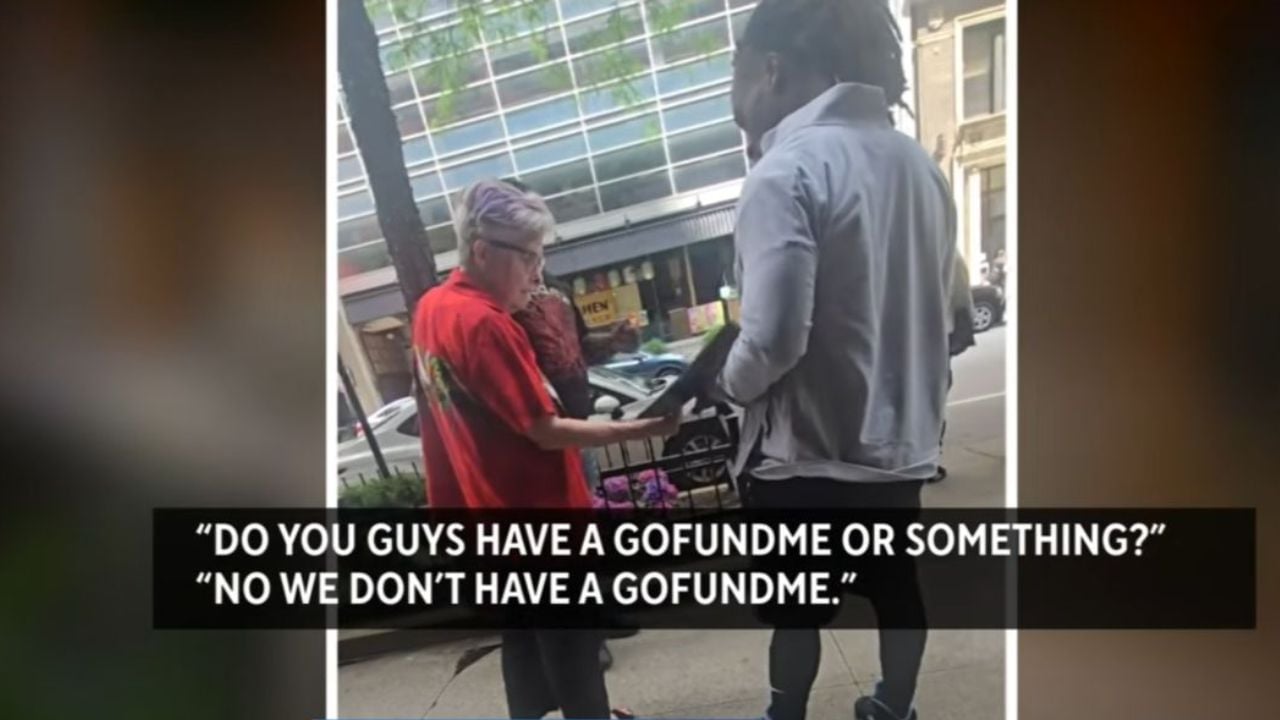
A woman in downtown Chicago started recording when she saw what looked like a funeral donation pitch turn into an attempted tap-to-pay scam, according to CBS Chicago.
The incident happened around noon Wednesday in Streeterville, near Ohio and St. Clair streets. A witness told CBS Chicago that four men surrounded another woman and asked her to donate to a cousin’s funeral fund.
The witness said she asked whether the group would take cash. They allegedly said no, and CBS Chicago described the setup as a tap-to-pay scam in which a person thinks they are donating a small amount, only for the card connected to the phone to be charged for far more.
In this case, CBS reported that the woman being targeted did not lose money. The witness said the group backed off after realizing she was recording.
The Donation Pitch Was Caught on Video
The woman who recorded the Streeterville encounter told CBS Chicago she called 911 while it was happening, took photos of license plates on a Nissan Altima and a Toyota Camry, and sent the footage to police. The targeted woman left without making a payment.
Chicago Police told CBS Chicago they did not have calls for service in that area when the station asked whether police were investigating the Streeterville incident. That leaves the video and witness account as the main public record of what happened.
The payment method is the warning for anyone approached on the street. A donation pitch may sound like a request for $5, $10, or $20, but the person holding the phone or payment device can control what amount is actually charged.
Earlier Chicago Victims Said Small Donations Became $5,000 Charges
CBS Chicago connected the Streeterville video to earlier reports involving people who said they were approached with funeral donation stories and later saw thousands of dollars charged.
Heather Radin told CBS Chicago she was waiting for a bus in Wicker Park when a boy approached her with a funeral story. She thought she was donating $10, but after tapping to pay, she said she received a $5,000 transfer notification.
In another CBS Chicago report, Monica Wieske said she was approached outside a Lakeview Whole Foods and believed she was donating $10. CBS reported that she was charged nearly $5,000 through two $2,400 transactions seconds apart.
CBS also previously reported a case involving a couple at a Target at Division and Larrabee streets. They agreed to donate $20, but Drew, one of the victims, saw that nearly $5,000 had been taken. He chased the people involved and was later thrown from a moving getaway car, according to CBS.
Those cases are separate from the Streeterville encounter, but the pattern is similar: a sad story, a refused cash payment, a phone or card tap, and a charge far larger than the person thought they approved.
Getting the Money Back Can Be Difficult
The financial damage can last long after the street encounter ends. CBS Chicago reported that Paul Mitchell in Lakeview did not get $5,000 back from his credit card company after a similar scam.
Steve Bernas, president and CEO of the Better Business Bureau of Chicago and Northern Illinois, told CBS Chicago that banks and credit card companies may not have to reimburse victims if the victim gave someone permission to charge them, even when the amount charged was higher than expected.
That makes tap-to-pay fraud especially risky for people trying to help. The transaction can look authorized because the victim allowed the phone or card to be used, even if the amount was not what the person believed they were approving.
Cash Refusal and Tap-to-Pay Pressure Are the Red Flags
The FTC warns that scammers often pressure people to act quickly and use payment methods that make money hard to recover. Its charity guidance also advises donors to research a charity before giving and to be suspicious of pressure tactics or payment requests that do not allow clear verification.
For street donation requests, the safer move is not to tap a phone or card on any device controlled by a stranger. A legitimate fundraiser should be able to provide a verifiable charity name, official website, or donation page that can be checked independently.
A refusal to accept cash, a refusal to provide a legitimate donation link, or pressure to tap immediately should stop the transaction. Anyone who believes they were charged without approval should contact the card issuer or payment app immediately, preserve screenshots and transaction records, and report the incident to local police and the FTC at ReportFraud.ftc.gov.