
A Louisiana business lost $40,000 after paying an invoice that appeared to come through a vendor relationship it had relied on for years. Investigators say the vendor’s email account had been compromised before the payment was sent.
Pamela Spracklen Smith, 61, of Decatur, Alabama, has been arrested in connection with the case. KALB reported that she faces two counts of theft involving more than $25,000 and two counts of computer fraud.
The victim was Montgomery Tank, a Grant Parish business. Owner Samantha Pinder said the company received the invoice through an established relationship with a vendor it had worked with for years and sent the $40,000 before learning that the vendor’s email account had been compromised.
Grant Parish Sheriff Steven McCain said investigators followed the money from Louisiana into Alabama. ATM surveillance allegedly showed Smith making multiple cash withdrawals, while investigators also traced some of the proceeds into Bitcoin accounts.
The Invoice Came Through a Vendor Montgomery Tank Already Knew
The FBI describes schemes involving messages that appear to come from known business contacts as business email compromise. One example the agency gives is a familiar vendor sending an invoice with updated payment information.
Criminals can gain access to legitimate email threads involving billing and invoices and use information from those conversations to make payment requests appear authentic. The FBI also warns that some schemes use addresses that closely resemble legitimate accounts rather than messages from obviously unfamiliar senders.
Investigators Followed the Money From Louisiana to Alabama
McCain said Grant Parish investigators worked with authorities in Alabama after tracing the financial trail out of Louisiana.
Investigators obtained ATM surveillance footage that allegedly showed Smith withdrawing cash on multiple occasions. McCain also said some of the money had been transferred into Bitcoin accounts after Montgomery Tank’s payment was diverted.
McCain told KALB that Grant Parish deputies traveled to Decatur and took Smith into custody before returning her to Louisiana. A Louisiana VINE custody record identifies Pamela Spracklen Smith at the Grant Parish Detention Center and lists a July 24, 2026 booking date, with the Grant Parish Sheriff’s Office identified as the reporting agency.
A Grant Parish Court Record Lists Theft and Computer Fraud Charges
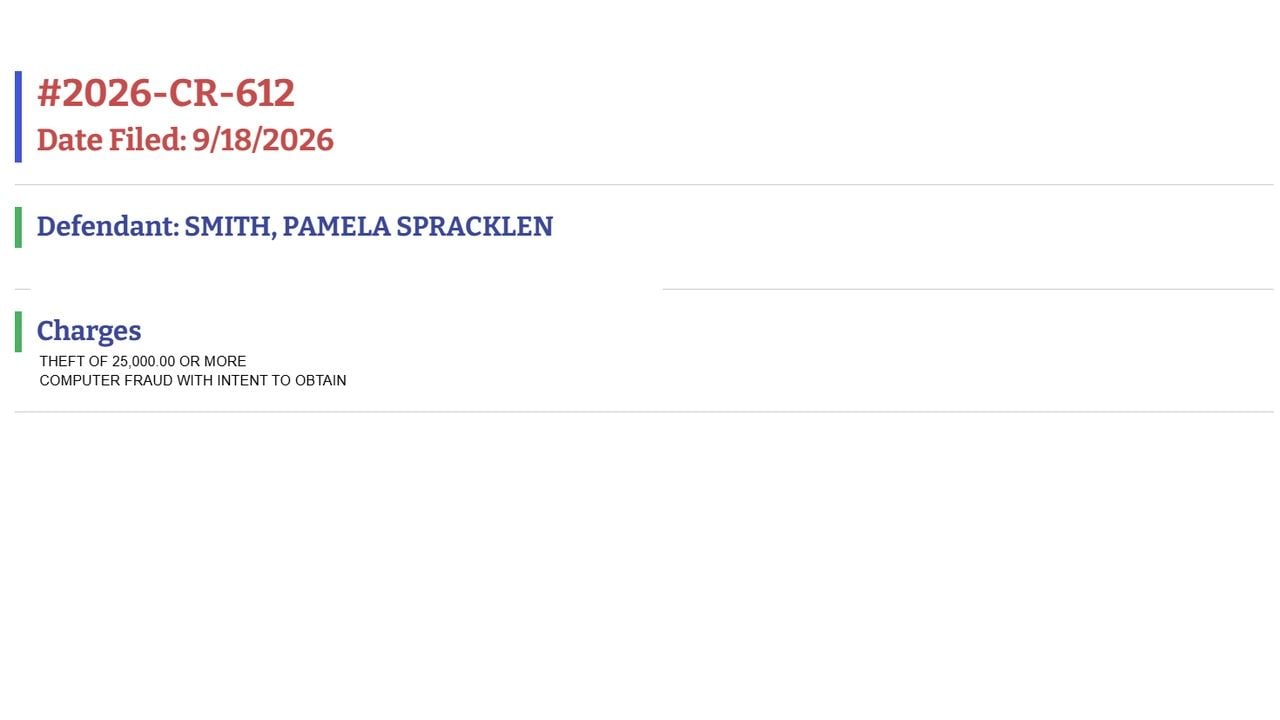
A Grant Parish court record identifies the criminal matter as case 2026-CR-612, filed Sept. 18, 2026, and names Pamela Spracklen Smith as the defendant. The record lists the charge categories as theft of $25,000 or more and computer fraud with intent to obtain.
KALB reported that Smith faces four felony counts in connection with the investigation: two counts of theft involving more than $25,000 and two counts of computer fraud.
Under Louisiana Revised Statute 14:67, theft involving property valued at $25,000 or more falls within the statute’s highest general theft-value tier. Louisiana’s computer-fraud statute covers accessing or causing access to a computer, computer system or network with intent to defraud or obtain money, property or services through fraudulent conduct or representations.
The charges are accusations. Smith is presumed innocent unless and until proven guilty in court.
A Familiar Invoice Still Needs Independent Verification
The FBI recommends verifying payment and purchase requests through a second channel. Any change in an account number or payment procedure should be confirmed with the vendor using contact information the business already has rather than a telephone number supplied in the email requesting the payment.
The Grant Parish Sheriff’s Office offered similar advice after the Montgomery Tank investigation. McCain urged businesses to double-check where money is going and verify account information before wiring funds.
If a fraudulent transfer has already been sent, the FBI advises contacting the financial institution immediately and asking it to contact the institution that received the transfer. Victims can also report business email compromise through the Internet Crime Complaint Center so investigators receive the transaction details as quickly as possible.