
An Ohio homeowners association treasurer discovered that two checks had cleared the group’s bank account even though the original checks were still in her possession. Investigators say bank surveillance eventually led them to a woman now indicted on aggravated theft and forgery charges.
Kristen L. Cherry, 42, of Lewisburg, was indicted in Geauga County on two counts of aggravated theft and two counts of forgery. Court records classify the theft counts as third-degree felonies and the forgery counts as fifth-degree felonies.
The investigation began after the HOA treasurer contacted Bainbridge Township Police on April 12 and reported two checks that had been cashed March 13 while she still physically held the originals, according to Cleveland 19, citing the Geauga County Prosecutor’s Office.
A Geauga County grand jury returned the indictment in late September. A warrant was issued for Cherry on Sept. 29, and the criminal case remained open when the court record was reviewed Oct. 6.
The Treasurer Still Had the Checks That Cleared the Account
According to Cleveland 19’s account of the prosecutor’s release, investigators believe a legitimate check written by the HOA to a vendor was likely stolen from the mail and used to create the two counterfeit checks.
Both counterfeit checks were cashed March 13 at separate financial institutions in the Dayton area.
Bank Surveillance Helped Police Identify Cherry
Bainbridge detectives obtained surveillance evidence from the financial institutions where the counterfeit checks had been presented.
Investigators compared images from the transactions with booking photographs and identified Cherry as the person suspected of cashing the checks, according to the Geauga County Prosecutor’s Office account cited by Cleveland 19.
The case then went before a Geauga County grand jury, which returned four felony counts against Cherry.
The Indictment Cites Two Prior Felony Theft Convictions
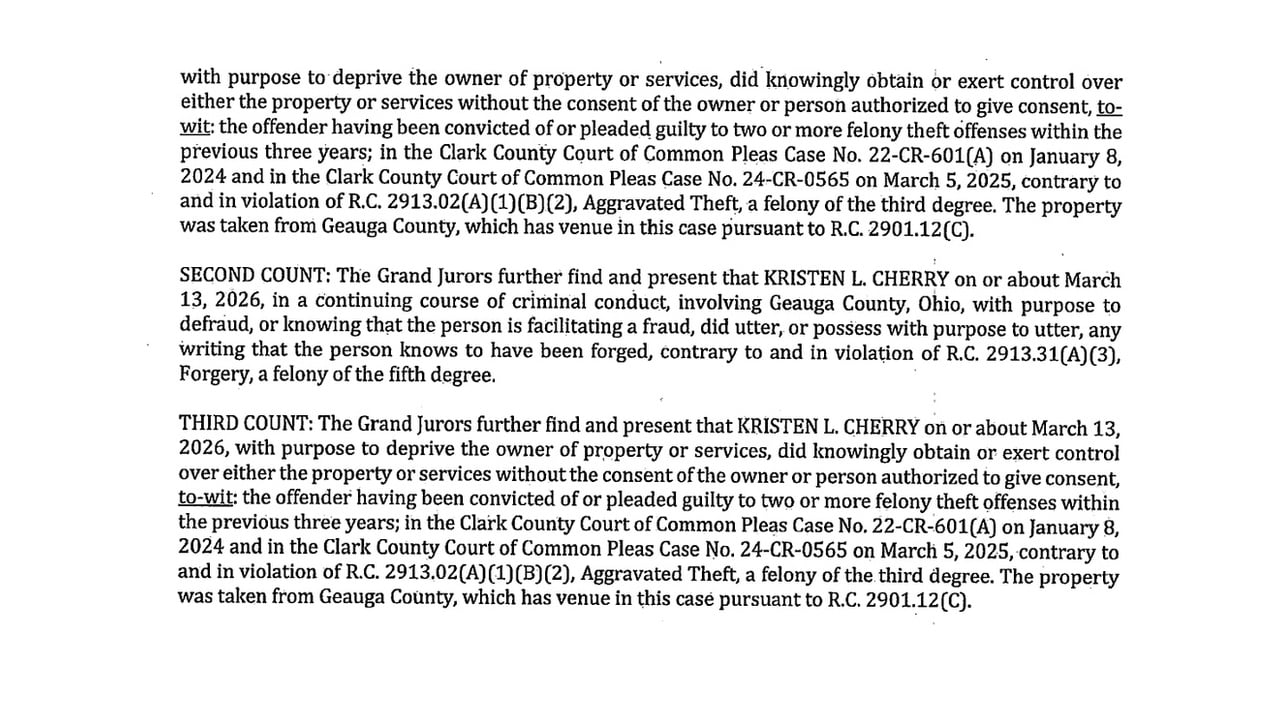
The indictment charges Cherry with two counts of aggravated theft under Ohio Revised Code Section 2913.02 and two counts of forgery under Section 2913.31.
The grand jury document says the aggravated-theft counts are third-degree felonies because Cherry had previously been convicted of or pleaded guilty to at least two felony theft offenses during the preceding three years.
The indictment specifically identifies Clark County Court of Common Pleas case 22-CR-601(A), dated Jan. 8, 2024, and case 24-CR-0565, dated March 5, 2025.
Each forgery count is charged as a fifth-degree felony. The indictment alleges that on or about March 13, Cherry knowingly uttered, or possessed with the purpose to utter, writings she knew had been forged.
The Court Record Lists Four Charges and an Open Case
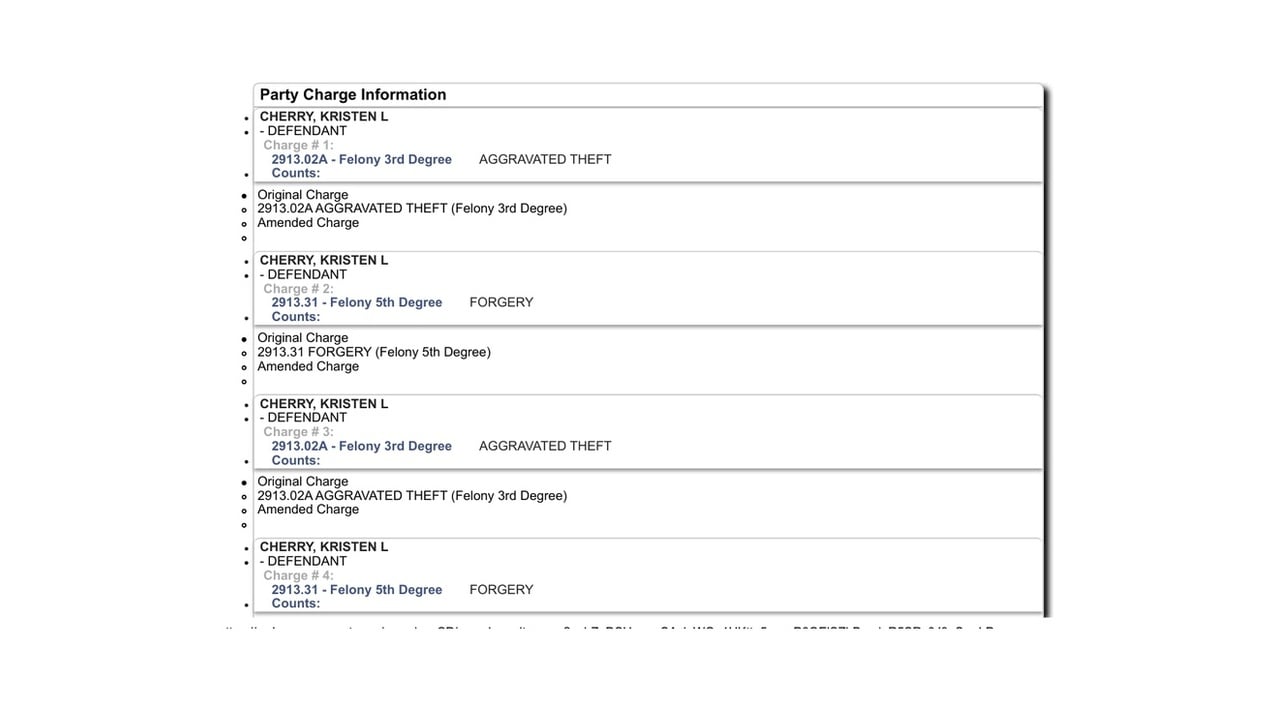
The Geauga County court record identifies the prosecution as State of Ohio v. Kristen L. Cherry, case 26C000151. The case was filed Sept. 29 and remained listed as open when the record was reviewed Oct. 6.
The docket lists two third-degree felony aggravated-theft counts under Ohio Revised Code Section 2913.02 and two fifth-degree felony forgery counts under Section 2913.31.
Under the version of Ohio’s theft statute in effect on March 13, 2026, two or more felony theft convictions or guilty pleas within the previous three years could elevate a theft offense to third-degree aggravated theft. The indictment expressly relies on Cherry’s two identified Clark County cases when grading the current theft counts as third-degree felonies.
Ohio’s forgery statute covers conduct including uttering or possessing with purpose to utter a writing known to have been forged.
A Warrant Was Issued After the Indictment
A separate warrant to arrest issued Sept. 29 lists the same four charges: aggravated theft, forgery, aggravated theft and forgery.
The warrant was issued before Cherry had appeared in the case. The court docket also records a warrant-on-indictment entry and an alert issued in her name on Sept. 29.
Cherry is expected to appear in Geauga County Common Pleas Court after she is taken into custody. The charges are allegations, and she is presumed innocent unless proven guilty.
Postal Inspectors Warn That Stolen Checks Can Be Used to Make Counterfeits
The U.S. Postal Inspection Service warns that criminals can intercept business mail, obtain examples of legitimate checks and duplicate their banking details onto counterfeit checks.
For businesses, postal inspectors recommend confirming that checks drawn from company accounts reach their intended recipients and flagging outstanding payments that have not arrived. The guidance also recommends asking banks about fraud-monitoring services, including Positive Pay.
If check fraud is discovered, the Postal Inspection Service advises contacting the bank and local police promptly. Suspected mail theft can also be reported directly to postal inspectors.