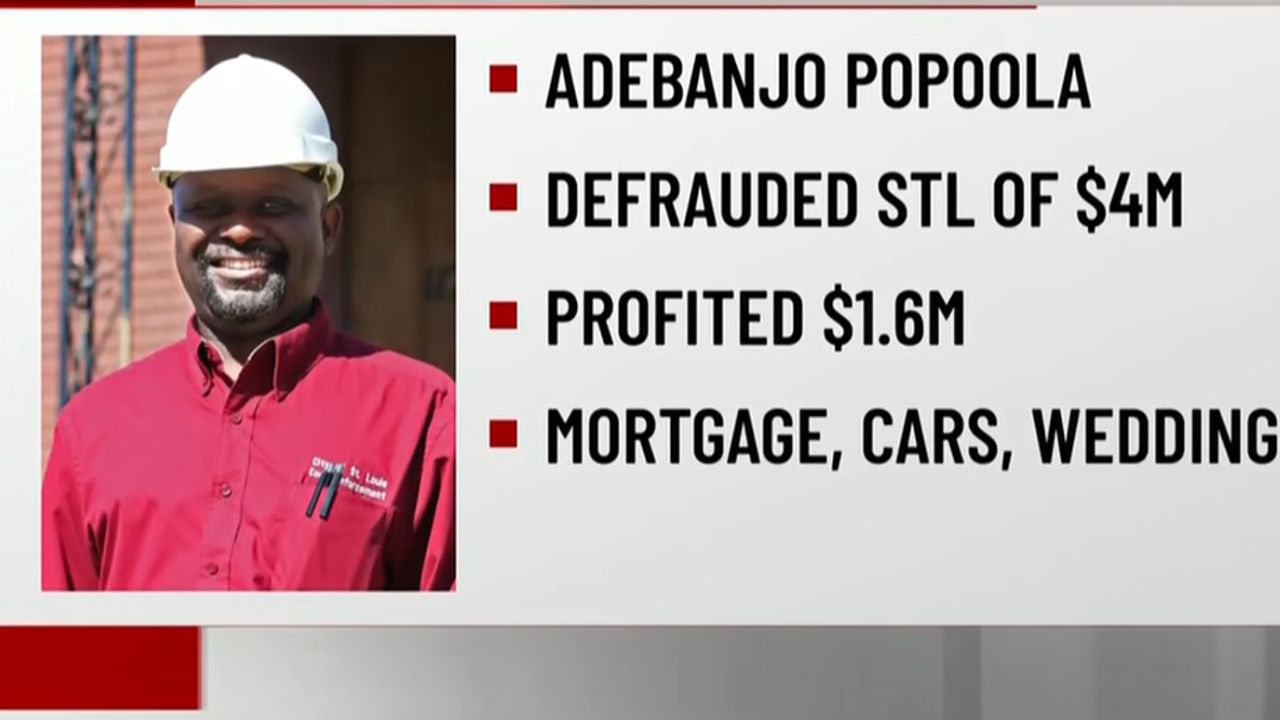
A former St. Louis building inspector has admitted steering $1.64 million meant for repairing deteriorating city buildings to himself and relatives.
Adebanjo “Banjo” Popoola, 57, pleaded guilty Tuesday in federal court to three counts of wire fraud, according to the U.S. Attorney’s Office for the Eastern District of Missouri.
Popoola worked in the city’s Building Division and helped manage programs designed to stabilize and rehabilitate St. Louis properties. One program used federal American Rescue Plan Act funds, while another used city-issued bond money.
Prosecutors said Popoola used that role to direct repair contracts to companies tied to his sister and future wife, then falsely certified that work had been completed properly so payments could be released.
The Programs Were Meant To Repair City Properties
DOJ said Popoola helped manage Stable Communities STL and Prop NS. Stable Communities STL was funded through federal ARPA money and intended for privately owned properties, while Prop NS was funded through city general obligation bonds and focused on residential properties owned by the city’s Land Reutilization Authority.
As part of his job, Popoola was responsible for identifying properties for repair or stabilization, developing the scope of work, reviewing and awarding bids, inspecting reported work, and certifying that work had been completed before contractors were paid.
The Contracts Went To Companies Tied To Him
Popoola admitted that his sister, a Texas resident who had never visited St. Louis, incorporated Farst Construction LLC in Missouri in October 2022. His future wife set up Premier Finish Contractors LLC in February 2021.
From 2023 through 2024, prosecutors said Popoola caused Farst to receive $1.4 million through Stable Communities STL and $339,500 through Prop NS. He also steered about $1.3 million in Stable Communities STL money and about $853,100 in Prop NS money to Premier.
DOJ said Farst and Premier received 42% of all ARPA funds disbursed through Stable Communities STL. Private building owners and representatives of the Land Reutilization Authority later reported that on multiple projects, the companies failed to perform the rehabilitation and stabilization work they were paid to do.
Prosecutors Say He Falsely Certified The Work
Popoola admitted he falsely certified that work had been performed completely and properly, allowing funds to be disbursed to the contractors.
He also admitted concealing his connection to the companies on city Employee Secondary Employment Questionnaires in 2022 and 2023. According to DOJ, Popoola falsely stated that he had no direct or indirect personal interest in city contracts and no interest in any business.
His sister and wife also falsely certified on contract documents that no city officer or employee connected to the project had a private interest in the contract, prosecutors said.
The Money Paid For Personal Expenses
After subcontractors were paid for purported stabilization work, Popoola, his sister, and his wife shared and personally used about $1.64 million, according to DOJ.
Popoola admitted using program funds for residential mortgage payments, multiple vehicle purchases and repairs, travel, his September 2023 Hawaii wedding, casino gambling, dining, and entertainment.
Sentencing Is Scheduled For October
Popoola is scheduled to be sentenced on Oct. 6. Each wire fraud count carries a maximum penalty of up to 20 years in prison, a $250,000 fine, or both.
DOJ said he will also be ordered to repay the money. The FBI investigated the case with substantial cooperation from the City of St. Louis Comptroller’s Office.
Residents Can Report Suspicious Public-Repair Spending
Property owners should keep records when a city-funded repair or stabilization project is approved for their building. Useful records include the scope of work, contractor name, inspection notices, emails, photos before and after the work, permit records, and any documents showing that work was marked complete.
If a repair project is listed as finished but the work was not done, residents should report it before more funds are released. The City of St. Louis Comptroller’s Office lists a Fraud Hotline for information related to theft, corruption, fraudulent financial statements, or improper spending of city tax dollars.
The FBI also accepts tips about federal crimes. Its public corruption guidance includes contract corruption, economic stimulus fraud, government fraud, and contracts awarded to companies that directly or indirectly benefit a public official or their relatives.