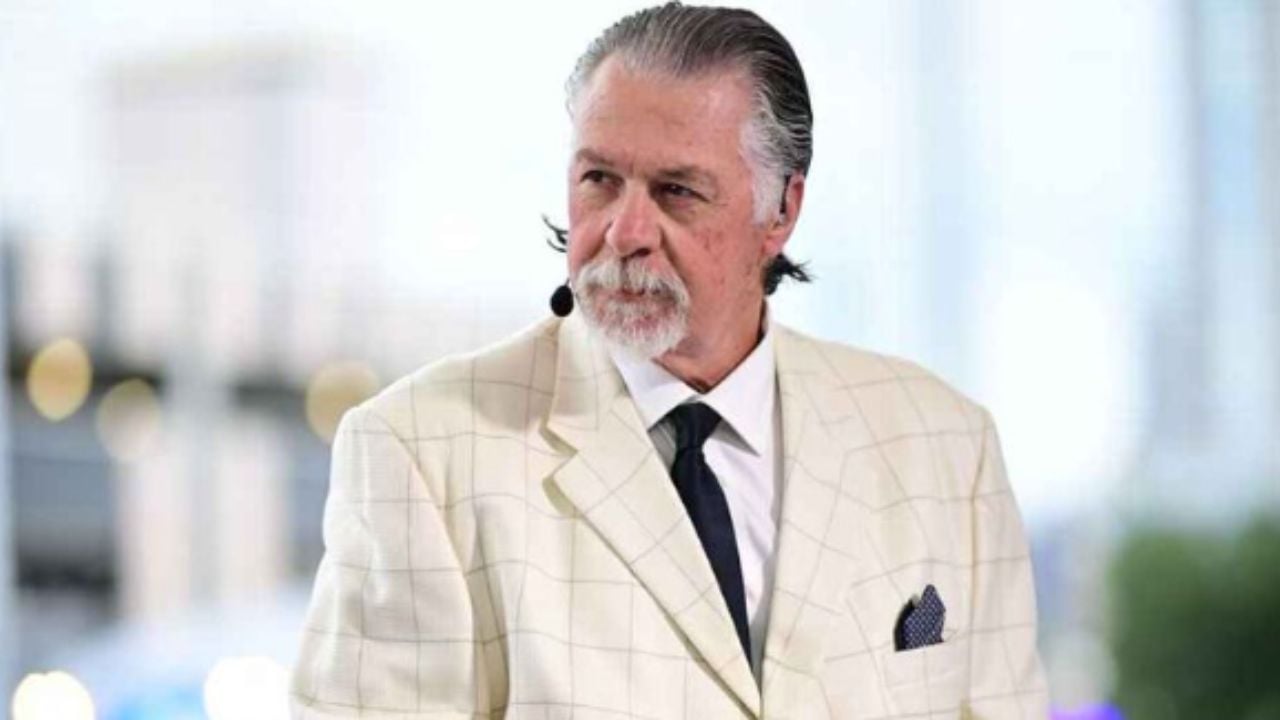
Barry Melrose spent more than half a century around hockey, building three separate careers that took him from the ice to an NHL bench and eventually into millions of homes through ESPN.
The former NHL defenseman, Los Angeles Kings coach and longtime television analyst died Wednesday, Sept. 9, at age 70. His wife, Cindy, informed ESPN’s Steve Levy of his death, according to TMZ.
Melrose had stepped away from broadcasting in 2023 after being diagnosed with Parkinson’s disease. ESPN remembered him as one of hockey’s most “distinctive and trusted” voices, while NHL Commissioner Gary Bettman pointed to the mullet, long suit coats and unmistakable personality that followed Melrose from the bench into television.
Before becoming that television fixture, Melrose had already played hundreds of professional games, won championships as a minor-league coach and guided Wayne Gretzky’s Los Angeles Kings to their first Stanley Cup Final. By the time he retired from ESPN, his connection to hockey stretched across more than 50 years.
His ESPN Colleagues Learned the News as Another Hockey Season Approached
Barry was my best friend at ESPN. A big brother figure of rock solid values. I am shook to my core. Barry gave his life to hockey and some of his ESPN family, like me, learned of his shocking death today while at a hockey rink in Las Vegas preparing for the upcoming season.… pic.twitter.com/x1zV1b4z87
— BucciOT.Com (@Buccigross) September 10, 2026
ESPN announced Melrose’s death Wednesday after Cindy contacted Levy. The network did not specify a formal cause of death in its announcement, although Melrose had publicly disclosed his Parkinson’s diagnosis when he retired three years earlier.
“For decades, Barry Melrose was one of the most distinctive and trusted voices in hockey,” ESPN said, praising his knowledge, candor and unmistakable enthusiasm for the sport.
John Buccigross, who worked alongside Melrose for decades, said he received the news while at a hockey rink in Las Vegas preparing for the upcoming season. He called Melrose his best friend at ESPN and a “big brother figure.”
Levy remembered him as a family man who never lost the connection to his Saskatchewan roots even after becoming one of the most recognizable hockey personalities in the United States.
The Associated Press described Melrose’s broadcasting style as conversational and funny. The goatee, slicked-back hair, mullet and attention-grabbing suits made him recognizable before he ever began explaining what had happened on the ice.
He Took Wayne Gretzky and the Kings to the 1993 Stanley Cup Final
Melrose reached the NHL with significant coaching success already behind him. He led the Medicine Hat Tigers to the Memorial Cup in 1987 and coached the Adirondack Red Wings to the American Hockey League’s Calder Cup championship in 1992.
The Kings hired him for the 1992-93 season, his first as an NHL head coach. Los Angeles finished 39-35-10 before producing what was then the deepest playoff run in franchise history.
Led by Gretzky alongside players including Luc Robitaille, Jari Kurri and Kelly Hrudey, the Kings defeated Calgary in six games, Vancouver in six and Toronto in a seven-game conference final to reach the Stanley Cup Final for the first time.
Montreal won the championship series in five games, but the run remained the defining achievement of Melrose’s NHL coaching career. He stayed with the Kings through most of the next two seasons before leaving the organization in 1995.
His only later NHL head-coaching job came with the Tampa Bay Lightning in 2008. That return lasted 16 games, after which Melrose went back to broadcasting. His NHL coaching record finished at 84-108-29 with four overtime losses recorded during the Tampa Bay stint.
ESPN Became His Hockey Home for Nearly Three Decades
Melrose became an ESPN hockey analyst in the 1990s and spent most of the next 27 years with the network, apart from his brief return to coaching in Tampa Bay.
He regularly worked alongside Levy and Buccigross and became a fixture across ESPN’s NHL programming, including coverage of the Stanley Cup Playoffs, Stanley Cup Final and All-Star events. His credibility came partly from having experienced the sport from both sides of the boards as a player and coach.
The television version of Melrose never looked particularly interested in blending into a studio. His long suit coats, patterned jackets, goatee and eventually signature mullet became almost as familiar as his analysis.
The NHL remembered him as an Emmy Award-winning broadcaster, while Bettman said Melrose’s enthusiasm had a way of increasing other people’s love for hockey.
Wayne Gretzky captured that influence when Melrose announced his retirement in 2023. In an ESPN tribute, Gretzky called him “bigger than any team” and compared his role in hockey’s broader community to that of a conductor.
His Hockey Career Began as a Rugged Defenseman From Saskatchewan
Long before the television desk, Melrose was a defenseman from Kelvington, Saskatchewan. The Montreal Canadiens selected him in the second round with the 36th overall pick of the 1976 NHL Amateur Draft.
His professional career began that year with the Cincinnati Stingers of the World Hockey Association. He played three seasons there, including the final one alongside a teenage Mark Messier, before moving to the NHL after the WHA folded.
Melrose played for the Winnipeg Jets, Toronto Maple Leafs and Detroit Red Wings. Across 300 NHL regular-season games, he recorded 10 goals, 23 assists and 728 penalty minutes. He added five goals and 27 assists in 178 WHA games with Cincinnati.
His playing career ended after the 1985-86 season, and coaching followed almost immediately. By 1987 he was a championship coach, five years later he had won the Calder Cup and one year after that he was coaching Gretzky in the Stanley Cup Final.
When Melrose finally stepped away from ESPN in 2023, he said he had enjoyed “over 50 extraordinary years” playing, coaching and analyzing hockey and wanted to focus on his health and family. Melrose is survived by his wife, Cindy, and their sons, Tyrell and Adrien.