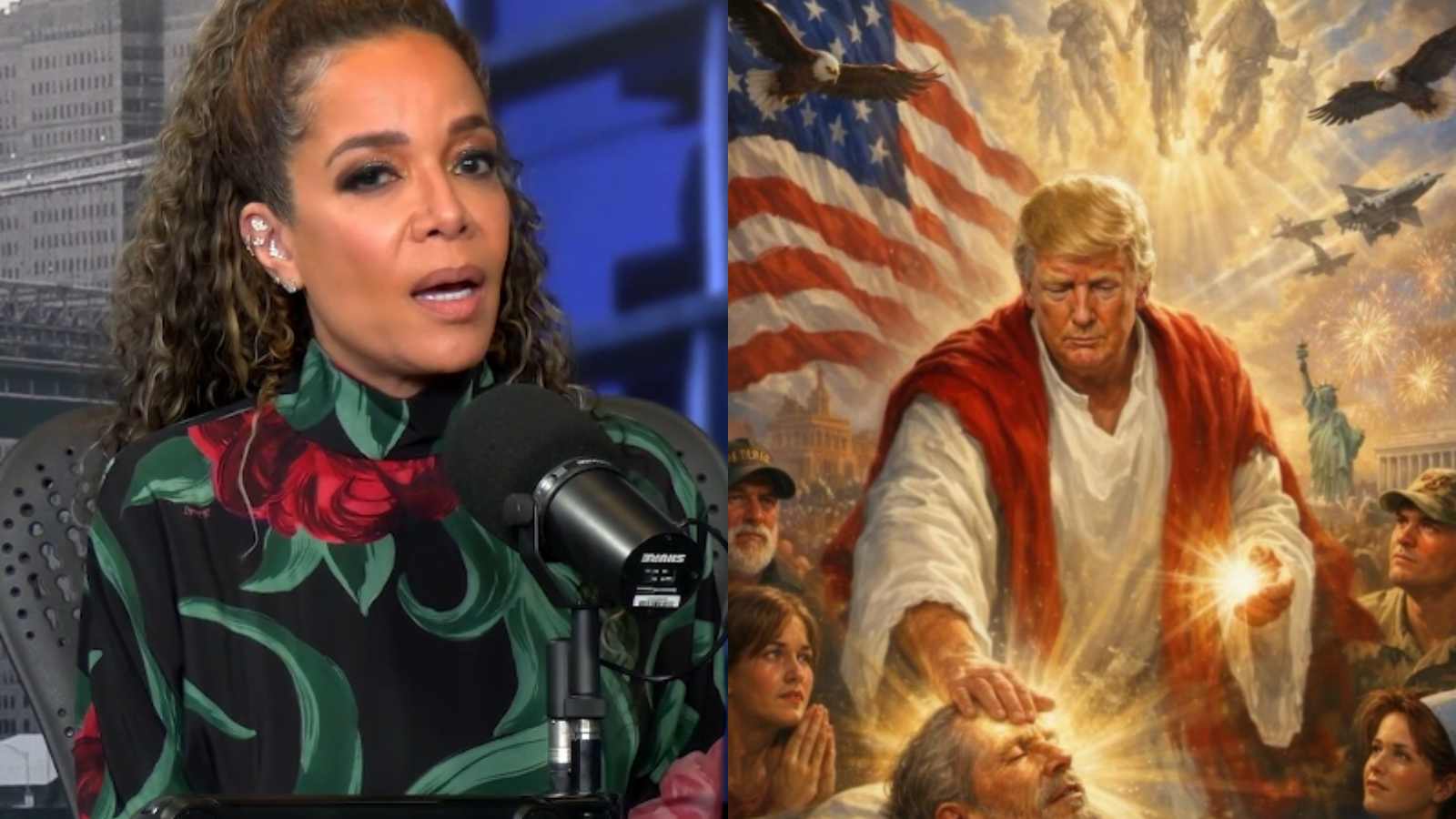
The atmosphere in The View studio was heated, with a particular kind of tension, on Monday, April 13, 2026. As the hosts returned from their spring break hiatus, the typical banter was instantly replaced by a palpable, collective recoil.
A single image, generated by artificial intelligence, had occupied the screen… a digital rendering depicting President Donald Trump in the likeness of Jesus Christ, complete with flowing robes and a miracle-working pose that mimicked the biblical account of Lazarus.
For Sunny Hostin, the reaction was instantaneous and severe, slicing through the usual morning talk show cadence with a blunt, constitutional demand: the invocation of the 25th Amendment.
It was a moment that transcended typical political bickering, touching on deep-seated nerves regarding the intersection of faith, leadership, and the boundaries of executive decorum in an era increasingly blurred by synthetic media.
The Constitutional Brink
Sunny Hostin’s call to action was not merely an expression of personal affront; it was a grave articulation of a standard she believes is foundational to the presidency. When confronted with the image, her response was unfiltered and direct. “25th Amendment,” she stated, emphasizing that the amendment exists for precisely such moments of what she deems disqualifying behavior.
TRUMP SHARES AI-GENERATED IMAGE OF HIMSELF AS JESUS: After the Pope spoke out against the war in Iran and Pres. Trump wasn’t pleased with his comments, ‘The View’ co-hosts react to what Trump posted and has since taken down. pic.twitter.com/MfRGJLbhNC
— The View (@TheView) April 13, 2026
The 25th Amendment serves as a vital constitutional mechanism, establishing a formal process for the temporary or permanent transition of presidential authority should a commander-in-chief become incapacitated or otherwise unable to fulfill the core responsibilities and obligations of their station.
It is a heavy hammer to swing, yet Hostin wielded it with an unwavering sense of necessity. She argued that the office of the presidency, the most powerful in the world, requires a level of sobriety and restraint that such a stunt fundamentally undermines.
The visual, which featured Trump performing a miracle with light radiating from his fingers, came directly on the heels of his public escalation of tensions with Pope Leo XIV.
The juxtaposition of attacking the leader of the Catholic Church while simultaneously positioning himself in a messianic, Christ-like role created a firestorm. For many viewers and critics, this wasn’t just a meme; it was a provocation that felt like a breach of the sanctity that many Americans hold dear.
While Whoopi Goldberg struggled to even look at the image, requesting that it be removed from the screen, the discourse it sparked moved beyond the meme’s aesthetics into the psychological and spiritual implications of a leader who appears to delight in such provocative symbolism.
A Theological Collision
“Our faith is bigger than politics.”@AlyssaFarah Griffin weighs in on Pres. Trump’s comments about Pope Leo. pic.twitter.com/GuXpo6Rfdq
— The View (@TheView) April 13, 2026
The backlash reached well beyond the set of The View. Alyssa Farah Griffin, returning to the desk after maternity leave, provided a sobering theological analysis of the situation. “In the Christian faith, this is considered blasphemy,” she noted, highlighting the inherent transgression of elevating a political figure to the status of Christ.
What makes this particular instance so fascinatingly chaotic is that the criticism isn’t strictly confined to political opponents. Even within the staunch MAGA base, there were reports of diehard supporters expressing genuine unease, with some going so far as to publicly ask for the post to be removed.
This creates a curious, contrarian reality: the post may have inadvertently acted as a bridge, albeit a fragile one, between disparate groups who found common ground in a shared sense of religious discomfort.
If the goal of such content is engagement, it succeeded, but at the cost of alienating a slice of the base that maintains that religion is the one thing that should never be subordinated to politics.
President Trump later offered a defense, claiming he viewed the image as depicting him as a doctor “making people better,” a remark that only served to further complicate the narrative and deepen the divide between those who view his social media activity as harmless, meme-driven humor and those who see it as a dangerous erosion of presidential dignity.
Was that Delusion or Rage Bait?
“[Trump’s] having a really bad week.” @AnaNavarro weighs in on Pres. Trump’s comments on Pope Leo and explains why she says it’s a distraction. pic.twitter.com/xpcdbO4B7i
— The View (@TheView) April 13, 2026
While the debate over blasphemy raged, others at the table, like Ana Navarro, pointed toward a more cynical motive: the rage bait play for distraction. Navarro argued that the timing of the post was far from coincidental.
With Trump’s approval ratings at 36%, a sobering number for any administration, and the economy facing tangible pressures, including soaring gas prices in cities like New York and a volatile stock market, the need for a diversionary tactic is a classic political maneuver.
In this view, the post isn’t necessarily a sign of a mental health crisis, as Hostin’s invocation of the 25th Amendment might suggest, but rather a calculated, if reckless, attempt to change the subject in a news cycle that has been consistently unforgiving.
This perspective invites a much colder, more analytical look at the power of AI-generated content in political messaging. If the goal is to dominate the headlines and force opponents to spend precious airtime reacting to your narrative, then the mission was accomplished with surgical precision.
The incident raises uncomfortable questions for the future of political communication: as the barriers to creating highly realistic, provocative imagery continue to drop, are we entering an age where the “content” of the presidency is no longer policy or diplomacy, but a relentless barrage of digital iconography designed to elicit, provoke, and divide?
TRUMP: “I was the one that posted the picture of me being depicted as Jesus Christ. But it’s really just me dressed up as a doctor bc I like to help people. Also, you’re fake news for asking.”
I’ve never seen someone be more publicly and openly full of shit than this guy. pic.twitter.com/6luwDYKnwL
— Stew Peters (@realstewpeters) April 13, 2026
The Unanswered Questions
As this narrative continues to unfold, several critical pieces of the puzzle remain unaddressed by the public record or the President’s own explanations:
Who was involved in the creation or selection of this specific AI prompt? While the President has acknowledged the post, the internal process of choosing such a loaded image remains opaque.
What is the specific internal feedback loop within the administration regarding the impact of religious-themed AI posts? It would be telling to know if there is any advisory body or communications strategy team that reviews the potential backlash of such content before it is pushed to Truth Social.
Has there been any formal communication, private or otherwise, between the White House and the Vatican following the President’s disparaging remarks toward Pope Leo XIV? Given the escalation, understanding if there is any diplomatic backchannel open is vital to assessing the severity of this breakdown.
To what extent are data metrics being used to determine the “meme-worthiness” of religious imagery? Understanding if there is an algorithmic approach to selecting these images could reveal a deeper, more calculated strategy than simple impulse.
The collision of pivotal global conflicts, religious tension, and the volatile nature of social media has created a bizarre, unprecedented atmosphere in American politics.
So is this a harmless, albeit tone-deaf, attempt at humor or a genuinely dangerous signal of instability? The reality is that the lines of discourse have shifted.
We are no longer just debating laws and budgets; we are debating the limits of what a leader can claim to be, and what the public will tolerate in the pursuit of political dominance.
The conversation sparked by The View hosts is perhaps just the beginning of a much larger, more uncomfortable reckoning with the role of technology and faith in the theater of the modern presidency.