
An Oklahoma bookkeeper and her husband are accused of embezzling more than $3.27 million from a movie theater and gas station in southeastern Oklahoma over a period exceeding five years.
Bria and Zane Davey, both 37, were identified in an Oct. 9 announcement by the Oklahoma State Bureau of Investigation (OSBI). The businesses are McCurtain Cinema and Gasquatch, a gas station in Idabel, and both share the same owner.
Bria Davey was hired in March 2021 as a secretary and bookkeeper for the two establishments. Investigators allege that money was diverted through unauthorized checks and business credit cards linked to Cash App without the owner’s permission.
The couple surrendered to authorities on Oct. 8, 2026. Separate McCurtain County felony cases now list two embezzlement counts against each defendant, while court records establish their bond amounts and upcoming initial appearances.
An Employee Embezzlement Complaint Brings in State Investigators
On June 4, 2026, the Idabel Police Department received a complaint alleging that an employee had embezzled funds from the businesses. Officers requested assistance from the OSBI the following day, bringing state special agents into the investigation.
Unauthorized Checks and Cash App Transactions Become Central to the Case
Investigators examining the businesses’ financial records identified numerous checks that had allegedly been issued without authorization. The owner also discovered that company credit cards had been linked to Cash App without permission, and investigators traced multiple transactions to accounts associated with Bria and Zane Davey, according to KOKH.
Investigators Trace Suspected Activity Back to March 2021
OSBI special agents calculated that the suspected embezzlement extended through May 2026, putting the period under examination at more than five years. The agency’s estimate of over $3.27 million represents the combined alleged losses of McCurtain Cinema and Gasquatch, not an independently established loss amount for each defendant.
The length of the alleged activity is notable compared with the Association of Certified Fraud Examiners’ 2026 study of occupational fraud. Its analysis of 2,402 cases across 143 countries and territories found that the median scheme lasted 12 months before detection.
Cases continuing for more than five years produced median losses exceeding $1.1 million in that study. The findings provide context for the financial damage that prolonged employee misconduct can cause, without establishing the allegations against the Daveys.
Bria Davey’s Court Record Lists Two Felony Embezzlement Counts
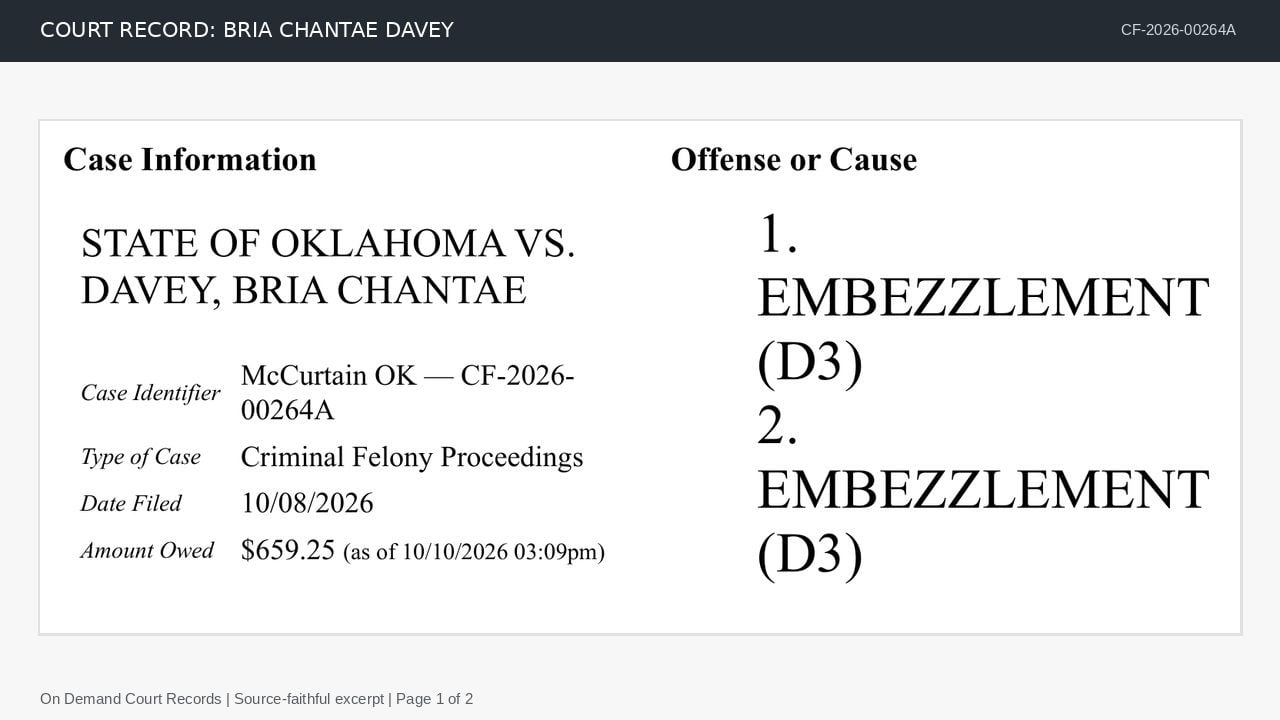
Bria Chantae Davey’s criminal case was filed in McCurtain County District Court on Oct. 8, 2026, under case number CF-2026-00264A. Bria Davey’s court record lists two embezzlement offenses and identifies Mark Matloff as the district attorney. The docket also records an affidavit and an Information filing entry dated Oct. 8.
Both Defendants Have $100,000 Bonds and October 30 Court Dates
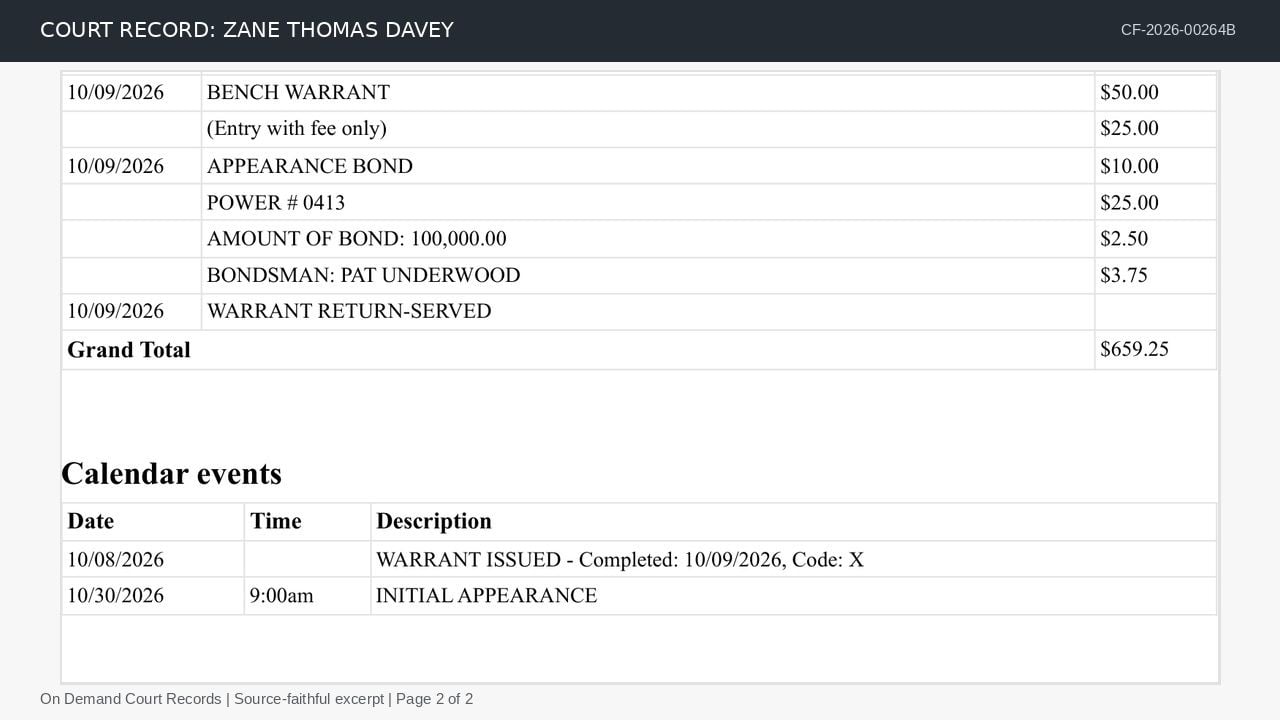
Zane Thomas Davey faces a separate criminal case, CF-2026-00264B, also filed on Oct. 8. Zane Davey’s court record lists two embezzlement counts and an appearance bond entry dated Oct. 9, with the bond amount recorded as $100,000.
Bria Davey’s docket likewise lists an appearance bond of $100,000, bringing the two recorded bond amounts to $200,000 combined. The figures represent the stated bonds, not the amount the couple necessarily paid to obtain release. Both were released after posting bond, according to local reporting.
The two court calendars schedule initial appearances for Friday, Oct. 30, 2026, at 9 a.m. in McCurtain County. Both defendants are presumed innocent unless proven guilty.
Oklahoma Law Covers Entrusted Money and Continuing Embezzlement Schemes
Under Oklahoma Statutes Title 21, Section 1451, embezzlement involves fraudulently appropriating property that was lawfully obtained or entrusted to someone for a use the owner did not authorize.
The statute also permits multiple acts to be considered together when they arise from a continuing scheme that meets the law’s conditions. The distinction is relevant to allegations involving recurring checks and electronic transfers over an extended period.
How Businesses Can Detect Unauthorized Checks and Cash App Transfers
Reviewing cleared check images directly through a bank can reveal payees, amounts or endorsements that differ from approved business expenses. Independent reconciliation is particularly important when an employee is responsible for preparing payments and maintaining the same accounting records used to review them.
Businesses should also examine corporate card statements for unfamiliar payment-app transactions and confirm that all connected accounts are authorized. Transaction alerts and separate payment approvals can help identify activity that would otherwise remain hidden within routine bookkeeping.
When suspicious transfers appear, owners should contact the bank or card issuer promptly, secure affected accounts and preserve cleared checks, statements and transaction records. The Association of Certified Fraud Examiners identifies proactive transaction monitoring and management reviews among the controls associated with lower fraud losses and faster detection.