Christopher Nolan has identified what he considers a recurring weakness in amateur film criticism, treating the recognition of a storytelling technique as proof that the technique has failed.
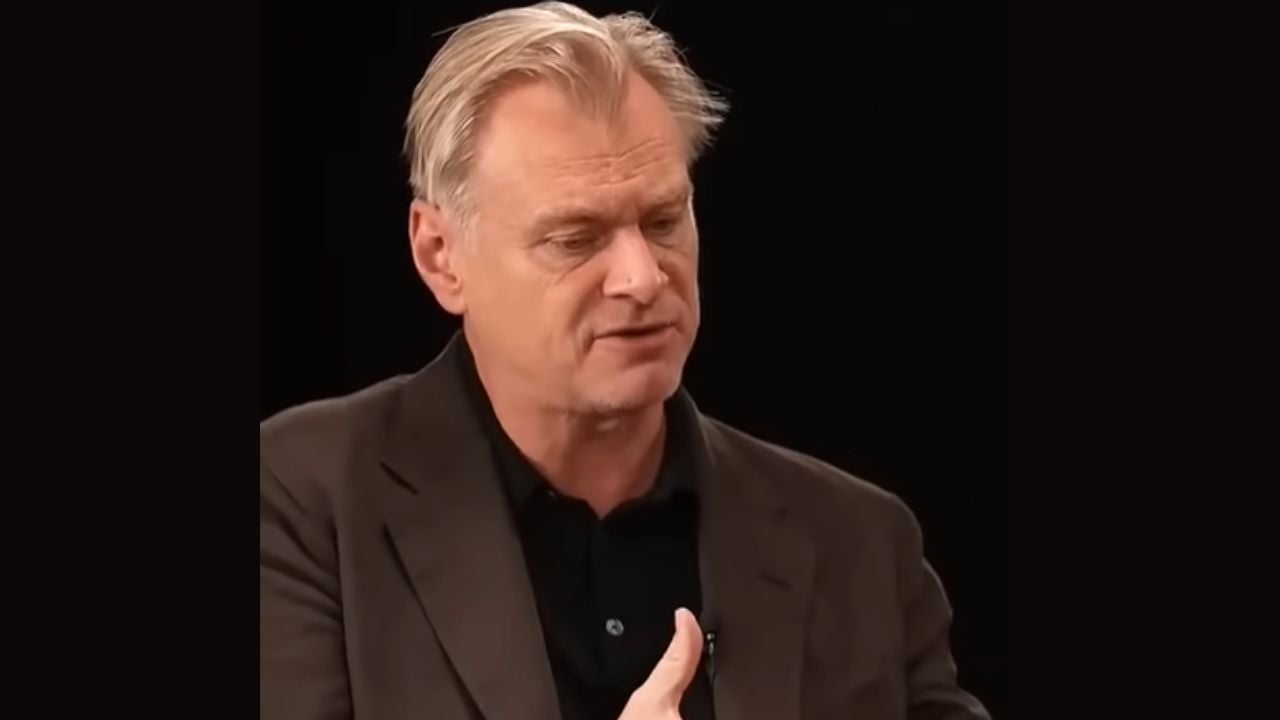
The filmmaker discussed the subject while promoting The Odyssey in Beijing during an interview with political philosophy lecturer and podcast host Zhong Shu.
According to Deadline’s report on his remarks, Nolan argued that some viewers dismiss a narrative choice as manipulation simply because they understand how it is intended to affect them.
Nolan focused on a particular kind of commentary that identifies a familiar storytelling mechanism without fully evaluating how it functions within the movie.
The Discussion Began With Making a Hero Sympathetic
Zhong asked Nolan how contemporary filmmakers portray greatness in an era when audiences may expect powerful or heroic figures to apologize, reflect on their actions or confront the consequences of their privilege.
The question related directly to Nolan’s depiction of Odysseus, played by Matt Damon, as a military leader whose journey home requires him to confront the destruction caused by war, pride and violations of the ancient Greek principle of hospitality known as xenia.
Nolan responded that storytellers are always working in conversation with the expectations an audience brings to a character. “Being able to identify the mechanism does not invalidate the mechanism,” Nolan said. Recognizing that a scene is designed to create sympathy may explain part of its construction, but Nolan argued that recognition alone does not demonstrate that the scene is dishonest, ineffective or dramatically unjustified.
He said some viewers reason that because they understand why a story produced a particular emotional response, the technique must not have worked. Nolan rejected that conclusion, arguing that awareness of a narrative device and susceptibility to its effect can exist at the same time.
Nolan Was Speaking Primarily About Amateur Criticism
Nolan later clarified that he was thinking primarily about amateur film criticism rather than professional reviews. He said experienced critics generally understand that filmmakers need recognizable mechanisms to establish characters, guide audience sympathy, provide narrative direction and communicate emotional information.
Nolan was addressing how a specific argument is constructed rather than deciding who is entitled to discuss movies. His concern was with commentary that effectively stops after identifying a trope, convention or emotional strategy. The full podcast conversation placed those remarks within a broader discussion of heroism, adaptation and the relationship between filmmakers and audiences across different cultures.
Familiar Storytelling Devices Still Have to Evolve
Nolan acknowledged that recognizing a mechanism can become a legitimate criticism when a technique has grown so familiar that it no longer produces its intended effect. When audiences encounter the same trope too often, filmmakers may need to alter it, undermine it or find a new way to communicate the same idea.
At the same time, Nolan argued that cinema has developed a shared language over more than a century of filmmaking. Audiences already understand many of its conventions, allowing filmmakers to build on that knowledge rather than inventing an entirely new narrative system for every project.
He described Hollywood filmmaking as an unusually accessible visual language capable of communicating across national and linguistic boundaries. Filmmakers can break or reshape those rules, Nolan said, but they still need to understand the expectations they are modifying.
‘Memento’ Combined an Experiment With a Familiar Foundation
Nolan used Memento as an example of preserving a conventional foundation while radically changing a more visible part of the storytelling. The 2000 psychological thriller follows Leonard Shelby, played by Guy Pearce, as he attempts to identify his wife’s killer while living with a condition that prevents him from forming new long-term memories.
Much of the film’s narrative is presented in reverse chronological order, forcing viewers to continually reconsider what they know about Leonard, his investigation and the people around him. Beneath that unconventional chronology, however, Nolan said he retained a clear and comparatively simple three-act structure.
He also noted that even an original film such as Memento is not judged in isolation. Audiences compare it with existing traditions involving film noir, amnesia stories and mystery thrillers, just as they compare an adaptation such as The Odyssey with earlier versions of the same characters and myths. “You can’t completely have a tabula rasa,” Nolan said. “You can’t throw everything away.”