Late at night, the only real sound on Air Force One is the low, steady hum of the engines. It’s a setting usually reserved for grave discussions on national security or global trade, yet sometimes, the most revealing moments happen over something as simple as a silver tray and a cold can of soda.
There is a certain kind of vulnerability in these small, everyday habits… the way a person clings to a favorite comfort food when the weight of the world is on their shoulders. For Donald Trump, that comfort has famously been a steady stream of diet sodas, delivered at the push of a red button.
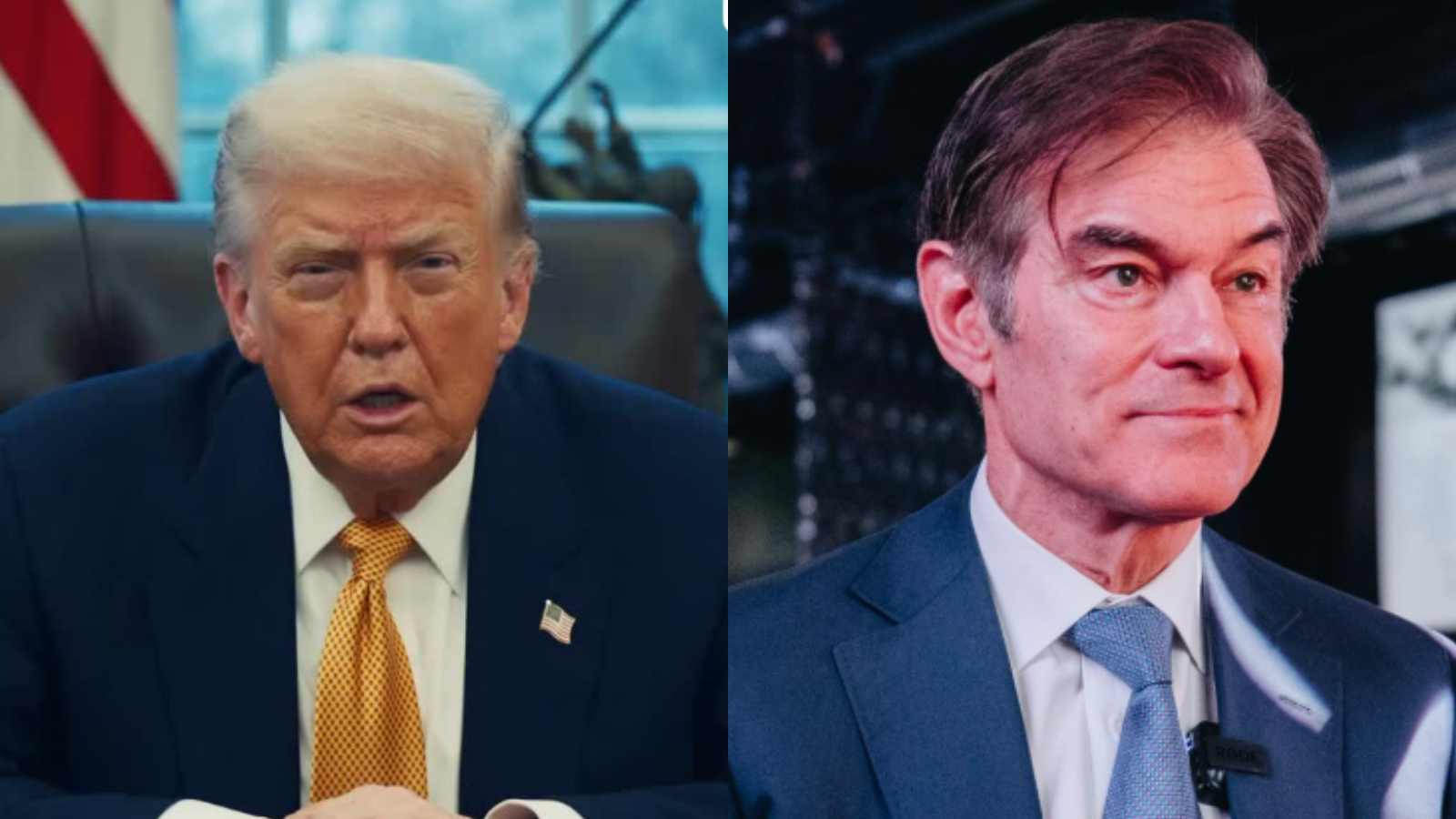
But according to Dr. Mehmet Oz, there is more to this habit than a sweet tooth; it reflects a philosophy of health that defies every medical textbook in the building.
It is a logic born from a world where simplicity is king and traditional science is often viewed with a skeptical side-eye, turning a fizzy refreshment into a perceived shield against the body’s greatest enemies.
The Grass-Roots Theory of Oncology
During a recurring segment on a popular political podcast hosted by Donald Trump Jr., Dr. Mehmet Oz, now the Administrator for the Centers for Medicare & Medicaid Services, shared a story that sounds like it was plucked straight from a comedy sketch, yet it was told with the sincerity of a man who has witnessed the inexplicable.
Dr. Mehmet Oz:
“Trump argues that diet soda is good for him because it kills grass if poured on grass; therefore, it must kill cancer cells inside the body.” pic.twitter.com/Nv5v6cjao3
— Vitamvivere (@Vitamvivere) April 14, 2026
Oz recalled conversations with the 47th President where Trump laid out a truly unique biological hypothesis. The logic was deceptively simple: if you pour diet soda on a patch of grass and it kills the grass, then surely, once inside the human body, it must be potent enough to seek out and destroy cancer cells. It is the ultimate “man of the people” science… the kind of logic that bypasses the lab and goes straight to the backyard.
Oz admitted to being left surprised by the reasoning, yet he watched as Trump continued to defend his love for the beverage with a sheepish grin and an unwavering confidence in his own internal chemistry.
This isn’t just about a soda habit; it’s about a worldview. For Trump, the world is often a series of direct cause-and-effect relationships that don’t need the “clutter” of peer-reviewed studies.
On another occasion, while seated behind the Resolute Desk with a Fanta in hand, Trump reportedly doubled down on the idea, telling Oz that the drink was “freshly squeezed,” so it couldn’t possibly be bad for him.
When Oz questioned the logic of a bright orange, carbonated beverage being “fresh,” Trump’s defense was a mix of charm and stubbornness. He sees the world through a lens of utility; if something is strong enough to act as a herbicide, it must be a powerhouse for the immune system.
It’s a “battery theory” of health… the idea that the body has a finite amount of energy and shouldn’t be wasted on things like exercise, but can be fortified by the “cleansing” power of a chemical-heavy fizzy drink.
BREAKING: Coca-Cola has begun selling soda made with cane sugar in the U.S. after President Trump called on the company to create an American version of its popular Mexican Coke.
— The General (@GeneralMCNews) October 22, 2025
Is There “Logic” in the Illogical?
Now, let’s take a moment to look at this through a completely different lens. While the medical community, and likely anyone who has ever passed a high school biology test, would scoff at the idea of Diet Coke as a cancer-fighting agent, is there a psychological benefit we’re missing?
We live in an era where “wellness” has become a trillion-dollar industry filled with kale smoothies and expensive supplements that often have just as little clinical backing as Trump’s soda theory. In a bizarre way, Trump’s “grass logic” is the ultimate placebo.
If a person truly believes that their 12-can-a-day habit is a protective shield, the lack of stress and the surge of dopamine from the caffeine and sweetness might be doing more for their mental state than a stressful, restrictive diet ever could. It’s the “grandfather’s logic,” the man who smoked until he was 95 because he believed the smoke “cured” the air around him.
There is also the “MAHA” (Make America Healthy Again) factor to consider. Dr. Oz and Health and Human Services Secretary Robert F. Kennedy Jr. are now tasked with overhauling the nation’s health, yet they serve a man who thrives on McDonald’s and aspartame.
This creates a fascinating tension at the heart of the administration. While RFK Jr. talks about removing chemicals from the food supply, Trump is actively lobbying Coca-Cola to switch back to cane sugar because it’s “better” and “more real.” It suggests that even Trump recognizes some level of “natural” is superior, even if his definition of natural is a bit… unconventional.
This take isn’t saying the soda kills cancer, let’s be clear, it doesn’t, but rather that there is a certain rugged individualism in rejecting the “expert” consensus in favor of one’s own lived experience, even when that experience involves a lawnmower and a twelve-pack.
The Policy Paradox of Dr. Oz
The appointment of Dr. Oz to lead CMS brings these personal anecdotes into sharper, more professional focus. Oz, a man who built a career on television by bridging the gap between traditional medicine and “miracle” cures, is now the gatekeeper of health coverage for 160 million Americans.
His stories about Trump’s diet aren’t just gossip; they are insights into the mind of the man setting the nation’s healthcare agenda. If the President believes in “grass logic,” how does that translate to funding for cancer research or the regulation of artificial sweeteners?
Oz has already shown he isn’t afraid to provide a reality check, as seen during a televised briefing where he corrected Trump’s claims about Ozempic pricing. It’s a delicate dance: Oz must respect the President’s personal “logic” while managing a massive federal agency that relies on hard data.
As we look toward the future of American healthcare under this duo, the questions are as numerous as the bubbles in a freshly poured Fanta. Can a “Make America Healthy Again” movement really take root when its leader is the world’s most famous consumer of ultra-processed foods?
Perhaps the goal isn’t to change the man, but to use his unique perspective to challenge a healthcare system that many feel has failed them. It’s clear that the conversation around American health is changing, whether you see Trump’s soda theory as a dangerous delusion or a quirky bit of “folk medicine.”
It’s moving away from the sterile halls of academia and into the podcasts, the dinner tables, and yes, even the backyards where the grass is definitely not drinking Diet Coke.