
In an industry where “smoke and mirrors” is the literal job description, a new kind of special effect is haunting the halls of Tinseltown, and this time, it’s not for the cameras. A high-profile Hollywood insider has officially pulled back the curtain on what she calls a “massive, industry-wide deception” regarding the use of Artificial Intelligence.
In a bombshell interview on February 18, 2026, Janice Min, the CEO of Ankler Media and former iconic editor of The Hollywood Reporter, did the unthinkable: she accused every major studio and streamer of lying to the public about their AI integration.
“Everyone’s lying just a little bit,” Min told Peter Kafka. “And by a little bit, I mean they are using it far more than they are ever willing to admit.”
The revelation has sent shockwaves through a town still reeling from the scars of the 2023-2024 strikes, where AI protections were the primary battlefield. Here is the deep dive into the allegations and the high-tech “shadow war” currently being fought in Hollywood.
“A Don’t Ask, Don’t Tell Policy”

Janice Min’s claims strike at the heart of Hollywood’s current identity crisis. According to Min, while studios publicly pay lip service to “protecting human creativity,” the reality behind closed doors is a frenzy of automation.
Min made the daring claim that every single Best Picture nominee for the 2026 Academy Awards has likely used AI in its production process. “It is crickets this year,” she noted, referring to the sudden lack of controversy compared to previous years.
Min alleges that tech companies are lying about the capabilities of their products, while creative people (actors and writers) are lying about the fact that they aren’t using them. “I dare you to find a screenwriter who is staring at a blank page and not talking to Claude or ChatGPT at the same time,” Min challenged.
This “deception” is a strategic move to avoid the PR nightmare that hit films like Late Night with the Devil (criticized for AI-generated inserts) or The Brutalist, which faced backlash after it was revealed AI was used to refine the lead actors’ accents.
The Looming Job Displacement

While the studios might be staying quiet, the economic forecasts for 2026 are shouting. Credible data reports now paint a grim picture of the human cost of this “hidden” AI transition.
Nearly two-thirds of professionals working in media and entertainment, about 65%, believe artificial intelligence will meaningfully reshape their day-to-day responsibilities within the next year. However, data suggests that roughly 204,000 jobs in film, TV, and streaming are projected to be “materially affected” by AI over the next three years.
Despite the efficiency, there is a “quality tax.” Audience fatigue with what critics call “AI slop” is beginning to show in subscriber churn data, with a 15% drop in engagement for content flagged as heavily synthetic.
The “Thanksgiving Day” Scandal
To see what happens when the “deception” fails, look no further than the recent AMC Theatres debacle on February 24, 2026.
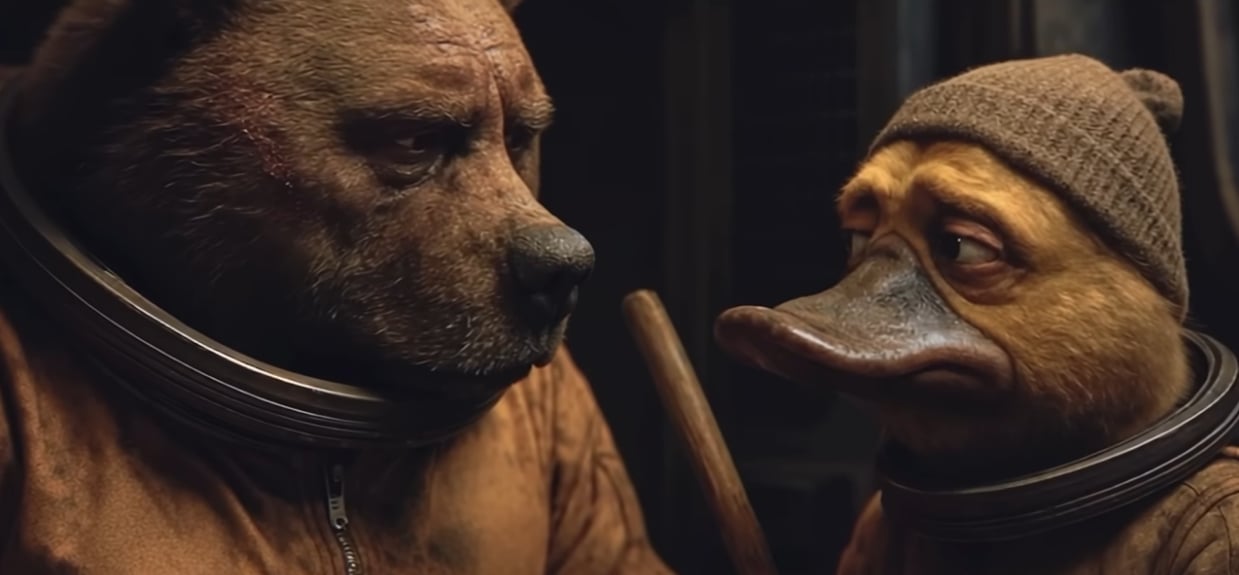
A short film titled Thanksgiving Day, created by Kazakhstani filmmaker Igor Alferov using Google’s Gemini 3.1 and Nano Banana Pro, was slated to play nationwide as part of a festival prize. However, after the news leaked online, a massive public outcry forced AMC to distance itself immediately.
AMC released a statement claiming it was a “third-party initiative” and that they would not participate. It was a rare, public rejection of AI in the cinema space, proving that while studios might be using it behind the scenes, the audience still isn’t ready to pay for it on the screen.
China’s “Seedance” Panic
Adding to the industry’s anxiety is the rise of Seedance 2.0, a Chinese AI video model that rocked Hollywood in mid-February 2026.
Animation studio heads have noted that Seedance produces action sequences so realistic that it feels like having a “top-tier cinematographer” assisting you for a fraction of the cost.
However, major players like Disney and Paramount have already issued cease-and-desist letters to ByteDance (the owners of Seedance), alleging that the AI was “pre-packaged with a pirated library” of characters from Marvel and Star Wars.
Is AI Just the “New CGI”?

While Min’s exposé frames AI as a deceptive threat, some insiders argue we are simply watching the “Evolution of Tools.” In the 1990s, the move from practical effects to CGI was met with similar cries of “deception” and “the death of cinema.”
Proponents argue that using AI for “busy work,” like color grading, background noise removal, or accent refinement, actually allows the human director to focus on the “soul” of the story. If every Best Picture nominee is using it and the quality is higher than ever, is it really “deception,” or is it just the new standard of excellence?
The counter-argument, of course, is the consent of the workers. Using AI to “tweak” a performance without an actor’s specific knowledge violates the hard-won terms of the 2024 SAG-AFTRA agreement.
Hollywood has always been a place where the truth is “negotiable,” but Janice Min’s exposé suggests that the gap between what we see and how it’s made has never been wider. As the Academy adopts a “don’t ask, don’t tell” policy, the burden of truth has shifted to the audience.
Do you care if your favorite movie was “assisted” by a chatbot, or does the “AI-ness” of it all ruin the magic? Should the Oscars require a “100% Human-Made” seal of approval?
Is the Hulk still the Hulk if a machine did the heavy lifting?