
Two Connecticut homeowners paid a combined $40,500 upfront for home improvement projects that were never completed, according to West Hartford police. Both had hired Imperial Construction and Masonry.
Richard Kiely, 35, of Bloomfield, was arrested November 5 in the investigation, according to a November 9 police announcement reported by CT Insider. Authorities accuse him of posing as a registered home improvement contractor.
Police began investigating the two complaints in March 2025. Detectives subsequently obtained two arrest warrants, according to Patch’s account of the department’s announcement.
Police are asking anyone with information about the case, or who experienced a similar incident, to contact investigators. Tips can be submitted at 860-570-8969 or whpdtips@westhartfordct.gov.
Two Court Cases List Theft and Contractor Impersonation Charges
The first Hartford court record, case H14H-CR26-0780561-S, lists an alleged offense date of January 28, 2025. The second Hartford court record, case H14H-CR26-0780563-S, lists January 30, 2025.
Each case contains one count of second-degree larceny, classified as a Class C felony, and two misdemeanor counts. The misdemeanors are impersonating a registered home improvement contractor, a Class B offense, and notices in a sales agreement, a Class C offense.
Court Records List Posted Bonds Totaling $38,000
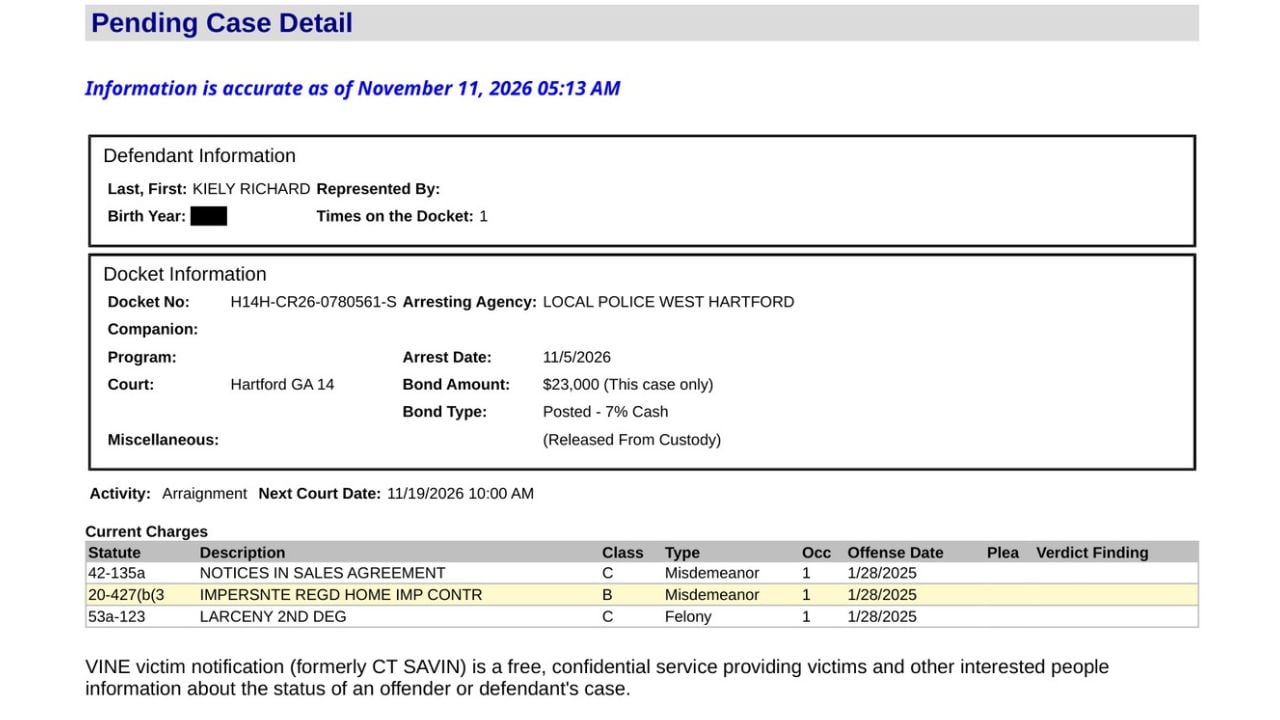
The court entries list a $23,000 bond in the first case and a $15,000 bond in the second. Both describe the bond type as “Posted – 7% Cash” and list Kiely as released from custody in records updated November 11.
Both cases are scheduled for arraignment November 19 at 10 a.m. in Hartford’s GA 14 court. Kiely is presumed innocent unless proven guilty.
Verify Contractor Registration and Tie Payments to Work Progress
The Connecticut Department of Consumer Protection advises homeowners to check a contractor’s name or business in the state’s eLicense database and confirm that the registration is active. The agency also recommends requesting proof of insurance and confirming coverage directly with the insurer.
DCP’s contracting guidance says a written, signed and dated agreement must include the contractor’s registration number, the work and price, start and completion dates, and cancellation notices. Homeowners generally have three business days to cancel; Saturday counts as a business day in Connecticut.
The agency recommends three or four payments tied to construction progress, with the final installment due after satisfactory completion. It says an upfront payment generally should not exceed one-third of the project price and advises against paying cash. Keep receipts, the signed agreement and written changes to the work.
Homeowners with unresolved contractor disputes can file a DCP complaint and include copies of supporting paperwork. Connecticut’s Home Improvement Guaranty Fund may cover up to $25,000 of a qualifying unpaid judgment, but eligibility depends on the contractor’s registration history and other requirements.