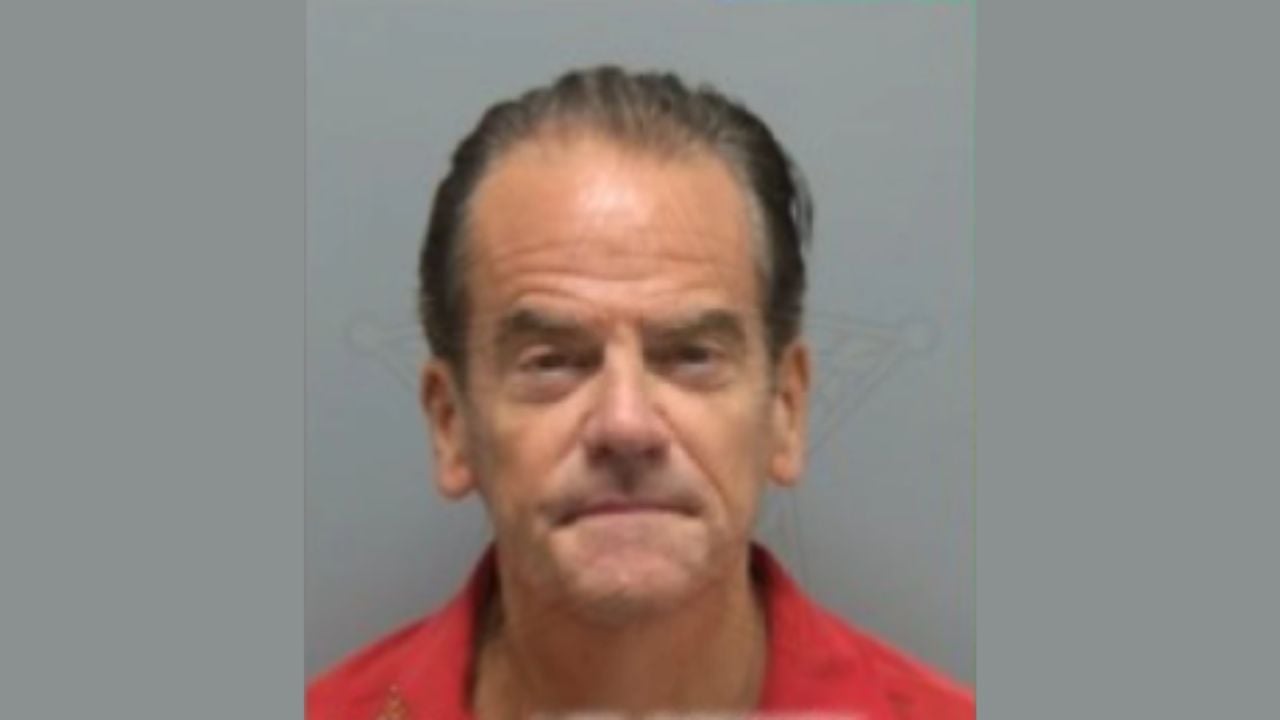
Three Southwest Florida homeowners paid more than $308,000 for cabinets and other work after Hurricane Ian. A police investigation found that some of the money passed through a home-improvement company to a cabinet maker, then into cryptocurrency accounts instead of the materials needed for the jobs.
The customers dealt with Cornerstone Home Solutions, whose owner, Manuel Cajigas, arranged the projects and forwarded payments to Christopher Edward Kane, according to a sworn Fort Myers police affidavit. Investigators said Kane never delivered the cabinets or woodwork the homeowners were expecting.
Kane, 60, of Naples, entered no-contest pleas on Oct. 12, 2026, to money laundering involving more than $100,000 and participating in a scheme to defraud. A Lee County judge adjudicated him guilty and sentenced him to 70 months in prison, followed by 10 years of probation.
Judge Bruce E. Kyle also ordered restitution to three recipients. The award reflects the customers’ original payments, rather than adding together repeated transfers between bank and cryptocurrency accounts.
Three Homeowners Paid Through Cornerstone Home Solutions
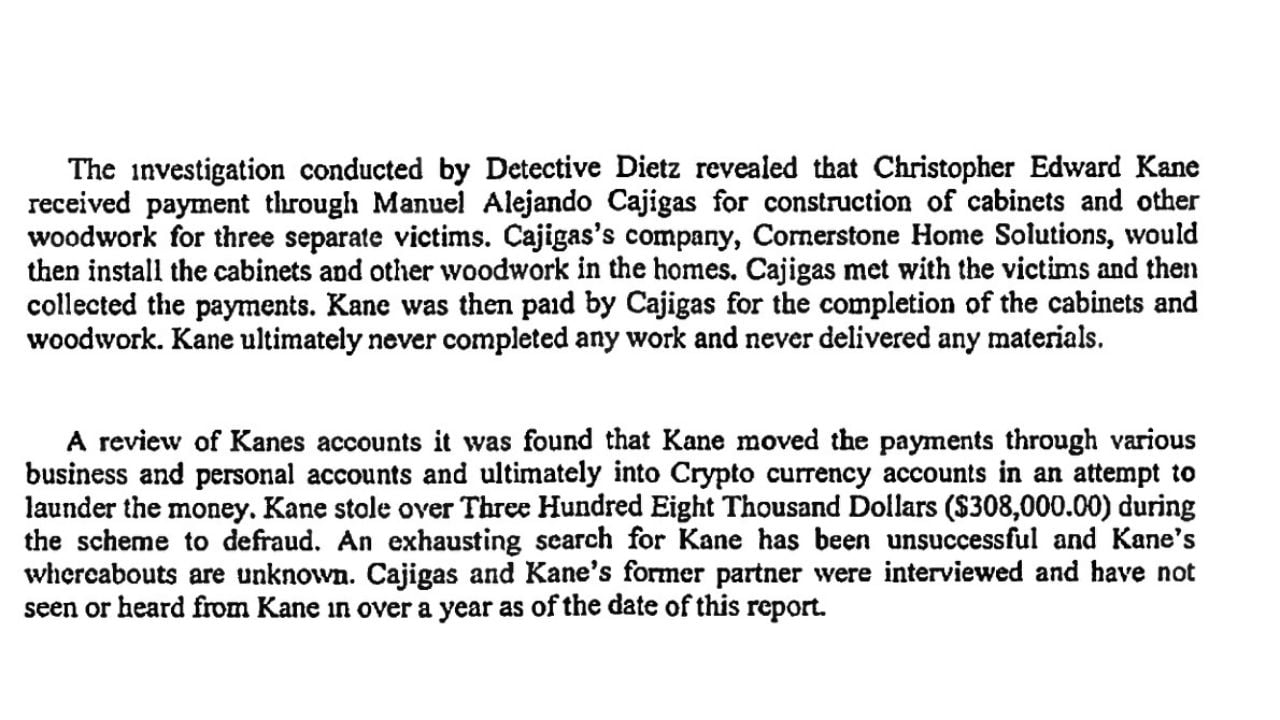
The projects began in early 2023, as residents of Lee County repaired hurricane damage. Cajigas met with customers, collected payments through Cornerstone Home Solutions and arranged for Kane to produce cabinetry and other woodwork. Cornerstone was to handle installation, according to an affidavit excerpt from Fort Myers Detective David Dietz.
The records describe three projects involving new cabinetry, countertops, flooring or framing. One customer later ordered and paid for additional work. Cajigas transferred portions of the money to Kane, including payments into an account held by Benjamin Franklin LLC, which the affidavit identifies as Kane’s business.
The homeowners did not receive the promised materials. A former workshop subcontractor told detectives that work on the three projects had not been completed and materials had not been purchased. Cajigas also told investigators that Kane had delayed deliveries and that he sought a refund after customers began demanding answers.
An $85,000 Cabinet Payment Went Through Coinbase and Crypto.com
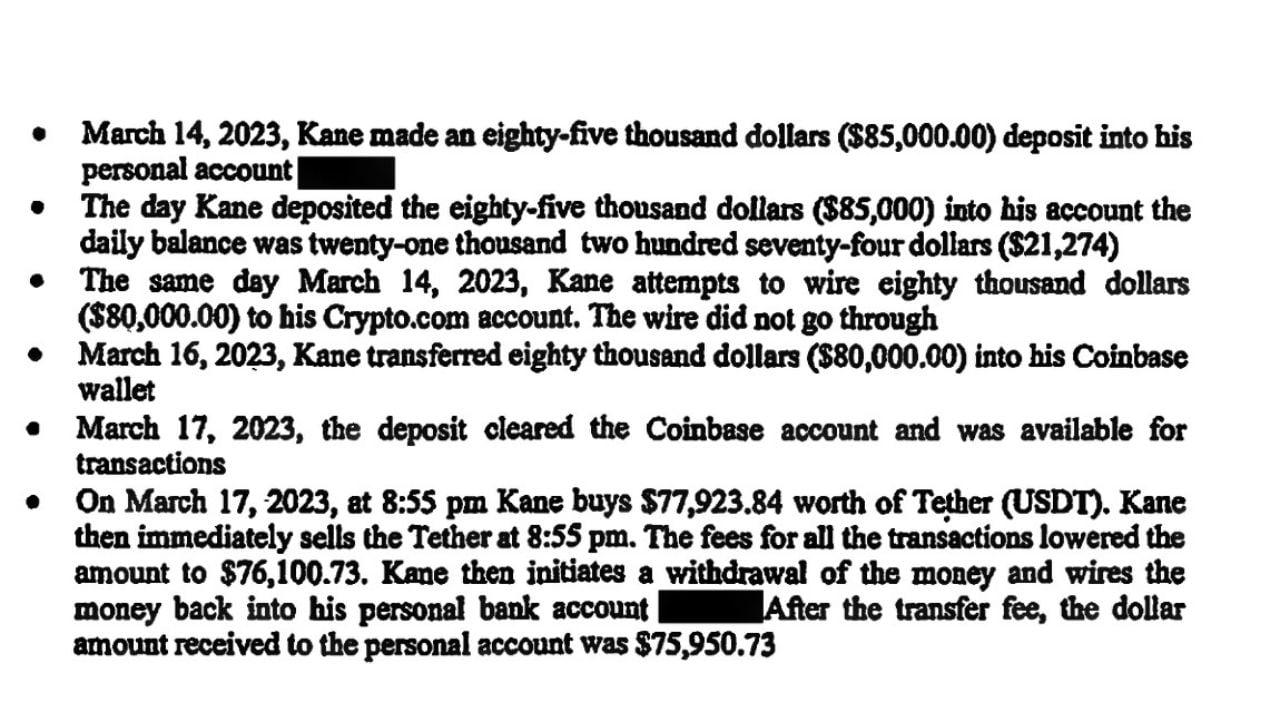
For the $85,000 project, the homeowner wrote a check to Cornerstone on March 2, 2023. The detective’s review of bank records traced that amount to Kane’s personal account on March 14, according to the affidavit. Kane then attempted to wire $80,000 to Crypto.com, but the transaction did not go through.
On March 16, Kane transferred $80,000 to a Coinbase wallet. The following evening, he bought $77,923.84 in Tether, a cryptocurrency also known as USDT, before quickly selling it. After fees and withdrawals, the affidavit records $75,950.73 returning to his personal bank account.
On March 20, investigators identified another $78,000 wire to Crypto.com. The affidavit describes further movements of cryptocurrency through multiple blockchain addresses. These figures trace successive movements of funds and should not be added together as separate homeowner losses.
Other Homeowner Payments Followed Similar Financial Routes
Bank records in the affidavit also trace money from the homeowner who made two payments. After Cornerstone received the initial $100,000, Cajigas sent $90,000 to Kane’s Benjamin Franklin LLC account in January. The next day, investigators recorded a $78,000 transfer through Kane’s personal account to Crypto.com. Following the customer’s later payment for upgrades, another $30,000 was sent toward that exchange in March.
The third project involved a $93,150.76 cashier’s check delivered to Cornerstone. Investigators identified a $79,702 check from Cornerstone to Kane’s business marked for that project. On Feb. 22, 2023, $70,000 moved from the business account to Kane’s personal account and then to Crypto.com, according to the bank-record summary.
Detectives obtained customer statements, payment documents and financial records to reconstruct the transfers. The State Attorney’s Office later said Kane used the repair money for cryptocurrency purchases, whose value subsequently declined, without supplying the promised cabinet materials.
Refund Demands Led to a Criminal Case and an Interstate Arrest
Fort Myers police began receiving complaints in 2023. Detective Dietz interviewed the homeowners and people involved in arranging or manufacturing the projects, and reviewed account records that prosecutors said were obtained as part of the investigation. The affidavit also documents failed attempts to locate Kane after customers and business contacts lost touch with him.
A February 2025 charging document was filed in Lee County Circuit Court. Earlier WBBH reporting said investigators located Kane in Pennsylvania before his return to Florida. A Lee County warrant was served on Sept. 27, 2025, according to the later arrest paperwork. After a missed court appearance later that year, Southwest Florida Crime Stoppers publicized the case in January 2026, according to WBBH.
Kane Entered No-Contest Pleas and Received 70 Months in Prison
The February 2025 Information filed in Lee County case 25-CF-000132 charged Kane with two first-degree felonies: money laundering involving more than $100,000 and a scheme to defraud involving property valued at $50,000 or more. Earlier investigative and booking paperwork listed additional proposed or initial offenses, but those were not the two counts set out in the operative Information.
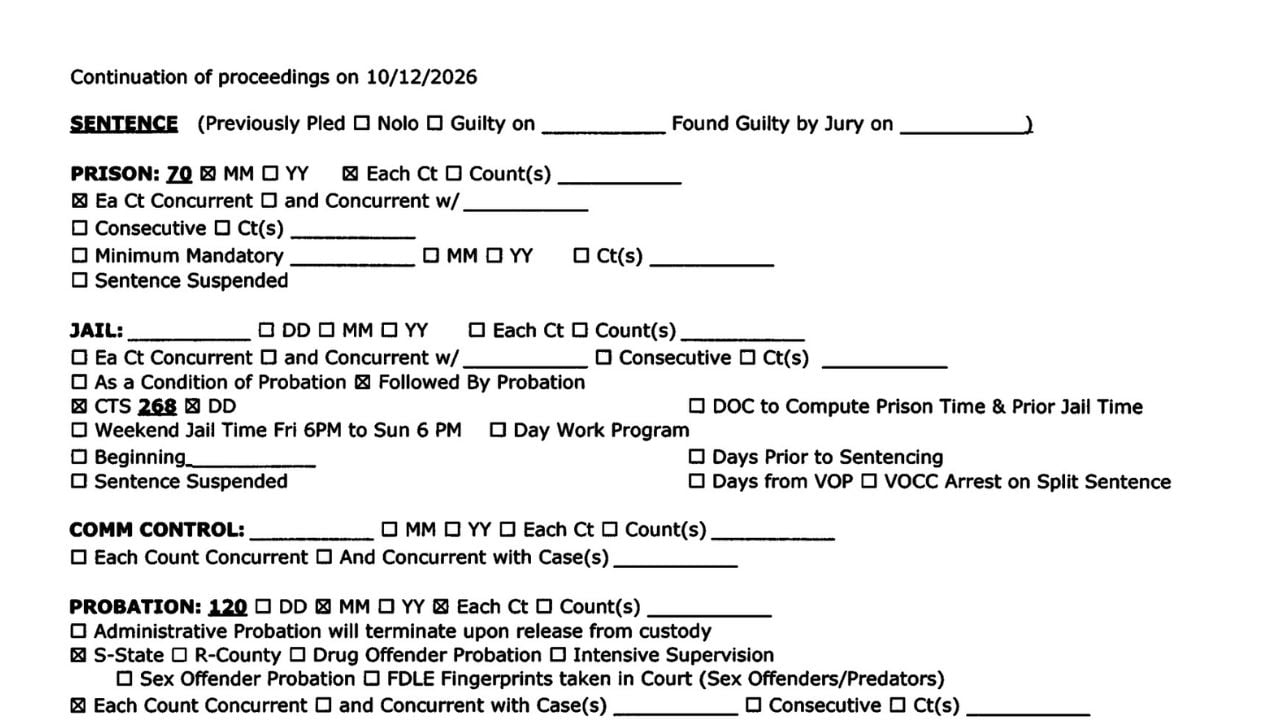
At an Oct. 12, 2026 proceeding before Circuit Judge Bruce E. Kyle, Kane entered pleas of nolo contendere, or no contest, to both counts as charged. The judge adjudicated him guilty. The sentencing minutes record a 70-month prison sentence on each count, to run concurrently, followed by 120 months of probation.
Florida’s money laundering statute covers specified transactions involving proceeds of unlawful activity, including transactions with virtual currency. Its organized fraud law allows amounts obtained through a single scheme to be aggregated in determining the offense level.
Restitution Order Specifies $308,826.76 and Monthly Payments
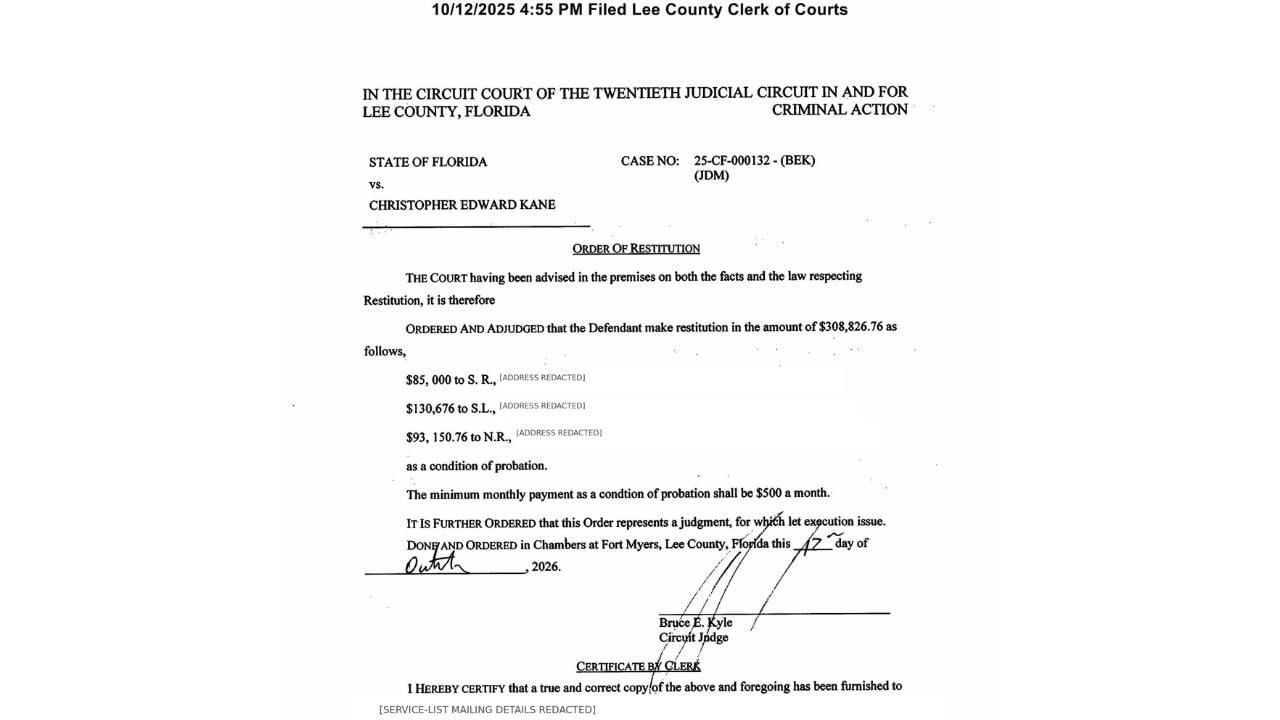
Judge Kyle signed an October 12 restitution order directing Kane to pay $85,000 to one recipient, $130,676 to another and $93,150.76 to a third. Those three obligations total $308,826.76, matching the homeowners’ payments documented in the investigation.
The order sets a minimum restitution payment of $500 per month as a condition of probation. The restitution is a court-ordered financial obligation, distinct from the transfers through cryptocurrency exchanges and from any criminal assessments or fees. Assistant State Attorney J.D. Miller, the 20th Judicial Circuit’s Economic Crime Unit chief, prosecuted the case.
How to Protect Payments for Hurricane Repairs
Homeowners hiring a contractor after storm damage can reduce their exposure by confirming the contracting parties and understanding which business will actually provide materials and labor. The Federal Trade Commission recommends checking references, securing a written scope of work and payment schedule, and avoiding demands for full payment before work begins. Florida homeowners can check applicable state-regulated licenses through the Department of Business and Professional Regulation.
If one company collects payment while another will manufacture or install the materials, identify both parties in the contract and obtain documentation of orders and progress before releasing further payments. Keep copies of contracts, checks, invoices and correspondence. When promised materials do not arrive, contact the payment provider promptly about possible remedies and report suspected fraud to local law enforcement.