
An Iowa credit union employee allegedly transferred $1,028.99 from a living customer’s account after beneficiaries of a deceased member discovered money missing. Investigators say the transaction was part of a broader scheme involving $28,326.28 in suspected theft from seven accounts.
Amanda Nicole Tincher, 38, of Davenport, worked at IH Mississippi Valley Credit Union. Police allege that six affected accounts belonged to members who had died, while the seventh belonged to someone still living. The suspected transactions included cashier’s checks, money orders, Cash App transfers and cash withdrawals.
The investigation began after the credit union reported suspicious activity to Bettendorf police in July. An internal review subsequently uncovered additional accounts, including some whose owners had died years before the disputed transactions occurred.
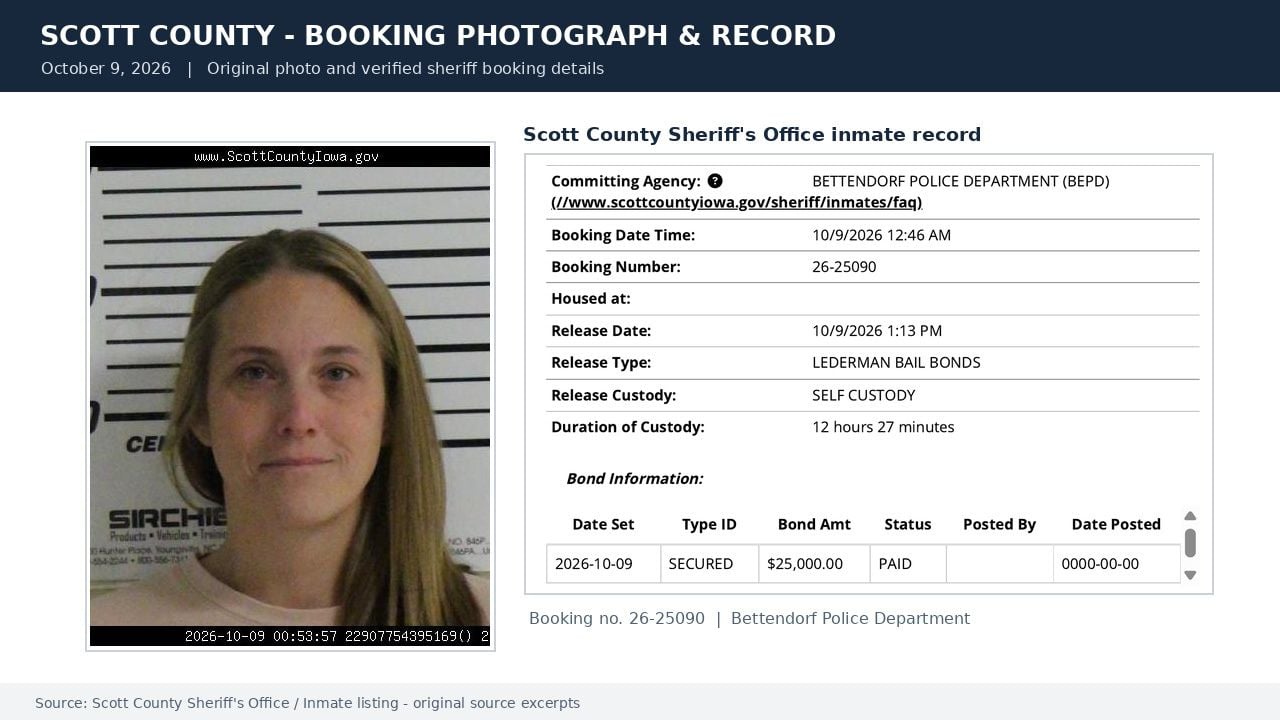
Two Scott County court records now list 15 criminal counts involving theft, fraudulent practice and ongoing criminal conduct. Tincher was booked into the Scott County Jail on Oct. 9, 2026, and released later that day on a $25,000 secured bond. The allegations have not resulted in a conviction.
Credit Union Official Reports $21,279.51 Missing From One Account
On July 2, 2026, the risk and compliance director of IH Mississippi Valley Credit Union contacted Bettendorf police about suspicious transactions involving an account belonging to a deceased member.
According to KWQC, investigators determined that Tincher had allegedly created cashier’s checks payable to herself, transferred funds to a Cash App account registered in her name and made cash withdrawals from the member’s account.
The questioned transactions from that account totaled $21,279.51, making it the largest individual loss identified in the published allegations.
On July 3, a police officer questioned Tincher at the credit union. According to Scott County arrest affidavits cited by local reporters, Tincher responded, “It’s pretty clear what was done,” when asked about the suspicious transactions.
She denied taking money from other accounts, investigators reported. The credit union continued reviewing its records and eventually identified six additional accounts associated with similar activity.
Investigators Trace Withdrawals to Members Who Died Years Earlier
The expanded investigation identified transactions involving account holders who had been deceased for months or years. According to arrest affidavits examined by reporter Linda Cook and published by WHBF, the suspected withdrawals occurred on different dates and involved several payment methods.
On Sept. 30, 2025, Tincher allegedly created a money order for $946.76, less a $4 fee, payable to herself. The account holder had died on Sept. 3, 2024.
Another member had died on Aug. 26, 2022. Investigators alleged that Tincher issued a cashier’s check for $2,517.12 from that person’s account on Feb. 23, 2026, approximately three and a half years after the death.
A separate account belonged to a member who died on Nov. 2, 2025. Police alleged that Tincher withdrew $250 in cash from that account on Feb. 9, 2026.
The affidavits also describe two cash withdrawals totaling $1,279.22 on Jan. 10, 2025, from an account belonging to someone who died in February 2023. These transactions were among the additional irregularities uncovered after the credit union expanded its review beyond the initial complaint.
Living Customer’s Money Allegedly Used to Cover Missing Funds
On Dec. 26, 2025, Tincher allegedly withdrew $728.99 in cash and created a $300 money order payable to herself from an account whose owner had died the previous month. The total associated with those two transactions was $1,028.99.
According to the affidavits summarized by WHBF, the beneficiaries subsequently discovered that money was missing. Investigators alleged that Tincher then transferred $1,028.99 from another member’s account on March 2, 2026, to replace the funds.
Unlike the other account holders identified in the investigation, the member whose money was used for that replacement transfer was still alive.
Iowa Court Records List 15 Theft, Fraud and Criminal Conduct Counts
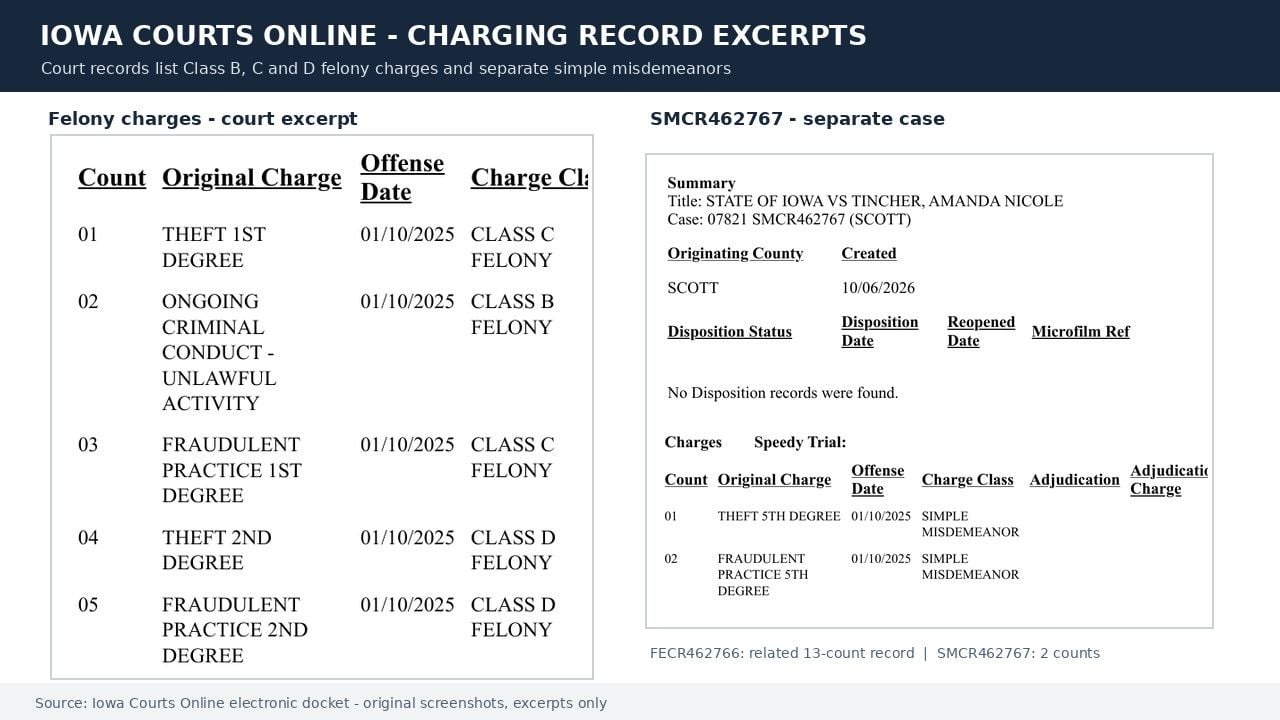
The Iowa Courts Online records identify two Scott County criminal cases associated with Tincher. Case FECR462766 lists 13 counts, while SMCR462767 lists two additional misdemeanor counts.
The felony case includes first-degree theft, a Class C felony, and ongoing criminal conduct involving unlawful activity, a Class B felony. It also lists first-degree fraudulent practice as a Class C felony, along with second-degree theft and second-degree fraudulent practice as Class D felonies.
The remaining eight counts in FECR462766 consist of four third-degree theft charges and four third-degree fraudulent practice charges, all classified as aggravated misdemeanors. The separate SMCR462767 case lists fifth-degree theft and fifth-degree fraudulent practice, both simple misdemeanors.
Under Iowa Code Chapter 714, first-degree theft generally involves property exceeding $10,000 in value and constitutes a Class C felony. Second-degree theft generally involves property exceeding $1,500 but not $10,000 and is classified as a Class D felony. Third-degree theft is ordinarily an aggravated misdemeanor.
Iowa’s ongoing criminal conduct statute establishes separate penalties for specified unlawful activities, including a Class B felony classification for certain violations. The inclusion of that charge does not by itself establish that anyone else participated in Tincher’s alleged conduct.
The misdemeanor docket shows no recorded disposition in the supplied court summary. The listed charges are accusations, and no finding of guilt is established by the documents.
Scott County Jail Confirms Booking, Release and $25,000 Bond
The Scott County Sheriff’s Office inmate record identifies the Bettendorf Police Department as the committing agency and records Tincher’s booking at 12:46 a.m. on Oct. 9, 2026.
The booking was assigned number 26-25090. The jail record shows that Tincher was released at 1:13 p.m. the same day, with Lederman Bail Bonds listed as the release type.
Her secured bond was set at $25,000 and is marked paid in the sheriff’s public record. That entry establishes the recorded bond status, not that she personally deposited the full amount in cash.
WHBF reported that Tincher’s preliminary hearing was scheduled for Oct. 16 in Scott County. The hearing date was reported following her arrest and remains subject to any subsequent court scheduling changes.
How Families Can Check Deceased Relatives’ Credit Union Accounts
When a family member dies, an authorized estate representative or beneficiary should notify the financial institution and determine what documents are needed to establish authority over the deceased person’s accounts. The representative should review available account statements for unfamiliar transactions occurring around or after the death.
Cashier’s checks, money orders, cash withdrawals and transfers to payment services deserve particular attention when the account holder could no longer have personally authorized the transactions.
IH Mississippi Valley Credit Union’s member agreement addresses how account ownership, survivorship rights and beneficiary designations affect the distribution of funds following a member’s death. The procedures may differ depending on whether an account is jointly owned, has a payable-on-death beneficiary or belongs to an estate.
If suspicious activity is discovered, the authorized representative should contact the credit union’s fraud department, preserve statements and supporting documents, and report suspected theft to law enforcement. The Consumer Financial Protection Bureau explains that prompt reporting is important when unauthorized transactions occur, although applicable rights and deadlines depend on the type of transaction and account circumstances.