
White House Press Secretary Karoline Leavitt sat on stage at George Washington University on Thursday night, fielding questions from Turning Point USA CEO Erika Kirk, when she offered a room full of college students a piece of career advice: be the most well-read person in every room you walk into.
It was advice she credited to former Press Secretary Dana Perino, who shared it before Leavitt took the job. And Leavitt told the students she tries to live by it every day. But then she took it a step further.
“Donald Trump always is,” Leavitt said. “That man does not miss a story, let me tell you. He’s always reading the papers and watching the TV. He doesn’t miss anything anyone says in the whole world.”
The event was the kickoff of Turning Point USA’s spring college tour, with Leavitt appearing alongside TPUSA CEO Erika Kirk. And the moment might have passed without much notice — just another night of praise for the president from his press secretary — if not for a rather inconvenient piece of reporting that had surfaced just eight days earlier.
Leavitt: “You always want to be the most well-read person in the room, and I try to be every day. But Donald Trump always is.” pic.twitter.com/HmaduJOjpX
— Aaron Rupar (@atrupar) April 2, 2026
A Two-Minute Montage
Every morning, the sitting president receives what’s known as the Presidential Daily Briefing — a document prepared by the intelligence community that synthesizes the most critical threats and developments facing the country. It is one of the most sensitive intelligence products in the world, and presidents are expected to read it, absorb it, and use it to inform decisions that affect millions of lives.
On March 25, NBC News reported that Trump’s daily update on the war in Iran looks nothing like that. According to three current U.S. officials and one former official, military officials compile a short video montage — typically around two minutes — showing the biggest and most successful American strikes on Iranian targets from the previous 48 hours. One official described the videos to NBC as clips of “stuff blowing up.”
Trump also receives updates through conversations with advisers. But officials told NBC the curated footage has raised concerns that the president may not be absorbing the full picture of a conflict now well into its second month.
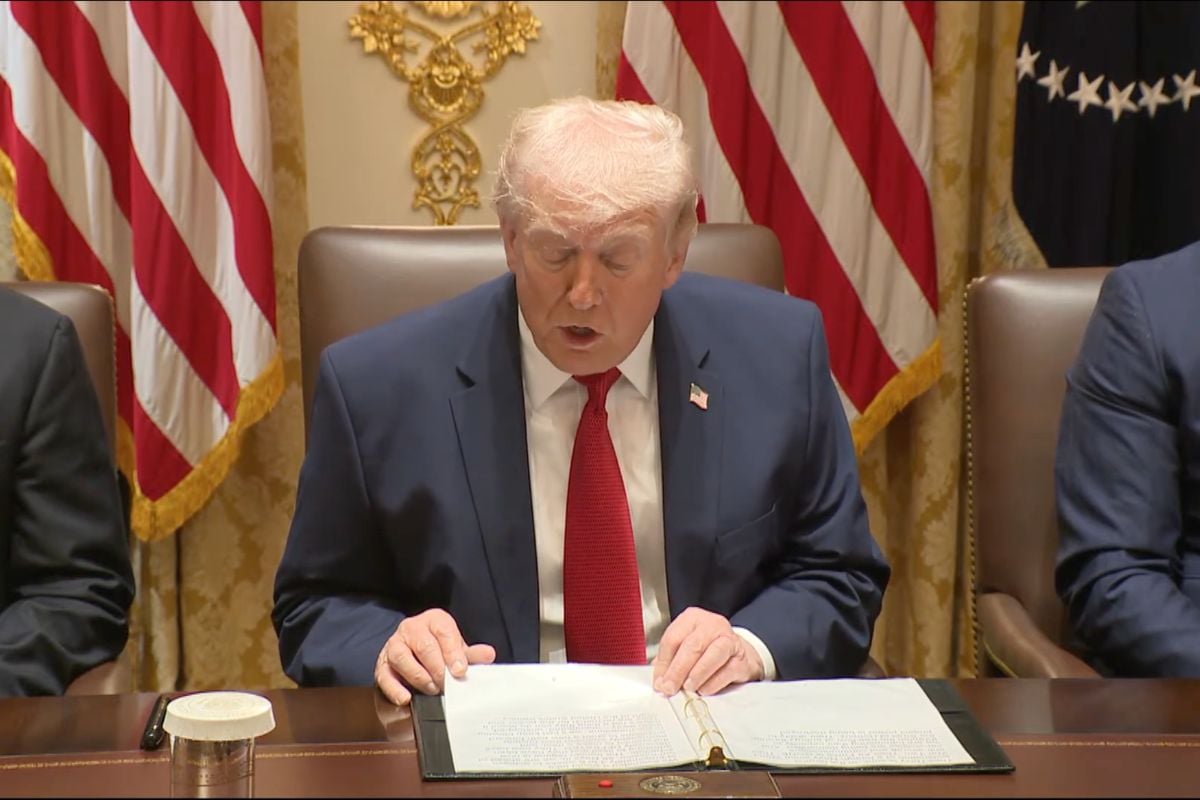
The reporting also revealed that Trump has had to ask his own generals and intelligence officials whether videos he’s encountered online are real or generated by artificial intelligence. He told attendees at a Kennedy Center lunch that he’d called a top military general after seeing footage of the USS Abraham Lincoln apparently engulfed in flames. The general assured him the ship was fine and that Iran had fabricated the video.
When NBC sought comment, Leavitt pushed back. “That’s an absolutely false assertion,” she said, adding that Trump “actively seeks and solicits the opinions of everyone in the room.”
A Pattern That Predates the War
@jamellebouieMarch 26, 2026. tl;dw: According to a recent NBC News report, President Trump isn’t receiving actual briefs on the ongoing war with Iran — instead, aides give him a two-minute daily video of airstrikes and destroyed Iranian assets. Here’s why that matters, beyond the fact that the president is clearly illiterate.♬ original sound – b-boy bouiebaisse
None of this arrived in a vacuum. During Trump’s first term, multiple outlets documented how he struggled with the Presidential Daily Briefing and how aides adapted it to hold his attention — shortening it, adding visual aids, and simplifying the language. In one of the most scrutinized moments of that era, intelligence about alleged Russian bounties on American troops in Afghanistan appeared in his written briefing. The White House said he was never briefed on it.
New York Times columnist Jamelle Bouie was among those who connected the first-term pattern to the current reporting. In a video posted to social media, Bouie argued that Trump’s resistance to reading has only deepened — a wartime president whose primary daily update on a major military operation is a two-minute highlight reel designed to showcase American successes.
‘Check Other Sources’
Perhaps the most striking part of Leavitt’s GWU appearance wasn’t the claim about Trump’s reading habits. It was what came right after it.
After praising the president as the most informed person in any room, Leavitt pivoted to advising the students on media literacy. Before getting worked up about a story, she told them, they should check other sources and use their best judgment to figure out where the truth actually lies.
“And unfortunately,” she said, “that’s just the way it has to be done.”
She may not have intended the advice to apply to her own remarks. But for anyone who’d read the NBC report from the week before, it was hard not to notice that it did.