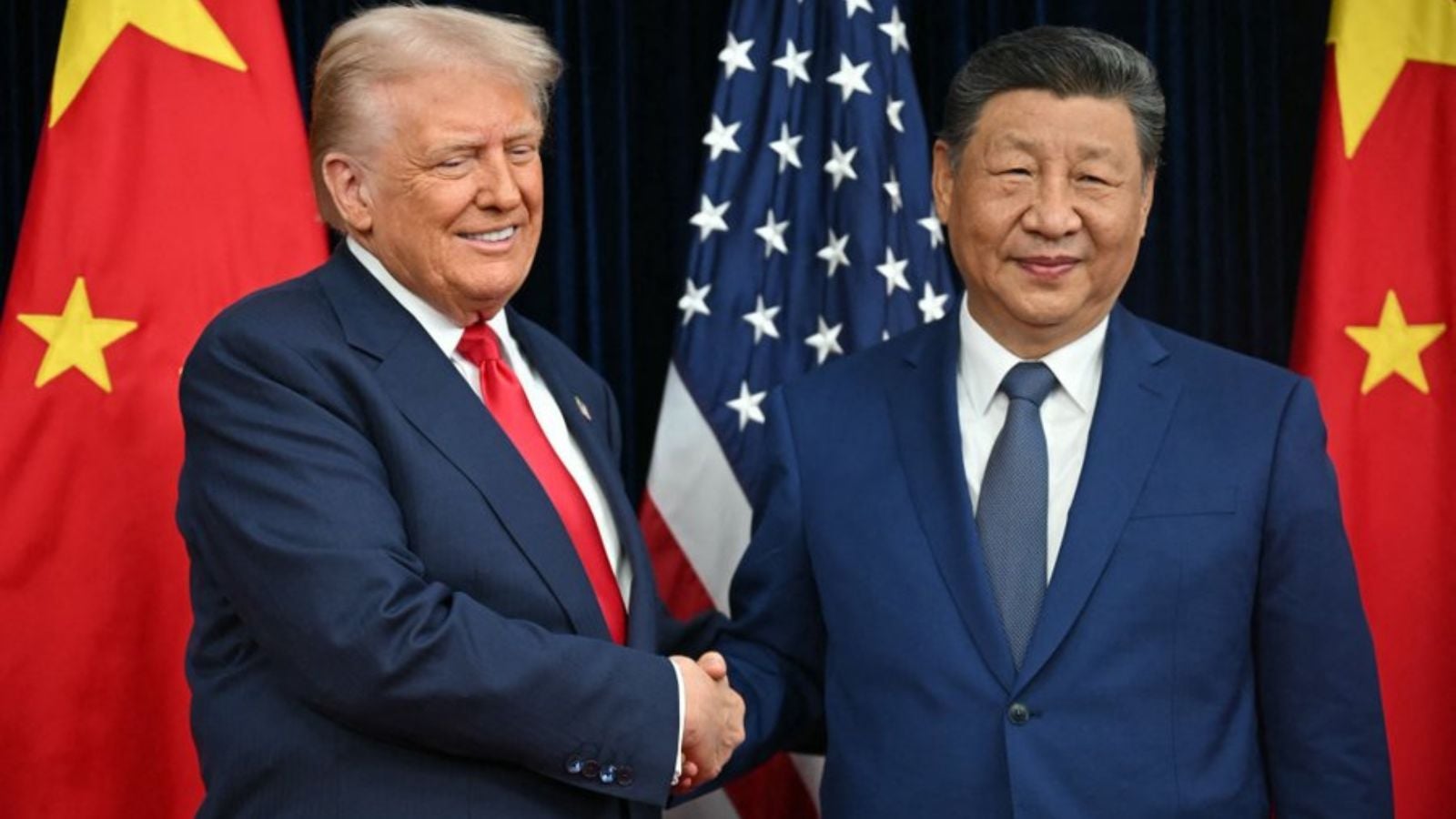
Chinese President Xi Jinping is sending a message that goes far beyond diplomacy after publicly emphasizing cooperation, stability, and partnership with President Donald Trump during remarks that are now drawing global attention.
Speaking both directly to Trump and at a broader conference discussing China-U.S. relations, Xi framed the relationship between the world’s two largest powers as one of the defining issues of the modern era.
“A stable bilateral relationship is good for the world,” Xi said.
He added that China and the United States “both stand to gain from cooperation and lose from confrontation,” while urging both nations to become “partners, not rivals.”
On the surface, the language sounded diplomatic and predictable. Beneath it, however, sits a far more important geopolitical reality. Xi’s comments reveal how both Washington and Beijing increasingly understand that open conflict between the two superpowers would carry catastrophic economic, technological, and military consequences not just for themselves, but for the entire global system.
BREAKING: President Xi stuns the room saying to Trump: “We should be partners, not rivals” 🇺🇸 🇨🇳
I NEVER in a million years would have thought Xi would say something like that
The Deep State is shaking right now pic.twitter.com/tBIfUAPCMG
— MAGA Voice (@MAGAVoice) May 14, 2026
Xi’s Language Reflects Strategic Calculation, Not Just Diplomacy
Xi’s remarks were carefully constructed. Every phrase carried strategic meaning.
When he said China and the United States should “help each other succeed and prosper together,” he was not simply promoting goodwill. He was signaling that Beijing still sees mutual economic dependence as the safest path forward despite years of escalating tensions over trade, artificial intelligence, military expansion, Taiwan, semiconductors, and global influence.
China understands that its economy still relies heavily on access to Western markets, advanced technology, global trade routes, and financial stability. At the same time, the United States remains deeply tied to Chinese manufacturing capacity, supply chains, consumer markets, and debt structures.
That interdependence creates a strange reality where both countries increasingly view each other as strategic competitors while simultaneously remaining economically intertwined in ways that are extremely difficult to unravel.
Xi’s speech appeared designed to reinforce the argument that controlled competition is survivable, but full-scale confrontation is not.
The “Historic Landmark Year” Comment Matters
One of the most revealing parts of Xi’s remarks came when he said he hoped to work with Trump to make 2026 “a historic landmark year” for China-U.S. relations.
That phrase stands out because it suggests Beijing believes a major reset, breakthrough, or restructuring of relations may now be possible under Trump’s leadership.
That may sound surprising given Trump’s history of tariffs, trade wars, and aggressive rhetoric toward China during his first presidency. But international politics often functions less on emotion and more on predictability and leverage.
Beijing may view Trump as confrontational, but also transactional and direct. Chinese leadership has spent years studying Trump’s negotiating style, media behavior, political instincts, and pressure tactics. In some ways, a leader who openly states demands may actually be easier to negotiate with than a system Beijing sees as fragmented or ideologically inconsistent.
Xi’s comments therefore may not represent weakness or surrender. They may reflect an attempt to stabilize relations before tensions spiral into something economically or militarily uncontrollable.
China and the U.S. Are Competing for the Future of Global Leadership
Behind the diplomatic language sits the real issue shaping the 21st century: global dominance.
The United States and China are no longer merely competing economically. They are competing over which political system, technological infrastructure, financial model, and geopolitical order will dominate the coming decades.
Artificial intelligence, semiconductor production, rare earth minerals, military modernization, space technology, cyber capabilities, and global trade influence are all part of the same larger struggle.
That is why Xi’s comments matter.
China does not want direct conflict with the United States while it is still expanding economically and technologically. America, meanwhile, is trying to slow China’s rise without triggering a collapse in global markets or pushing the world toward military escalation.
Both countries are essentially attempting to weaken each other strategically while avoiding outright rupture.
That balancing act is becoming harder every year.
Xi’s Message Also Appears Directed at the Rest of the World
The speech was not only aimed at Trump. It was also aimed at global audiences watching the relationship between Washington and Beijing with growing anxiety.
Many countries now fear being forced to choose between the American and Chinese spheres of influence economically, militarily, and technologically. Xi’s emphasis on partnership and cooperation helps China project the image of a stable global actor rather than an aggressive destabilizing force.
That image matters especially as China continues expanding influence across Africa, Latin America, the Middle East, and parts of Europe through trade, infrastructure investment, energy deals, and technological partnerships.
Beijing wants the world to view China as disciplined, patient, economically essential, and open to coexistence even while strategic competition intensifies.
The Real Test Will Come After the Speeches End
Diplomatic language is easy. Structural rivalry is much harder to manage.
The United States and China remain deeply divided on Taiwan, military expansion in the Indo-Pacific, trade restrictions, intellectual property disputes, artificial intelligence competition, cybersecurity accusations, and control over next-generation technologies.
Those tensions did not disappear because Xi used cooperative language.
At the same time, global markets, multinational corporations, and allied governments desperately want stability between Washington and Beijing because the economic consequences of serious escalation would likely affect nearly every country on Earth.
That is why speeches like this matter. They offer clues about how both powers are attempting to manage a rivalry that neither side can fully escape and neither side can fully afford to lose.
If the world’s two most powerful nations increasingly see each other as both indispensable partners and existential competitors at the same time, how long can that balance realistically hold?