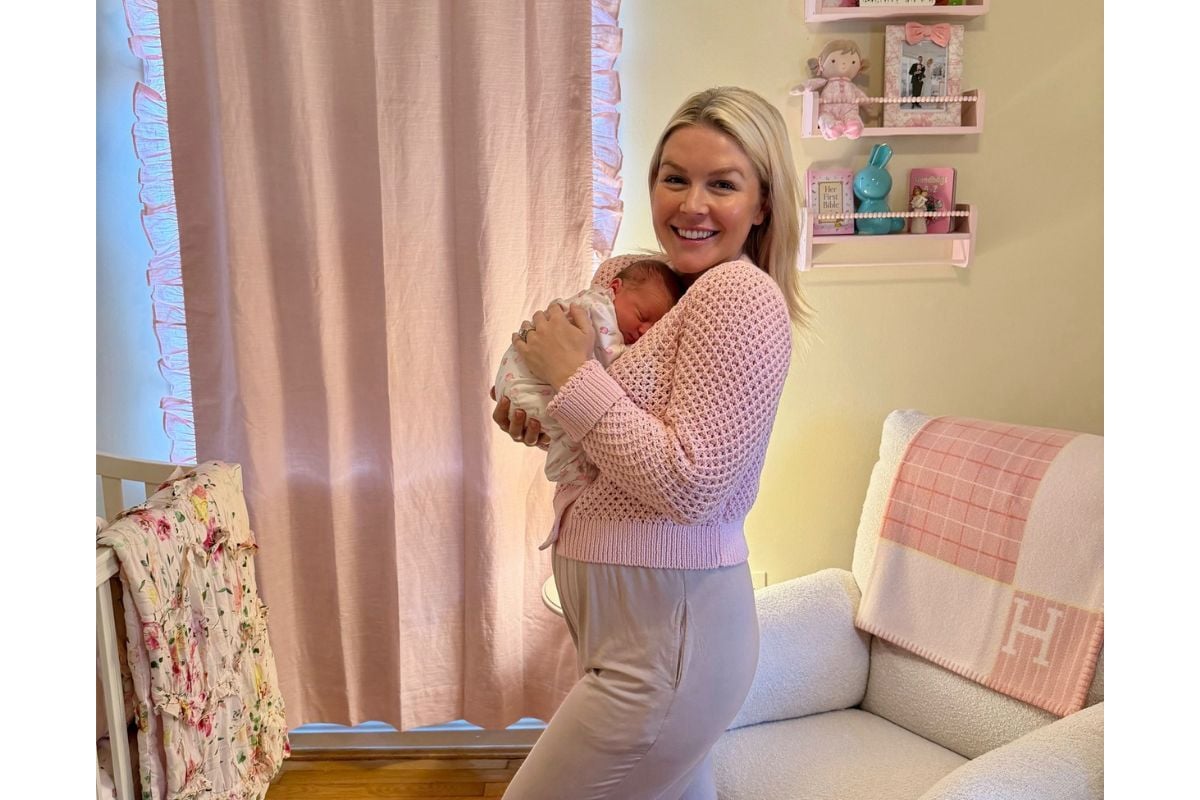
White House press secretary Karoline Leavitt welcomed her second child, a daughter named Viviana, on May 1. She shared the news six days later with a photograph that has since drawn 14 million views.
In the photo, Leavitt holds her newborn in a nursery that looks like it was pulled from an editorial spread. Everything is pink. The curtains are ruffled and floor-length. Custom wall shelving displays a curated collection: a plush doll, a blue bunny sculpture, a framed photo, and a small stack of first books. Among them: Her First Bible by Melody Carlson, a Washington DC, ABC book, and Handbags A to Z by Little Fancy Books, a board book that teaches babies the alphabet through designer purses. C is for Chanel. H is for Hermès. L is for Louis Vuitton.
In the corner, a glider chair sits beneath a casually draped blanket. It has been identified by multiple outlets as the Hermès Avalon Cabriole throw in pink plaid. It retails for $1,375.
“We are enjoying every moment in our blissful newborn bubble,” Leavitt wrote. “God is Good.”
It is a beautiful room. It is also a room that exists on a different planet than the one most American mothers inhabit.
What $1,375 Means Somewhere Else
The price of that single blanket would cover sixteen months of diapers and wipes for a newborn. It would pay for six months of infant formula. It would cover two full months of daycare in Mississippi, or three weeks in Washington, D.C., where infant care now runs $2,020 a month.
For a mother on Medicaid delivering her baby in a rural hospital, $1,375 could be the difference between making rent the month she gives birth and not making it.
These are not hypothetical women. For the majority of American families, the arrival of a child does not come wrapped in Hermès. It comes wrapped in math. Pregnancy, childbirth, and postpartum care now average over $20,000. Even with coverage, families pay $2,700 to $5,000 out of pocket. For the one in ten babies who arrive premature, the bill can exceed $144,000.
Across the first five years, annual costs average nearly $30,000. That number assumes everything goes smoothly.
Things frequently do not go smoothly.
The Leave She Has and the Leave They Don’t
While Leavitt recovers and bonds with Viviana, her White House briefings are being handled by Cabinet secretaries. Secretary of State Marco Rubio stepped in this week. One official called him “a natural.”
She has not announced a return date. There is no public pressure to rush. She is being given exactly what every new mother should have: time.
Most American mothers do not get it. One in four is back at work within two weeks of giving birth. Not because they want to be, but because the country they live in has decided that their recovery is their own problem to finance. Only 27% of private-sector workers have access to paid family leave. For the lowest-paid workers, the ones stocking shelves and cleaning rooms and answering phones, the number drops to 6%.
The United States has no national paid maternity leave, one of only a handful of countries on Earth in that position. The Family and Medical Leave Act guarantees 12 weeks unpaid, but only for employees at companies with 50 or more workers. Nearly half the workforce doesn’t qualify.
When Leavitt announced her pregnancy last Christmas, she thanked President Trump for “fostering a pro-family environment in the White House.” She called motherhood “the closest thing to Heaven on Earth.”
No federal paid leave legislation has advanced under this administration. A bipartisan bill to eliminate out-of-pocket childbirth costs was introduced last year. It has gone nowhere.
What the Photograph Cannot Say
⛔️The Trump administration has secretly eviscerated half of the Affordable Care Act without ever admitting it.
⛔️By slashing Medicaid, Washington is intentionally forcing millions to drop their life saving coverage.‼️ pic.twitter.com/DVrhh3YqKx
— Dr.Sam Youssef Ph.D.,Ph.D.,DPT. (@drhossamsamy65) May 7, 2026
There is nothing wrong with a beautiful nursery, or with a mother who can afford nice things buying them for her child. Karoline Leavitt did not create the cost of American motherhood, and her blanket is not the reason a woman in Topeka is Googling whether she can go back to waitressing nine days after a C-section.
But photographs from people in power carry a frequency beyond what they intend. When the woman who speaks on behalf of an administration shares a snapshot of new motherhood, the image becomes a statement about what motherhood in America looks like. For millions of women watching from kitchens and break rooms and hospital beds, the distance between that nursery and their own reality is not a matter of taste. It is a matter of policy.
Outside that room, the country Leavitt speaks for is asking new mothers to return to work before their bodies have healed, to pay childcare costs that consume a fifth of their income, and to do it all inside a system that calls itself pro-family while offering no paid leave, no cost relief, and no plan to change either.
Leavitt called it a blissful newborn bubble.
For 3.6 million American families welcoming babies this year, the bubble looks nothing like that.