
A South Florida Nordstrom Rack employee allegedly issued herself $444.89 in refunds for four purchases without returning the merchandise, according to a Boca Raton police affidavit. The transactions, involving less than $500 altogether, resulted in a third-degree felony charge.
Oksana Gennadyevna Kurilova, 49, of Lantana, was arrested on Oct. 14, 2026, following an internal investigation at the retailer’s University Commons store on West Glades Road in Boca Raton.
Store loss prevention reviewed register records and surveillance footage before involving police.
Palm Beach County court records show one organized-fraud charge filed Oct. 15 under case 50-2026-CF-007775-AXXX-MB. The case was listed as open in the records printed Oct. 18.
Four Purchases Were Refunded Between September and October
The affidavit lists a $260.80 purchase made Aug. 29, followed by a refund Sept. 5. Another purchase totaling $111.73 on Sept. 16 was refunded Sept. 22. A $21.27 transaction from Sept. 17 was also refunded on Sept. 22.
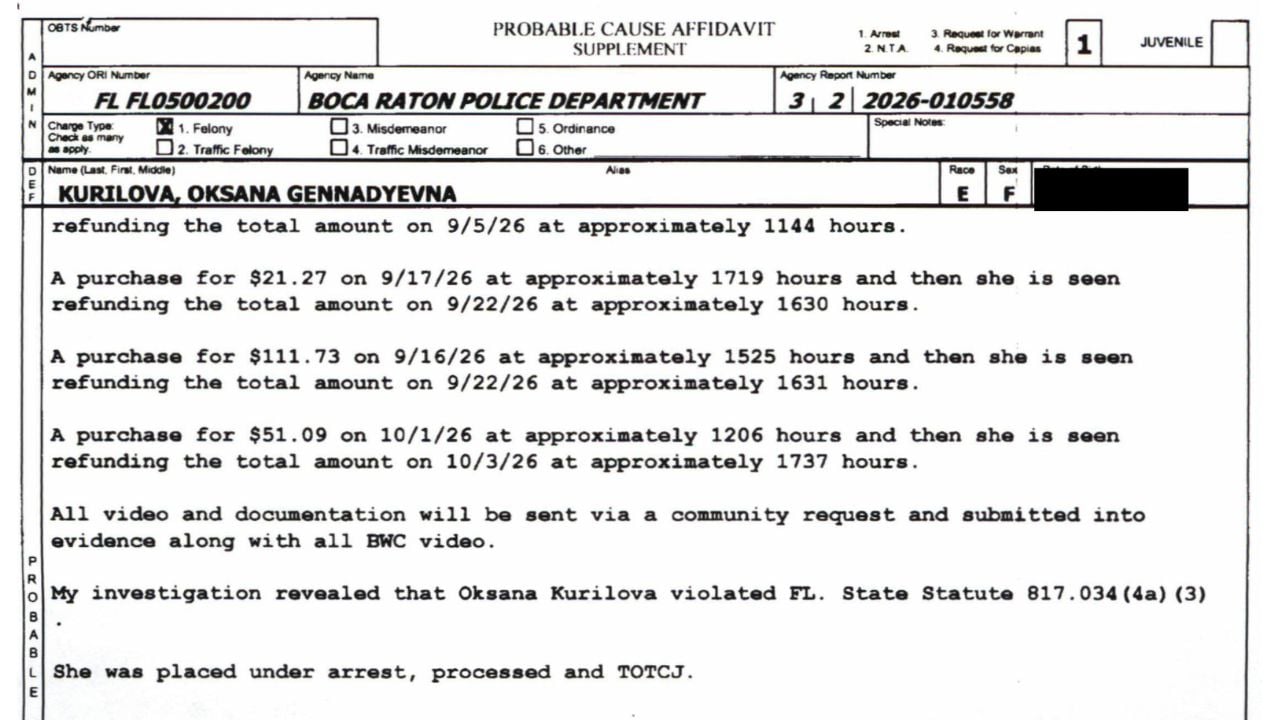
According to the officer’s record of store video, the two Sept. 22 refunds were processed at approximately 4:30 p.m. and 4:31 p.m., one minute apart. The final purchase, for $51.09 on Oct. 1, was refunded Oct. 3. The gap between purchase and refund ranged from two to seven days.
A White Purse Appeared in the Store’s Investigation
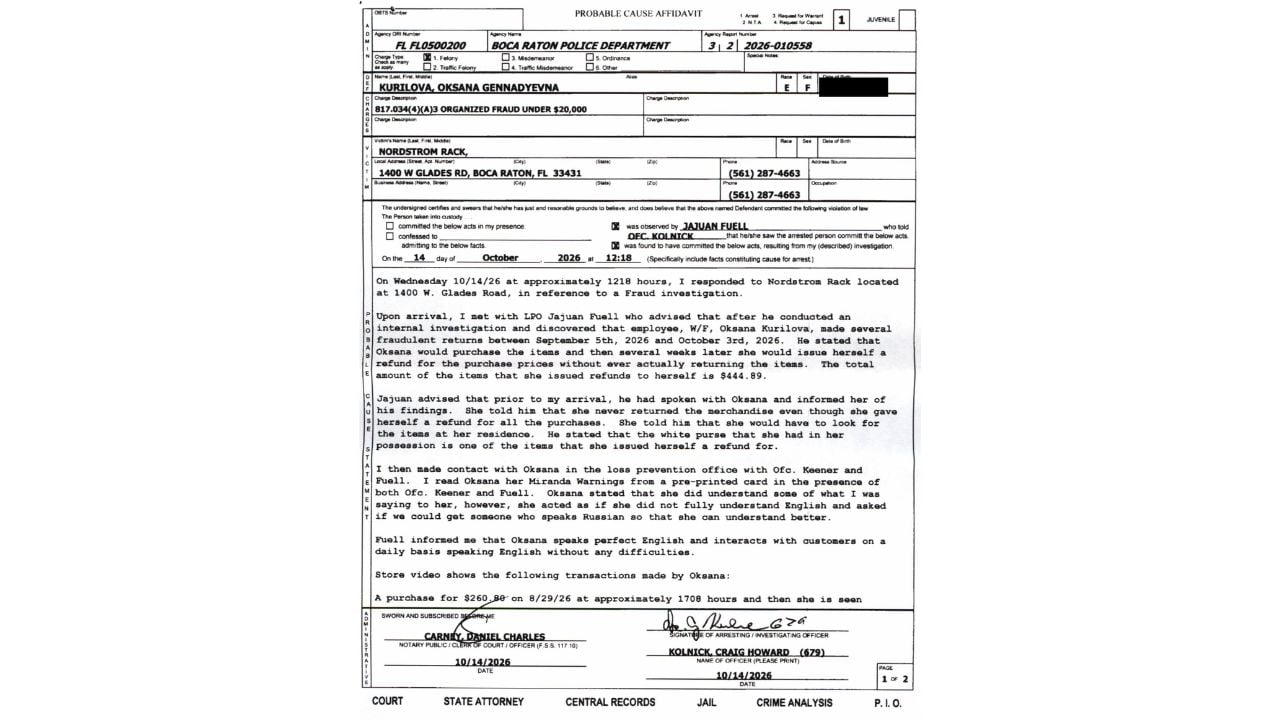
According to Boca Raton Officer Craig Howard Kolnick’s probable-cause affidavit, the store’s loss prevention officer confronted Kurilova about the questioned refunds. The investigator told police that Kurilova said she had not returned the merchandise and suggested he look for the items at her residence. He also identified a white purse in her possession as one of the items for which she had allegedly refunded herself.
Why Less Than $500 in Refunds Can Lead to a Felony
The court’s eCaseView record lists one charge under Florida Statute 817.034(4)(a)3, organized fraud involving less than $20,000. The arrest-and-bond record lists a $5,000 bond, while the docket includes an Oct. 15 entry marked “Defendant Bonded.”
Under Florida’s Communications Fraud Act, organized fraud involves obtaining property through a scheme to defraud. Values from separate transactions within the same scheme may be combined, and a scheme involving less than $20,000 is a third-degree felony. The term “organized” does not require more than one alleged participant.
Florida generally sets the ordinary third-degree grand-theft threshold at $750, but organized fraud is a separate offense with different elements. A third-degree felony ordinarily carries a maximum five-year prison term and a possible fine of up to $5,000. Those are statutory limits, not a predicted sentence. Kurilova is presumed innocent unless proven guilty.
Nordstrom Rack Requires Merchandise for a Refund
Nordstrom Rack’s published return policy generally gives customers 40 days to bring eligible store purchases back to a Nordstrom Rack or Nordstrom location. Returns must satisfy conditions covering receipts, original tags or packaging, and the item’s condition. Eligible refunds ordinarily go to the original payment method.
How Stores Can Check Whether Refunded Items Came Back
The National Retail Federation recommends verifying returned items and using transaction-pattern reviews to identify activity requiring closer examination. For a case involving an employee’s own purchases, a retailer can compare the original sale, refund record, item physically received and the worker who processed the credit.
Stores can also require a second employee to approve refunds on staff purchases and preserve relevant receipts, transaction logs and surveillance when a discrepancy arises. Those records can help distinguish legitimate returns from credits that were processed without the merchandise being brought back.