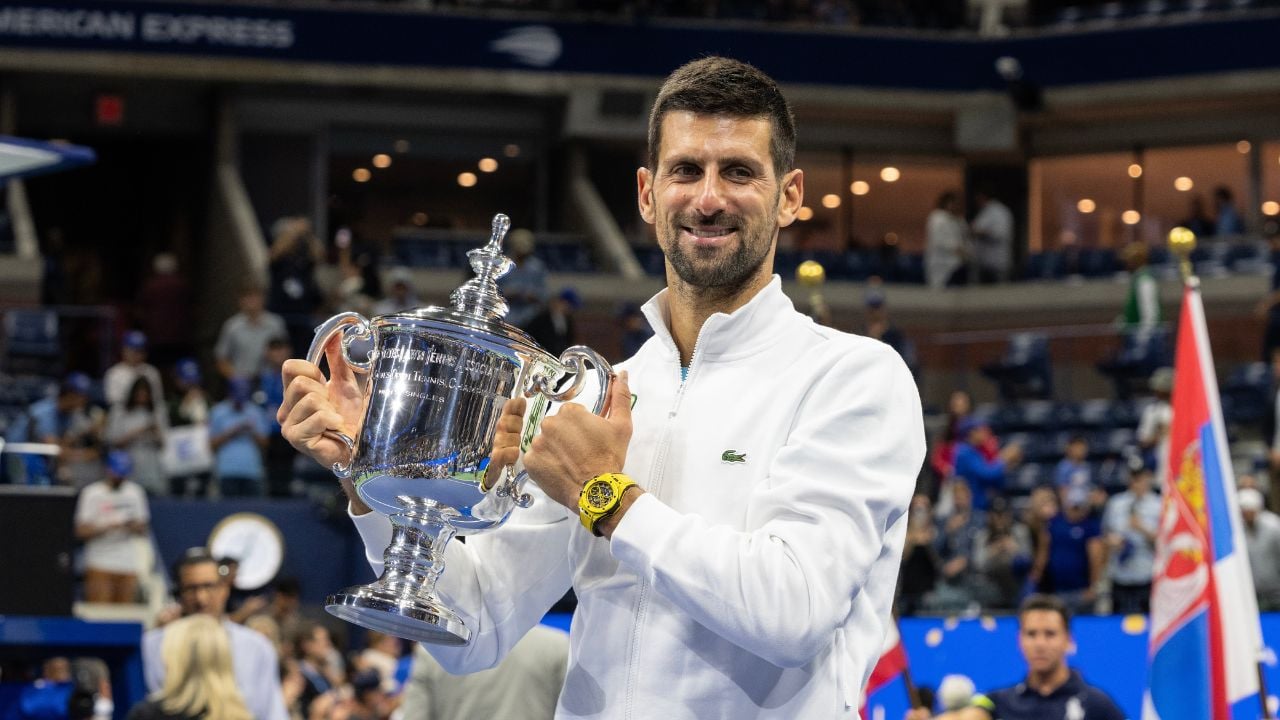
Novak Djokovic is still competing for the biggest prizes in tennis, but the decisions shaping the final stretch of his career increasingly extend beyond what happens on court. At 39, the 24-time Grand Slam champion says time with his wife and children now weighs heavily when he decides how long and how often he wants to compete.
Ahead of the release of his new Prime Video documentary, Novak Djokovic: The Wolf in Winter, Djokovic told PEOPLE that he does not want his legacy reduced to trophies and highlight reels. His family, particularly wife Jelena and children Stefan and Tara, occupies a large part of the story he wants audiences to see.
He is also speaking more openly about the finish line. Djokovic still hopes to compete at the 2028 Olympic Games in Los Angeles, when he would be 41, and has previously described those Games as the ending he would like for his professional career. His latest comments retain an important qualification: “We’ll see.”
In the documentary, Djokovic is looking back at a career that includes 24 Grand Slam singles titles, a record 428 weeks at world No. 1 and an Olympic gold medal without presenting it as a completed story. Prime Video will release the film worldwide on Aug. 20.
The Documentary Goes Beyond Djokovic’s Records
View this post on Instagram
Prime Video says The Wolf in Winter includes behind-the-scenes access to Djokovic at major tournaments, during training and in quieter moments at home with his family.
Jelena appears in the documentary alongside Rafael Nadal, Andre Agassi, Pete Sampras, Boris Becker, Jim Courier and other figures connected to Djokovic’s career. Jason Hehir, who directed The Last Dance, directed the feature-length film. For Djokovic, the family story begins long before his own marriage and children.
He told PEOPLE that growing up amid war and economic hardship in Serbia forced him to mature early while his parents made enormous sacrifices to support his tennis ambitions. After reaching the top of the sport, he said he wanted to repay those sacrifices with more than money. His goal was also to make his parents feel safe, happy and proud.
His own experience of parenthood later altered the way he understood the demands of his career. Djokovic said the 18 months after Stefan was born in October 2014 were arguably the most successful stretch of his career, and he experienced another boost after Tara’s birth in September 2017.
Those successes came with a cost he now considers more carefully. Djokovic acknowledged that maintaining a full tour schedule meant long absences from his children and credited Jelena with supporting the family while he traveled. He said missing parts of his children’s lives still hurts him.
Family Is Now Part of the Retirement Calculation
Djokovic made that point especially clear when PEOPLE asked whether he could imagine continuing into his mid-40s. For him, the answer is no longer determined solely by whether his body remains capable of competing. “It doesn’t depend only on the body,” Djokovic said. “I don’t want to be missing out on different events of close family members.”
He acknowledged that reaching the highest level in an individual sport requires a degree of selfishness because family members repeatedly organize their lives around the athlete’s ambitions.
Paris 2024 Is the Moment Djokovic Places Above Almost Everything Else
Among all of the milestones revisited as the documentary arrives, Djokovic has singled out his Olympic gold medal in Paris as perhaps the most meaningful achievement of his life and career. He defeated Carlos Alcaraz 7-6, 7-6 in the 2024 final at Roland Garros to win the Olympic singles title that had remained missing from his résumé.
The family element is central to how he remembers it. Jelena, Stefan and Tara were there to watch the victory and celebrate with him before Djokovic returned to Serbia carrying his country’s flag.
In a new interview published as The Wolf in Winter approaches its release, Djokovic called Paris “probably the most important moment of my life and of my career.” He emphasized not only winning the medal but having his wife and children there to experience it with him.
Los Angeles 2028 Is His Preferred Finish Line, Not a Guarantee
Earlier in 2026, he described his ideal ending as retiring at the Los Angeles Olympics with the Serbian flag in his hands. At the same time, he acknowledged that circumstances beyond his control make it impossible to guarantee that plan years in advance.
His latest comments maintain the same balance. In an interview reported on Aug. 17, Djokovic said he has stated repeatedly that he wants to reach the 2028 Games and believes he can do it. “I think I can achieve it,” he said. “We’ll see.”
He then linked that ambition directly to his reduced schedule, explaining that he competes in far fewer tournaments than during most of the previous 20 years because he also wants more time with his family. Staying healthy and competitive until 41 remains part of the challenge.
He also told PEOPLE that he may eventually stop competing at the highest level, but he has no intention of truly “hanging up” his racket. Instead, he expects to continue playing for the simplest reason, he still loves the sport.