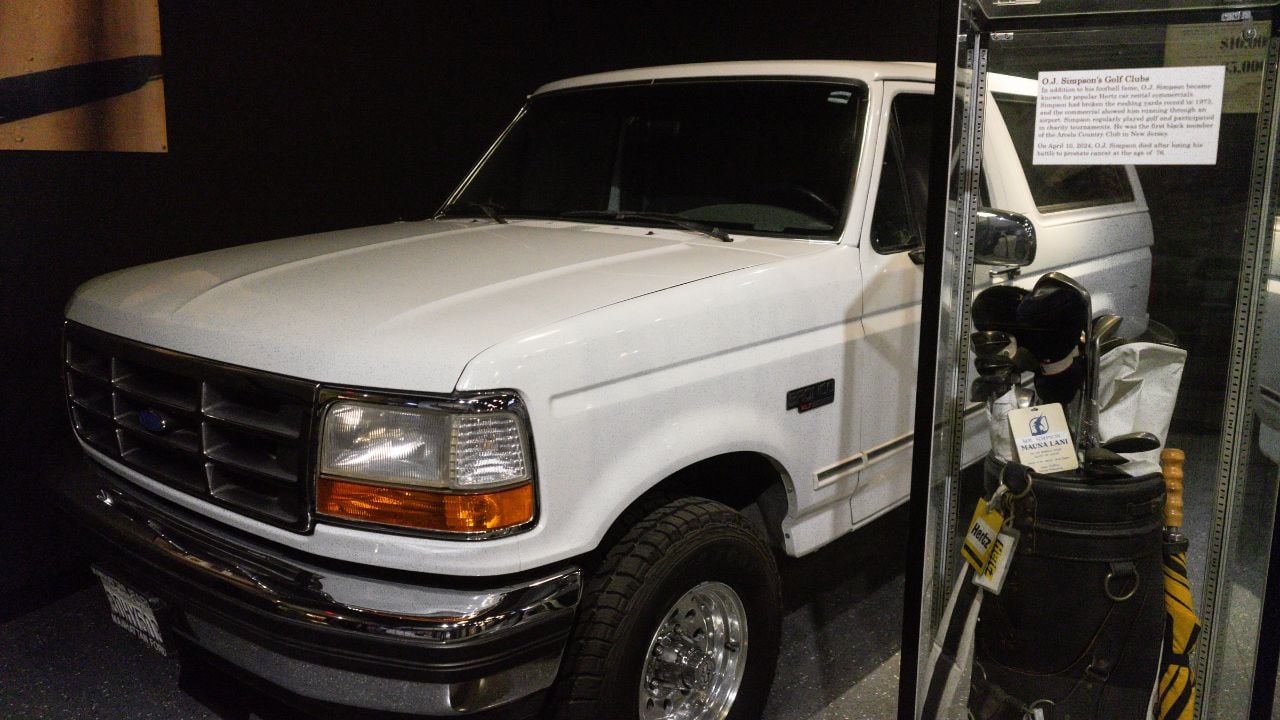
O.J. Simpson stood beside a white Ford Bronco at a used-car lot, signed the vehicle and told a prospective buyer that he was the reason the SUV had become famous.
The scene came from Juiced, Simpson’s largely forgotten hidden-camera prank project, and is back in circulation because of Investigation Discovery’s four-part documentary O.J. Unseen: Exploitation of Evil. A new USA Today report syndicated by AOL examines the production using archival footage and interviews with people who worked on it.
The Bronco gag was especially blunt. Simpson joked about the vehicle’s ability to get someone out of trouble, repeatedly used the word “escapability” and told one shopper, “You know I made this car famous.” The bit deliberately invoked the 1994 police pursuit that became one of the defining images surrounding the murder case against him.
The stunt drew national coverage when Juiced was released on pay-per-view in 2006. What the new documentary adds is access to more than 60 hours of behind-the-scenes footage showing Simpson between takes, interacting with the crew and repeatedly returning to the case that had transformed his public life.
The Bronco Prank Was Built Around the 1994 Chase
The white Bronco used for Juiced was a prop for the prank, not the actual SUV from the 1994 pursuit. Simpson played a salesman and leaned heavily into the association anyway. According to PEOPLE’s account of the footage, Simpson described the Bronco as famous before autographing its driver’s-side door and declaring, “You know I made this car famous.”
Simpson pitched the vehicle’s “escapability,” telling shoppers that if they ever got into trouble and needed to get away, the Bronco could do the job. When one person brought up the possibility of a dead body inside, Simpson replied that he hoped there were “no bodies in this thing.”
The vehicle used in the stunt also had what was presented as a bullet hole. After signing the Bronco, Simpson described it as having an “authentic bullet hole” and joked that his autograph added value.
The real pursuit unfolded on June 17, 1994, after Simpson failed to surrender to authorities. His friend and former Buffalo Bills teammate Al Cowlings drove his own white Ford Bronco through Southern California with Simpson inside as police followed. Simpson surrendered later that night.
Simpson was acquitted in 1995 of murdering his ex-wife Nicole Brown Simpson and Ron Goldman. In 1997, a civil jury found him liable for their wrongful deaths and awarded $33.5 million in damages.
‘Juiced’ Tried to Turn Simpson Back Into an Entertainer
The Bronco was only one part of Juiced. Created during the hidden-camera boom associated with shows such as Punk’d, the project put Simpson into disguises and staged situations with people who did not initially realize they were being pranked.
He delivered pizzas, impersonated Elvis, appeared as an elderly bingo caller and played an aspiring rapper. The payoff generally came when Simpson revealed his identity and told the participant that they had been “juiced.”
Director Rebecca Halpern told USA Today that she came to see the two-week production as a case study in Simpson’s efforts to reclaim his celebrity. She said he appeared to interpret strangers wanting photographs or reacting excitedly to seeing him as evidence that the public still loved and respected him.
The footage becomes more uncomfortable when the finished pranks give way to what happened around them. People interviewed for the documentary describe Simpson becoming overly familiar with some women involved in production, while cameras also captured conversations in which he returned to the murder case and his public image.
‘Juiced’ Actually Reached Viewers in 2006
The project failed to become the mainstream television comeback its creators had envisioned, yet an edited version did reach paying viewers.
A contemporaneous Associated Press report published by CBS News on May 12, 2006, said the hour-long program was airing on pay-per-view. Executive producer Rick Mahr also told the AP at the time that an uncensored DVD version would follow.
The project nevertheless failed to turn into the larger entertainment vehicle its creators had envisioned as controversy and leaks overwhelmed the production.
More Than 60 Hours of Footage Survived the Production
Halpern reviewed more than 60 hours of behind-the-scenes material from the roughly two-week Juiced shoot. The footage includes downtime in cars, conversations between scenes, interactions with participants and moments that never became part of the finished prank program.
Some of the most revealing material involves Simpson talking about the murder case itself. Halpern told USA Today that cameras captured him discussing what he called the “bloody Bronco,” making jokes connected to Nicole Brown Simpson’s killing and talking about details he believed had been misrepresented publicly.
Producer Todd Lewis also describes growing increasingly uncomfortable with Simpson’s behavior toward some of the women participating in the production. In footage highlighted by the documentary, one woman recalls feeling vulnerable after a prank shifted in a direction she had not expected.
Halpern argues that the archive ultimately shows more than a failed celebrity comeback. For her, Juiced captured an early version of an attention economy willing to convert notoriety, scandal and outrage into entertainment.
Simpson died from cancer in April 2024 at age 76. O.J. Unseen: Exploitation of Evil aired as a four-part, two-night event on Investigation Discovery on Sept. 7 and 8 and is now available to stream on HBO Max.