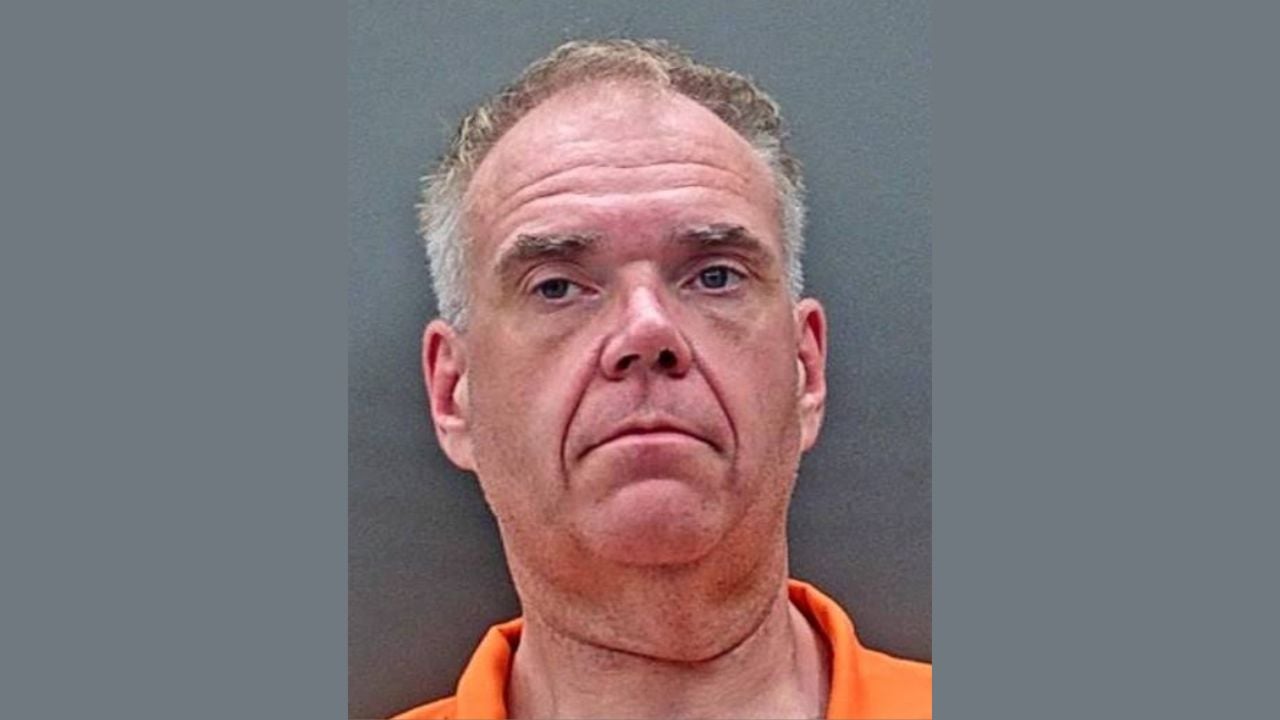
A Merrillville, Indiana, man accused of buying $16,000 in equipment with a fraudulent check was arrested three weeks later after police say he fled an attempted traffic stop. When officers later found him, police said the trailer attached to his vehicle was carrying a golf cart that had also been fraudulently purchased.
Anthony Zimmerman, 51, was taken into custody September 15 in Remington. WLFI, citing the Rensselaer Police Department, reported that investigators learned Zimmerman already had active fraud warrants in four Indiana counties.
The Rensselaer investigation began August 24 after officers responded to a business in the 1700 block of North McKinley Avenue. Police determined that Zimmerman had obtained approximately $16,000 in equipment using a fraudulent check.
The Jasper County case filed after his arrest is now pending in Circuit Court. Current Indiana MyCase records for case 37C01-2609-F6-000758 list five Level 6 felony charge entries, one more than the four Jasper County charges described in WLFI’s report on the arrest.
The $16,000 Equipment Purchase Started the Rensselaer Case
Police said Zimmerman obtained the equipment from the North McKinley Avenue business by presenting a check that later proved fraudulent.
As officers investigated that transaction, they learned Zimmerman was already wanted on fraud-related warrants in four counties, according to Rensselaer police’s account reported by WLFI.
The investigation also expanded to another local business. Police suspect Zimmerman used a fraudulent check to obtain building materials there. That transaction was still under investigation when police announced his arrest, with additional charges described as pending.
A Traffic Stop Turned Into a Multi-County Pursuit
On September 15, police learned that Zimmerman was expected to be at a business near Interstate 65 and State Road 114. Rensselaer police and Jasper County officers attempted to stop his vehicle, but police say he fled.
The pursuit continued into Newton County before officers terminated it for safety reasons. A license plate reader later located Zimmerman’s vehicle at a gas station in Remington.
Officers went to the gas station and arrested him. Police said the trailer attached to his vehicle was carrying a golf cart that investigators determined had been fraudulently purchased in White County.
Zimmerman was booked on the outstanding warrants. The new Jasper County case was filed the following day, September 16.
Jasper Court Records Now List Five Felony Charge Entries
WLFI initially reported two theft counts and two counterfeiting counts in Jasper County. The current MyCase record lists five Level 6 felony charge entries.
The court record includes one fraud entry alleging a loss between $750 and $50,000. It also lists two theft entries, one based on property valued between $750 and $50,000 and another alleging a prior theft or conversion conviction.
Two additional entries appear under Indiana’s counterfeiting statute. One concerns knowingly making or using a written instrument that purportedly was created under circumstances different from the actual ones, while the other concerns possession of more than one such instrument.
The docket also shows that prosecutors filed a probable-cause affidavit, charging Information, a notice of intent to seek an enhanced penalty based on a prior conviction and a habitual-offender notice on September 16.
The court ordered a warrant with a $10,000 surety or $1,000 cash bond. MyCase shows that warrant was served September 17. Zimmerman is presumed innocent unless and until proven guilty in court.
A Fraudulent Check May Not Be Detected Immediately
The Federal Trade Commission warns that counterfeit or fraudulent checks can closely resemble legitimate ones, sometimes using the name and address of a real financial institution.
Banks may also make deposited funds available before determining that a check is fraudulent. The FTC warns that money appearing in an account does not necessarily mean the underlying check is valid.
The FTC advises against relying on funds from a check unless the person providing it is known and trusted. When there is uncertainty about a check, the agency recommends contacting the supposed issuing bank using independently obtained contact information rather than information supplied with the payment.