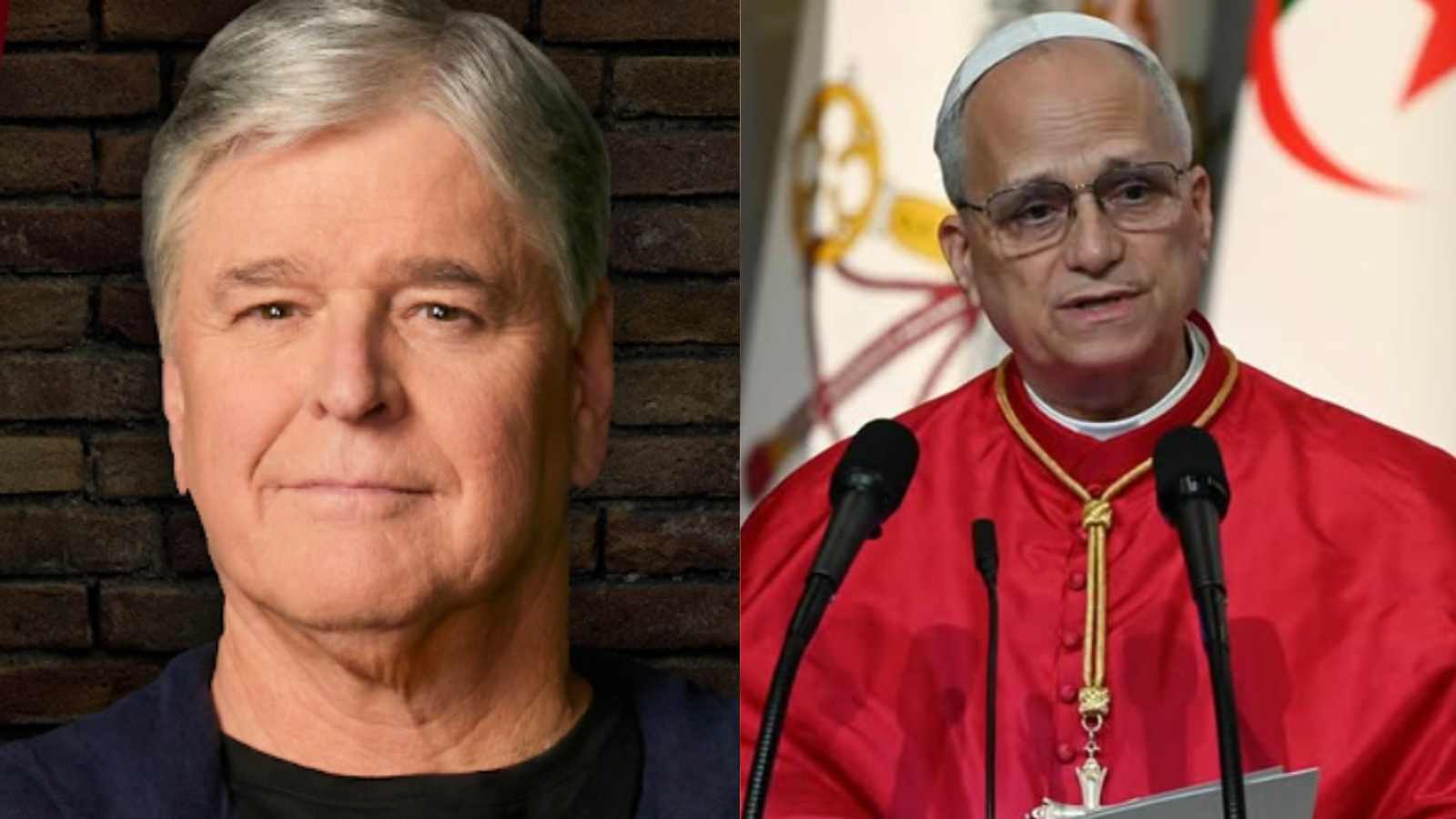
The airwaves have been buzzing with quite the sharp friction this week, the kind that usually signals a major miscalculation in the 24-hour news cycle.
Sean Hannity, a titan of the conservative media apparatus, found himself navigating a tempest entirely of his own making after his recent remarks regarding the Catholic Church, when he said the Pope also needs to be interviewed since the President gets interviewed all the time.
It wasn’t just a casual dismissal or a minor critique of a policy; it was a sweeping, arguably reckless, indictment of an institution that holds the loyalty of millions, including a massive swath of his own viewership.
When a personality whose brand is built on aligning himself with the traditional values of the American right decides to go to war with the very bedrock of traditional authority, the recoil is usually swift and unforgiving.
Watching the fallout has been like observing a master strategist trip over his own shoelaces in front of a live audience. The backlash wasn’t merely from the usual suspects who disagree with his politics; it was a profound fracturing of his own base, with prominent Catholic voices, who have historically given him the benefit of the doubt, publicly dismantling his arguments.
This isn’t just a case of someone putting their foot in their mouth; it represents a fundamental misunderstanding of the current cultural and political landscape, where the old rules of “conservative versus liberal” are being rewritten by a new, more complex set of allegiances.
The intensity of this pushback suggests that Hannity has wandered into a minefield he didn’t realize existed, and he is now struggling to find his footing while the ground beneath him continues to shift.
The Mechanics of a Strategic Blunder
At the core of the friction is a fundamental misreading of the room. Hannity’s decision to air his grievances about “institutionalized corruption” and “selective moral outrage” within the Catholic Church, framing it as his primary reason for parting ways with the faith after 12 years, was delivered with the kind of absolute certainty that usually wins arguments in a vacuum.
However, the world outside that vacuum is currently grappling with a very different reality. By positioning his criticism as a sweeping condemnation of the institution from top to bottom, he inadvertently ignored the lived experience of the millions of Catholics who manage to reconcile their faith with the realities of the modern world.
Fox News host Sean Hannity completely loses the plot and attempts to lecture Pope Leo on the Bible. He claims God authorizes war and accuses the Pope of being a Democrat for opposing the disastrous US-Israeli war on Iran. The Washington establishment is a death cult. pic.twitter.com/OJMKWjZHXO
— Furkan Gözükara (@FurkanGozukara) April 17, 2026
This is not the first time a television personality has conflated institutional flaws with the soul of a religion, but to do so while the conservative movement is already fractured by the ongoing tensions between the Trump-Vance administration and the Vatican creates a unique brand of political peril.
The backlash from heavy hitters like Bill Donohue of the Catholic League underscores a critical point: you cannot claim to be a defender of Western traditionalism while simultaneously taking a sledgehammer to one of its primary pillars.
Donohue’s blistering retort, which pointed out that Hannity’s characterization of the clergy abuse scandal as a perpetual, systemic issue does not hold up under the weight of historical scrutiny or data, effectively stripped away the “common sense” veneer Hannity often uses to shield his arguments.
When your own allies… those who are supposed to be in the trenches with you, turn around to correct your historical record, it signals that you’ve lost the narrative.
Hannity’s error was assuming that his audience would blindly follow him down this particular rabbit hole, failing to recognize that for many of his viewers, their faith is not a political talking point but a deep-seated identity that predates any news cycle.
This creates a fascinating internal conflict for the Fox News audience: do they stick with the voice that has defined their evening for decades, or do they defend the institution that defines their spiritual lives?
The current evidence points toward a significant number choosing the latter, rendering the “attack” a logistical nightmare for his producers.
Navigating the Minefield of Modern Allegiances
To fully grasp why this has turned into such a brutal backfire, we have to zoom out and look at the broader, chaotic theater of 2026. The atmosphere is thick with the ongoing friction between the White House and Pope Leo XIV.
With the President and Vice President JD Vance publicly questioning the Pope’s stance on international conflicts and morality, the “Catholic vote” is currently one of the most disputed and energized territories in the country.
By jumping into the fray with a broadside against the Church hierarchy, Hannity essentially walked into an active war zone without a helmet. The political climate right now is hyper-sensitive; the administration’s public spat with the Vatican has already left many conservative Catholics feeling defensive and alienated. They are looking for allies, not pundits who will add more fuel to the fire.
JD Vance sharply responds to Pope Leo XIV:
“When the Pope says God is never on the side of those who wield the sword, there is more than a thousand-year tradition of Just War Theory in Christianity.”
“Just as I have to be careful when speaking about public policy as Vice… pic.twitter.com/IdKDxTEW6p
— Gunther Eagleman™ (@GuntherEagleman) April 14, 2026
What makes this particularly interesting is the timing. With Pope Leo XIV… the first American pope, holding a level of cultural influence that seems to rattle even the most hardened political operators in Washington, the optics of attacking the Church right now are toxic.
There is a palpable shift occurring where the traditional “religious right” alliance is fraying at the edges. When the government itself is struggling to navigate its relationship with the Vatican, a media personality taking potshots feels less like “speaking truth to power” and more like an unwanted interference in a delicate geopolitical dance.
The irony here is thick: in attempting to assert a certain kind of “principled” conservatism, the narrative has instead highlighted a lack of diplomatic finesse.
The average viewer, who perhaps finds themselves sympathetic to the administration’s geopolitical goals but remains devoted to their Catholic identity, is left feeling caught in the middle. It’s a classic case of overplaying a hand.
By trying to dominate the conversation, the message lost all nuance and, in the process, turned a potential opportunity to rally a base into a referendum on Hannity’s own credibility.
The Performance of Outrage as a Currency
There is a different, rather deeper reality lurking beneath this entire spectacle that we rarely discuss openly: the profit motive of performative friction. In modern cable news, “winning” an argument is not the objective; the objective is to keep the viewer engaged through the next commercial break.
From this cynical perspective, perhaps the “backfire” was never the intended outcome, but the outrage itself is the product. We have to ask: Does a host of this caliber actually care if they alienate a subset of their audience, provided they replace them with a more radicalized, energized faction?
There is a cold, calculated efficiency to this kind of media strategy. By pushing the boundaries of what is acceptable to say about a pillar of tradition, a host can force their audience to choose sides, thereby deepening their loyalty to the host. It’s a loyalty forged in combat… “me against the world, and you are the only one telling you the truth.”
However, this strategy is reaching a point of diminishing returns. The “backfire” we are seeing isn’t just a temporary dip in sentiment; it is a structural failure.
When the backlash becomes more interesting than the initial attack, the host loses control of the story. The fact that we are analyzing this as a “brutal backfire” indicates that the audience is beginning to see the seams in the performance.
They are realizing that the outrage they are being fed might not serve their interests, but rather the network’s quarterly ratings. This is the ultimate danger for the legacy news personality: becoming a caricature of themselves, trapped in a cycle of needing to produce more extreme content to maintain the same level of attention, all while the real-world consequences, like the alienation of a vital, educated, and faithful demographic, continue to stack up.
The question isn’t whether Hannity will recover, but whether the medium of the “personality-driven outrage cycle” is nearing its own natural expiration date. When the audience stops shouting along and starts asking, “Why are you saying this?” you know the game has changed irrevocably.