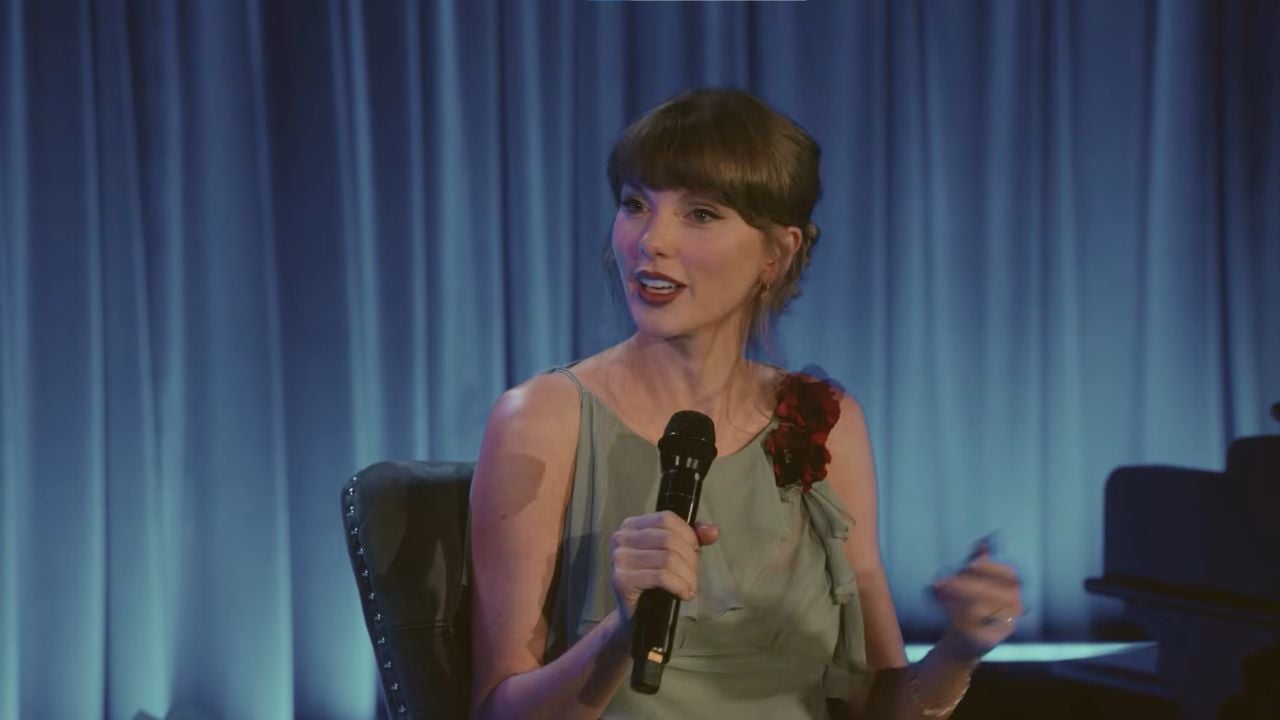
Taylor Swift has revealed one of the phrases she repeats to herself when the scale of her career begins to feel “unmanageably big”, “You chose this.”
The 36-year-old singer discussed the coping mechanism during The Icon Sessions with Taylor Swift: A 20-Year Retrospective, a career-spanning conversation with Recording Academy CEO Harvey Mason Jr. at the Grammy Museum in Los Angeles. The August 18 event was released online August 24, prompting new coverage from PEOPLE and The Hollywood Reporter.
Swift said she has developed several ways of dealing with the pressures surrounding her career. One involves reminding herself that she continued choosing music even when she could have stepped away before everything reached its current scale and that she stayed because making music remained worth what came with it.
The subject emerged during a wider discussion about trusting her creative instincts, dealing with public perception and accepting that releasing deeply personal work will never result in approval from everyone.
Swift Says Her Coping Mechanism Starts With ‘You Chose This’
Swift told Mason that she has developed “several processes and coping mechanisms” over the years, then described one of the reminders she returns to when the circumstances surrounding her career become overwhelming. “You chose this. You chose this every day,” Swift said. “You could have opted out of this any day before it got unmanageably big.”
She said she deliberately chose not to walk away “because I love it that much.” “Everything that comes with this ultimately is worth it, as long as I get to still make music,” she said.
The full Recording Academy conversation runs nearly 50 minutes and traces Swift’s development from a child studying songwriting and dreaming about Nashville through two decades of albums, public scrutiny and changes in the way she approaches her craft.
She No Longer Expects Her Music to Bring ‘Universal Validation’
Earlier in the conversation, Mason asked how Swift manages to trust her instincts while releasing intensely personal work to an audience large enough that almost every decision produces competing opinions.
Swift said part of the answer comes from remembering whom she is actually making the music for. “I’m playing for the fans,” she said, explaining that she releases songs for people who care about them and use music to process their own lives in the same way she relied on music growing up.
That understanding also changed what she expects after releasing a project she loves. “Putting out music you’ve made that you love so much is not the path to universal validation,” Swift said. “If you’re still doing it, then you love it for the right reasons.”
Swift Says Criticism Can Sometimes Fuel Her Songwriting
Swift became considerably more playful when Mason asked how she keeps the public’s voice out of her head while writing. “I don’t know. Sometimes it fuels it,” she replied. She then admitted that criticism can occasionally become material of its own. “Sometimes when people are mocking me, it’s really fun to mock them back,” Swift said, according to Entertainment Weekly.
She even joked about deliberately choosing language that makes the response slightly more difficult for her critics: “Sometimes I like to just use words that they have to look up in order to talk s— about.”
The conversation eventually touched on Reputation, Swift’s 2017 album created after a period of intense public backlash. She has repeatedly associated that record with feeling deliberately misunderstood, including when discussing why recreating it for a potential Reputation (Taylor’s Version) had proved unusually difficult.
The Conversation Looked Back on 20 Years of Songwriting
The Grammy Museum session was held August 18 for members of the Recording Academy’s Songwriters & Composers Wing before the full conversation was released publicly six days later. Its timing carried additional significance because Swift is marking 20 years since the release of her self-titled debut album in 2006.
The retrospective covered her beginnings in country music, the evolution of her songwriting, collaborations with producers including Max Martin and Shellback, her move into pop and the character-driven approach she embraced on folklore. It also arrived a little more than two months after Swift was inducted into the Songwriters Hall of Fame in New York City on June 11.
Steven Spielberg made a surprise appearance to induct her, while sombr opened Swift’s portion of the ceremony with performances of “cardigan” and “Dear John.” At 36, Swift became the youngest woman ever inducted into the organization.
Swift Ended the Session by Returning to the Piano
She sat at the floral piano familiar from the surprise-song portion of the Eras Tour and performed a medley connecting three songs from different stages of her catalog. Swift began with “I Knew It, I Knew You,” her song for the Toy Story 5 soundtrack, before moving into the folklore track “august” and then “All Too Well.”
She explained that during the Eras Tour, she enjoyed combining songs through shared musical or emotional threads. For the Grammy Museum performance, the connection was memory: looking back at experiences, reliving their details and considering why certain moments remain important long after they happen.