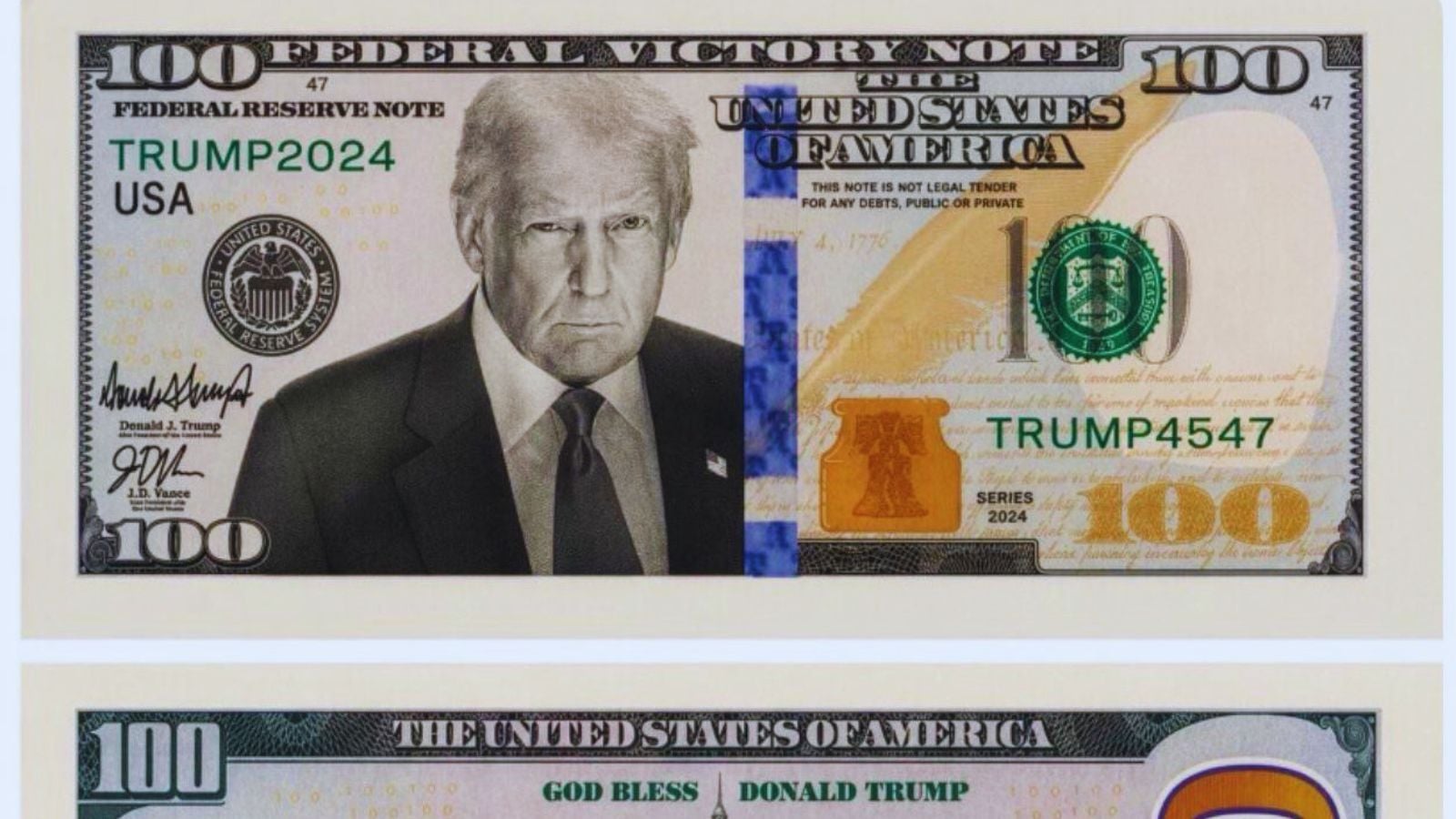
Benjamin Franklin has been on the hundred-dollar bill since 1914. On May 12, 2026, Trump posted images on Truth Social depicting a redesigned note featuring his own face where Franklin’s had been. It was one of several posts that day, and things only got wilder from there.
Within hours, the post had jumped from a single Truth Social upload to a full national conversation. And honestly? The details are what made this so wild.
The images weren’t just a face-swap. They replaced the standard Treasury headers with the phrase “Federal Victory Note” and swapped out the traditional serial numbers for strings like TRUMP2024 and TRUMP4547. Even the foundational motto of American currency was not left alone. “In God We Trust” was replaced with “God Bless Donald Trump.”
The Statutory Reality of the Benjamin
Here is the part where federal law comes in and basically slams the door on the whole thing. The Bureau of Engraving and Printing (BEP) and the Treasury operate under a very specific rule regarding which faces can appear on U.S. currency, and it is not up for debate.
Federal statute 31 U.S.C. § 5114(b) states that “only the portrait of a deceased individual may appear on United States currency and securities.” That is the law. The BEP reinforces this in its own public policy on portraiture, establishing a firm line that bars any living leader from being inscribed with the nation’s literal value.
So, regardless of how official those mock bills looked, they exist entirely outside of any formal Treasury process. There has been no announcement from the Treasury Department about a redesign of the hundred-dollar bill, and there is no evidence of such a redesign in progress.
Some members of Congress did try to push it through the front door. A few legislative proposals surfaced in early 2025 aimed at placing Trump on federal currency, including the Golden Age Act (H.R. 1790). Those bills were never enacted and remain stalled in committee. The history of American currency is one of slow, deliberate change, and the current statutory barrier ensures that Benjamin Franklin is staying right where he is.
The Architecture of a Digital Mockup
Reports have described these bills as AI-generated or high-fidelity mockups. This is part of a visible pattern in 2026: the president’s social media presence has been leaning heavily on hyper-realistic synthetic visuals to place him in various symbolic settings.
We have seen coronation-like scenes, other imagery dripping in authority, and now this. By using AI to generate a version of the hundred-dollar bill, a very specific picture of power gets projected, one that feels tangible and real even when it is entirely virtual.
That is what makes synthetic media such an effective political tool. When an image looks like an official government note, it tests whether the average person can distinguish between a formal Treasury action and a very well-executed digital illustration. The result is a blurring of lines. The mock bill was reported on with the same intensity as actual legislation, and the Treasury has not issued any official statement about the post.
The Search for Official Provenance
No technical verification or forensic analysis has been publicly released to confirm exactly how the images were produced or who designed them. The visual is very clear, but the administrative trail behind it is essentially nonexistent, which leaves the whole story in a kind of suspended state.
Then there is the counterfeiting question. The U.S. Secret Service enforces laws around unauthorized reproductions of currency, specifically anything bearing a “similitude” to genuine obligations under 18 U.S.C. § 474. According to CBS4Local reporting, no public investigation or inquiry into these mockups has been announced by either the Secret Service or the Treasury Department.
Federal guidelines do allow for the reproduction of currency for artistic purposes, but those images must meet specific requirements; they must be one-sided and significantly larger or smaller than the real thing. Whether these digital versions were ever subjected to that kind of review is unclear. Without a formal statement from the Bureau of Engraving and Printing, the claims that these images could cause confusion remain unverified.
The Shift Toward Personalist Symbols
The hundred-dollar bill was not even the only thing Trump posted that day. The May 12 Truth Social session was a full AI image spree, and each post was more pointed than the last. There was a Navy warship firing lasers at an Iranian-flagged aircraft, captioned “LASERS: BING, BING, GONE!!!” Then came images of U.S. strikes on Iranian fast boats, explosions mid-water, drone footage aesthetic, with captions running variations of “BYE BYE, FAST BOATS.”
Then it got more personal. A post showed Barack Obama, Joe Biden, and Nancy Pelosi wading through the Lincoln Memorial Reflecting Pool, only to find it filled with sewage. It was captioned “Dumacrats Love Sewage”. And then there was a cartoonish AI rendering of Illinois Governor JB Pritzker stuffing his mouth with a burger and pizza simultaneously, captioned “JB is too busy to keep Chicago safe.”
But of everything posted that day, the most loaded detail was still the replacement of “In God We Trust” with “God Bless Donald Trump.” That is not just a branding choice; it is a signal. A deliberate move away from collective national symbols toward something more personal, more centered on the individual leader than the state itself.
In celebrity culture, this kind of thing is completely standard. Seeing it applied to the hundred-dollar bill creates a specific friction because the dollar is not a concert poster or a brand logo. It is meant to be permanent. Taken together, the laser strikes, the sewage pool, the stuffed governor, and the Federal Victory Note are all doing the same thing: packaging power as content and daring you to scroll past it.
The mock hundred-dollar bill is less a proposal for new currency than a window into how political messaging works in 2026. Federal statute still restricts portraits on U.S. currency to deceased individuals, but the Federal Victory Note will likely outlive this news cycle and stick in the collective memory of this era, whether the government acknowledges it or not.