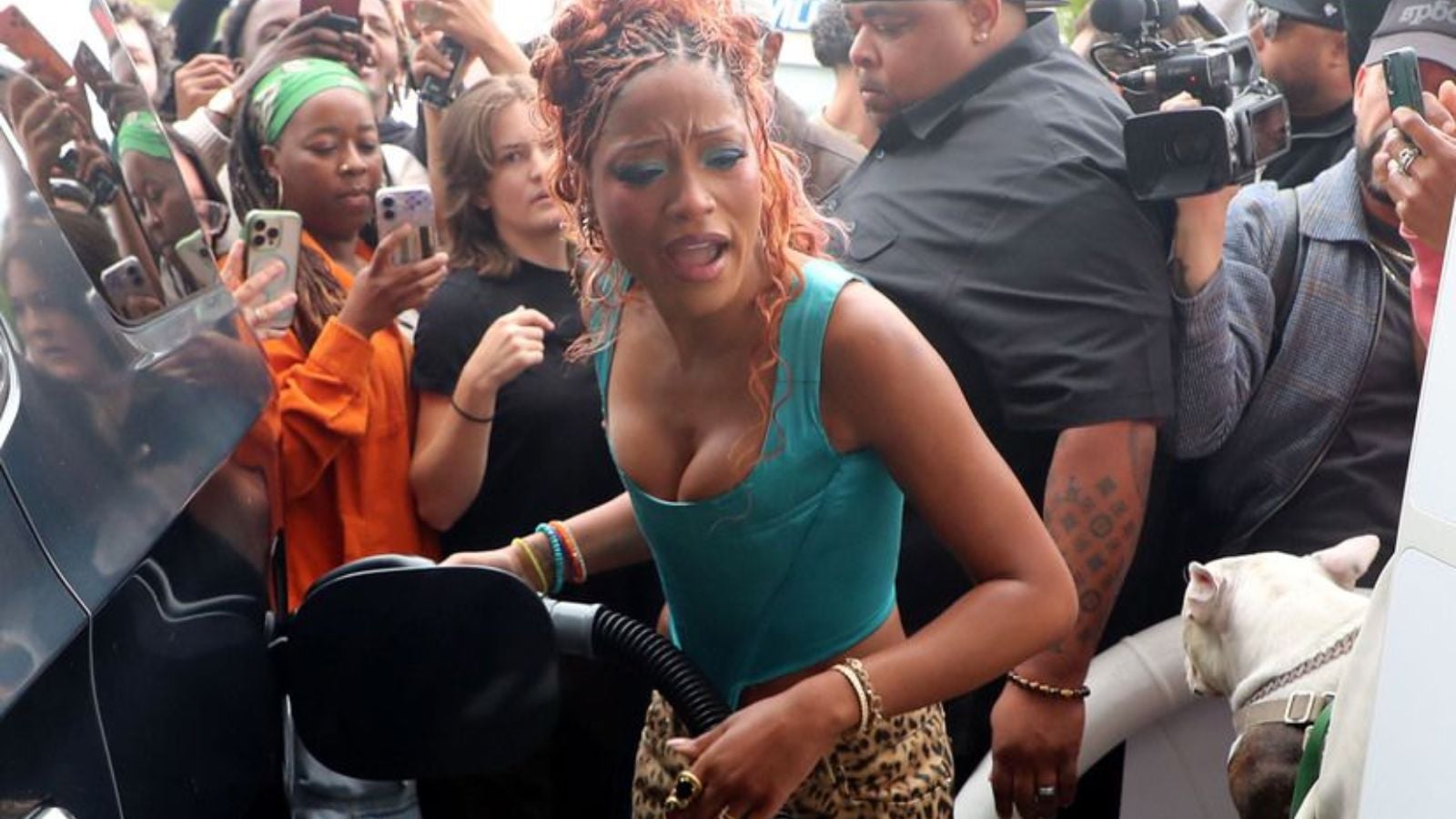
Keke Palmer and LaKeith Stanfield showed up to a Shell station on Pico Boulevard on Tuesday and started pumping free gas for strangers. Yes, for real. No, it was not a drill.
That was the scene on May 12, 2026, when the two stars turned up to promote their upcoming film I Love Boosters, which hits theatres on May 22. It was a marketing stunt, yes, but the kind that gets people talking because it offered something genuinely useful: fuel, at a time when the cost of a full tank has a very real weight on people’s everyday lives.
The event was first-come, first-served; it was reported that the promotion was intended for the first 70 drivers. As someone who has sat in traffic, wondering if my fuel gauge is a lie, I felt this one in my chest. Free gas is not a small thing. For some drivers, it was genuinely life-changing for that day.
The Geography of a Hollywood Handout
I love LA cuz yes Keke Palmer and LaKeith was out here filling ppl tanks for free for I Love Boosters but the real star was this chicken 😭😭😭😭 pic.twitter.com/2agcQ8EBRB
— Audra McDonalds Oscar Campaign Manager (@_AllThatJaz) May 13, 2026
The Pico Boulevard Shell station became something it probably never expected: a stage. Palmer and Stanfield were right there at the pumps, not tucked behind a velvet rope or visible only through a lens. They were in the middle of it, interacting with drivers, taking photos, doing the whole thing.
Media coverage reports that one driver walked away with what was described as a full tank, valued at roughly $100. That is not a bag of popcorn and a branded pen. That is real money, and for many people in Los Angeles who commute long distances, that kind of win hits differently.
The setup had all the ingredients of modern viral marketing: celebrities in person, a finite offer, social cameras rolling, and a crowd that grew faster than the pumps could handle. The images were immediately shareable. The problem was that scarcity was not just a marketing concept; it was something people felt in real time as they waited, watched, and hoped they had arrived early enough.
Friction at the Pumps
With gas prices continuing to rise , Keke Palmer and Lakeith Stanfield gave out free gas to people to promote their new movie ‘I Love Boosters.’
More on #CassiusLife.com
🎥: NBCLA pic.twitter.com/A9SZTPpOWa— CASSIUS (@CassiusLife_) May 12, 2026
As more cars arrived and the queue stretched past the 70-driver limit, frustration began to bubble among those who had arrived too late. That is just human nature. You hear about free gas, rush over, and then find out the offer is over. That stings.
TMZ reported that one latecomer who had actually run out of fuel after missing the cutoff called the police. The officers arrived, assessed the situation, and, according to reports, resolved everything on-site without any arrests or citations.
The promotion continued. Nobody was hauled off. The whole thing was handled with what sounds like a relatively calm outcome, given how heated the atmosphere reportedly got.
What the public record lacks is a formal LAPD incident statement, an incident number, or an on-the-record explanation from officers of exactly what the complaint covered. Was it a traffic obstruction? A disturbance? A trespass issue? Nobody is officially saying, at least not yet.
The Marketing of Resource Scarcity
Free Gas pop up promoting I Love Boosters this morning in LA! Movie hits theaters May 22 ⛽️🍿🎥 pic.twitter.com/jXnf7DBPLS
— aileen patricia 🏎️ (@Amazing_Aye) May 13, 2026
There is something very deliberate about choosing gasoline as the film’s giveaway item. It is not merch. It is not a coupon. It is something people actually need right now, and that directness is the whole point. When a brand or a film ties itself to a practical, immediate benefit, the goodwill generated is proportionally stronger.
Fuel prices and daily commute costs are not abstract for most people in a city like Los Angeles. They sit in traffic with their tanks on E, calculating whether the detour to the cheaper station is worth it. Keke Palmer and LaKeith Stanfield landing at a Pico Boulevard Shell station and making that calculation disappear, even briefly, for 70 drivers is a PR move that feels human rather than corporate.
That said, activations like this come with logistics that a press release cannot fully prepare for. Routing a surprise crowd into a working public petrol station creates real tension between the promotional moment and the municipal reality: traffic flow, permits, crowd management, and the very human frustration of missing out on something you were told was free.
The afternoon was always going to be chaotic. The question was how chaotic it was, and on May 12, the answer came in the form of a police call.
Aftermath and the Optics of Generosity
View this post on Instagram
Once the giveaway wrapped and Palmer and Stanfield left the forecourt, the crowd dispersed, and the afternoon went back to being an ordinary Los Angeles Tuesday. The promotion had done its job: the film got coverage, the stars got goodwill, and a handful of drivers got a full tank they didn’t expect when they woke up that morning.
But the part that lingers is the gap between the 70 drivers who got their gas and the ones who came and got nothing. In a city as sprawling and expensive as Los Angeles, showing up late to a free fuel giveaway and then running out of petrol on the way home is genuinely rough. That person’s frustration, wherever it led, is a reminder that when generosity is rationed by arrival time, someone is always on the wrong side of the line.
Both sides of this story live in the public record. The generosity was real. The disruption was also real. And the police presence, however briefly it touched the afternoon, is the kind of detail that tends to follow a feel-good marketing moment into the next news cycle.
I Love Boosters opens May 22, and whether the gas station stunt is remembered as a charming campaign move or a cautionary tale about crowd logistics probably depends on what the box office looks like two weeks from now.