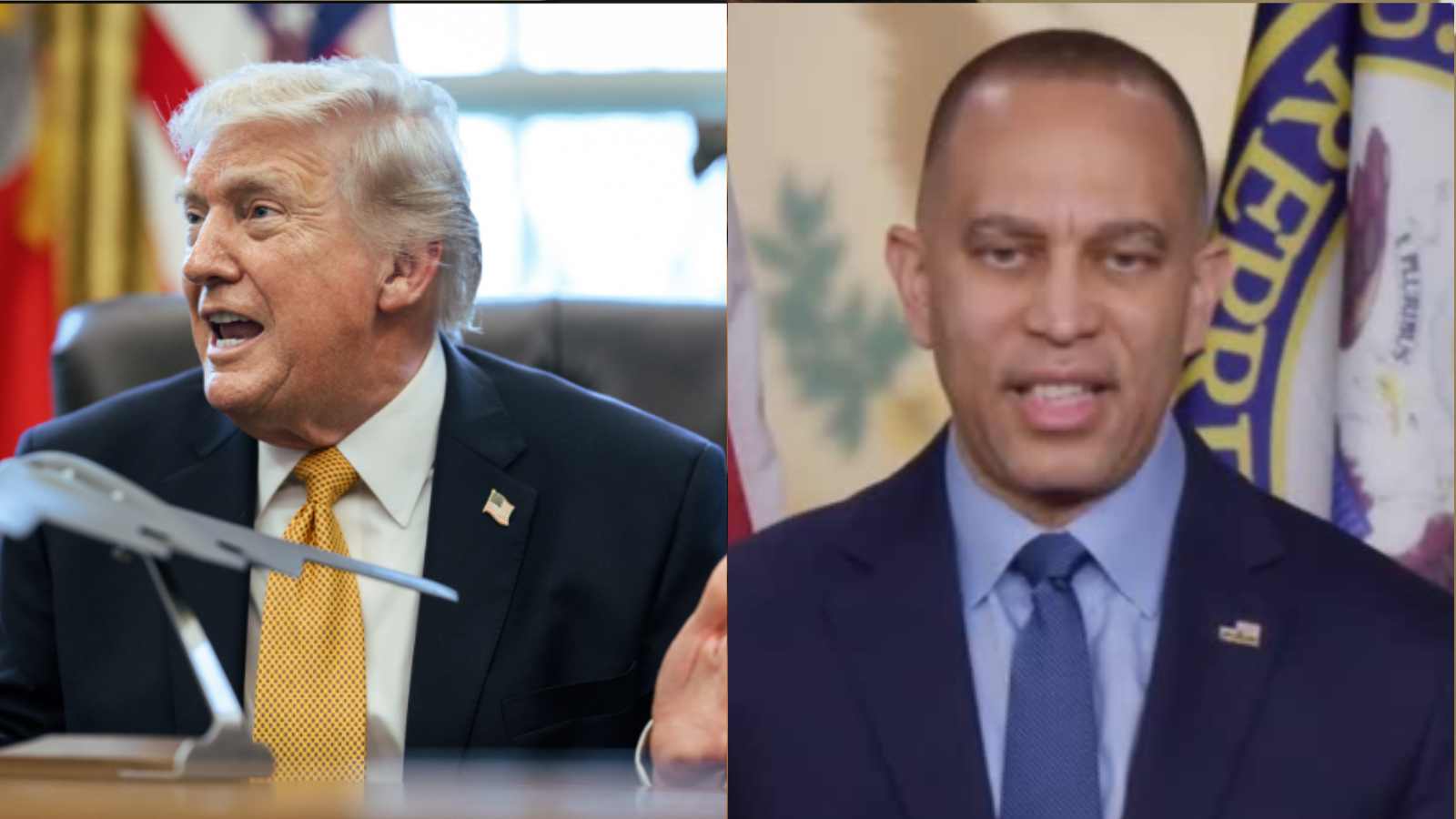
D.C. has always been a place where people, especially politicians, play dirty, but lately, it feels like the last bit of “acting like adults” has completely gone up in flames. There was a time, perhaps in a distant memory, when political disagreements were handled with a sternly worded letter or a tense floor debate. Those days are officially dead, gone, and buried.
Watching the current friction between House Minority Leader Hakeem Jeffries and President Donald Trump feels less like a legislative disagreement and more like a heavyweight bout where neither fighter is willing to wait for the bell.
It is chaotic, it is loud, and for the American public watching from the sidelines, it is deeply exhausting. We are living through a moment when the rhetoric has become so sharp that it is actually drawing blood, leaving many of us wondering when the focus will shift back to the people sitting at their kitchen tables, trying to figure out how to pay for eggs.
The latest firestorm ignited on Thursday, May 7, when Donald Trump took to Truth Social to launch a blistering attack on Jeffries, essentially calling for his head on a legal platter.
In a post that quickly bypassed the usual political filters, Trump labeled the New York Democrat a “lunatic” and “Hakeem ‘Low IQ’ Jeffries,” demanding that he be prosecuted for allegedly inciting violence.
The catalyst for this digital explosion traces back to a phrase Jeffries used after a redistricting victory in Virginia, in which he spoke of “maximum warfare, everywhere all the time.”
Trump linked this rhetoric to the horrifying assassination attempt that shocked the nation at the White House Correspondents’ Dinner, creating a direct line between the Minority Leader’s words and a moment of national trauma.
It was an accusation that took an already volatile situation and doused it in jet fuel, signaling that the “peaceful” era of political maneuvering is a relic of the past.
The Messy Reality Behind the ‘Maximum Warfare’ Controversy
To really see how we got to this point, you have to look at the linguistic chess match that has been playing out over the last several months. When Hakeem Jeffries initially used the “maximum warfare” phrase, it was framed within the context of a hard-won electoral battle in Virginia.
In politics, these kinds of metaphors are common, often used to rally the base and signal a refusal to back down from legislative or electoral challenges. However, the president has a unique ability to take his opponents’ words and recontextualize them for his audience.
By pairing a photo of Jeffries next to the “maximum warfare” slogan with images from the assassination attempt just three days later, Trump framed the Democrat not just as a political rival, but as a dangerous instigator of physical harm.
Jeffries, known for his calm and often poetic delivery, did not take the bait with a standard press release. Instead, he met the fire with a flamethrower of his own.
Responding to the call for his prosecution, Jeffries unloaded on the president, essentially asking the question that many Americans have been whispering in private: “What is wrong with you, bro?”
He didn’t stop at defending his own character; he took aim at Trump’s entire record, calling him a “complete and total failure” and asserting that the American people are the ones truly suffering because of the president’s actions and influence.
This wasn’t the measured, moderate tone we often see from leadership; this was a direct, personal rebuttal that highlighted just how much the relationship between the two sides of the aisle has deteriorated into pure, unadulterated animosity.
View this post on Instagram
A Different Perspective on the Rhetoric Trap
While the mainstream narrative focuses heavily on whether Trump’s accusations are grounded in reality or if Jeffries’ comeback was justified, there is an alternative way to view this entire spectacle.
We often blame the individuals for the heat of the conversation, but perhaps the real issue is the structural demand for this kind of “warfare” language from both sides.
When Jeffries uses terms like “maximum warfare,” he is speaking the language that his most fervent supporters want to hear, a signal that the Democratic Party is finally willing to fight as aggressively as their counterparts.
Conversely, when Trump calls for the prosecution of his rivals, he is fulfilling a promise to his base to be a “retribution” candidate. In this sense, both men are trapped in a never-ending cycle where the person shouting the loudest or acting the most hostile is the only one who gets any attention. Voice wins the most engagement.
This cycle suggests that we aren’t just seeing a clash of personalities, but a total breakdown of the political “middle.” If a leader can’t use a metaphor without it being turned into a criminal indictment, and if a president can’t post without calling for the opposition’s imprisonment, the space for actual governance disappears.
The danger here isn’t just the words themselves, but the fact that they have become the primary tool of engagement. When we look at the “maximum warfare” comment through a lens of political necessity rather than personal malice, it becomes clear that both parties are now operating under the assumption that nuance is a weakness.
This creates a vacuum where only the most extreme interpretations of any statement can survive, leaving the public to sort through the wreckage of a collapsed civil discourse.
View this post on Instagram
The Human Cost of the Digital Battlefield
Beyond the headlines and the snappy comebacks lies a much grimmer reality for the average person. While Jeffries and Trump trade barbs that dominate the 24-hour news cycle, the “suffering” Jeffries mentioned is very real for millions of families.
The disconnect between the drama in D.C. and the struggles of everyday life has never been more apparent. When a leader’s primary focus is on defending themselves against accusations of inciting an assassination attempt, they aren’t focusing on inflation, healthcare, or education.
The “explosive public meltdown” isn’t just a spectacle; it’s a distraction that costs the country time and progress. Every minute spent debating whether a “Low IQ” insult or a “warfare” metaphor crossed the line is a minute lost to the actual work of representing the people.
Ultimately, this latest chapter in the Trump-Jeffries saga serves as a sobering reminder of where we are as a nation. We are at a point where the leaders of the two major political factions can no longer see each other as human beings, but only as obstacles to be removed or prosecuted.
Jeffries’ blunt question, “What’s wrong with you, bro?” might be the most honest thing said in Washington all year, even if it was intended as a partisan jab. It reflects a profound bewilderment at the state of our union.
As we move closer to another election cycle, the “maximum warfare” isn’t just a slogan; it’s the new reality, and unfortunately for the rest of us, there doesn’t seem to be a ceasefire in sight.