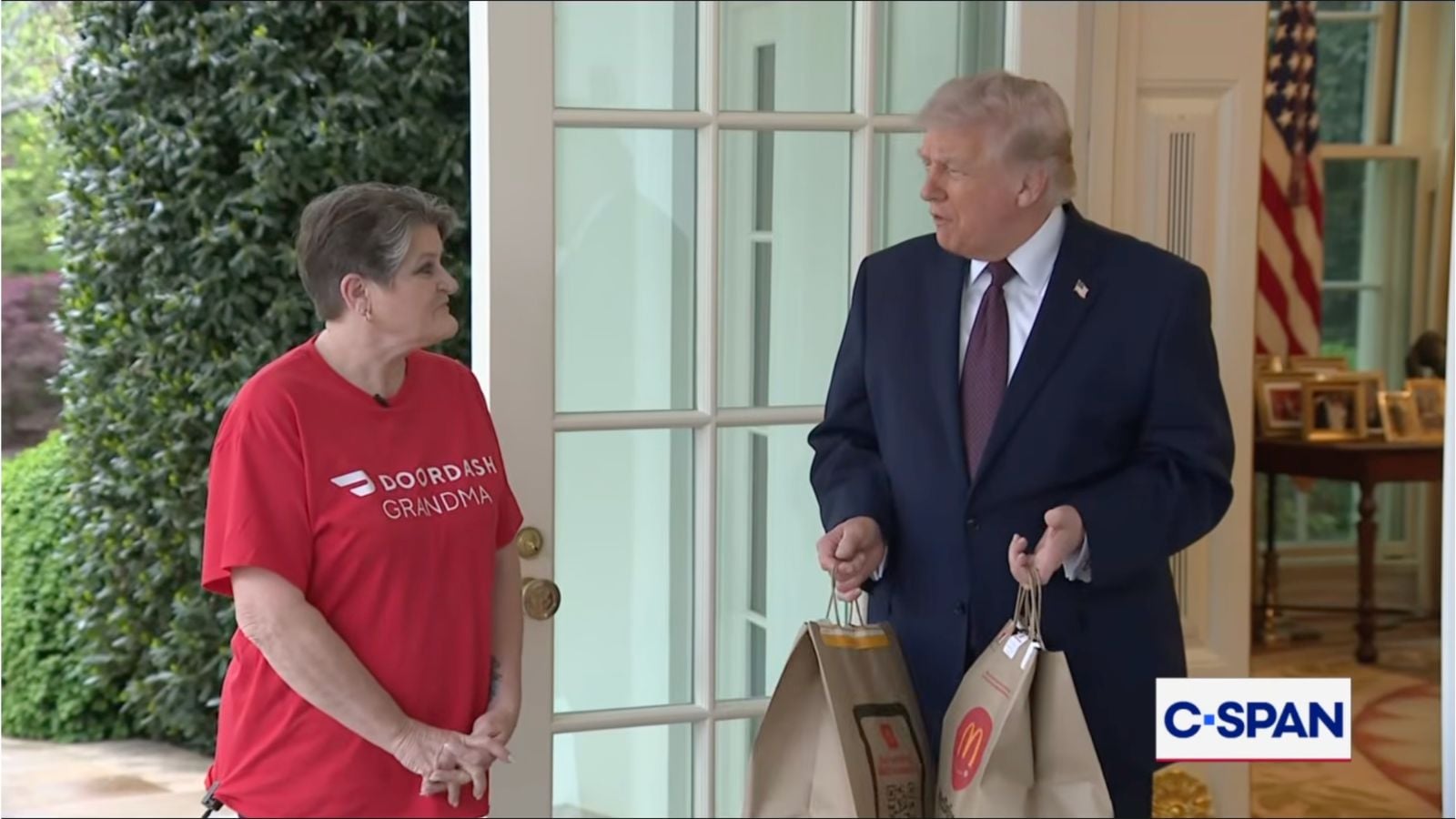
Sharon Simmons pulled up to the White House in a red t-shirt that said “DoorDash Grandma,” carried two bags of McDonald’s to the door of the Oval Office, and knocked.
President Trump was waiting on the other side.
“I have your DoorDash order for you, Mr. President.”
He took the bags, turned to the cameras, and said what he always says when something looks too perfect: “This doesn’t look staged, does it?”
The crowd laughed. The cameras rolled. And for a moment, the story was exactly what the White House needed it to be — a grandmother from Fayetteville, Arkansas, 14,000 deliveries deep, standing beside the president of the United States because a tax policy put $11,000 back in her pocket.
That part is real. As with most things in Washington, there is another side to this story.
14,000 DoorDash Deliveries
Sharon Simmons didn’t start driving for DoorDash because she wanted to. She started because she had to.
Her husband was diagnosed with stage-three cancer in 2024. He cut his work hours during treatment. The savings they had spent their lives building started disappearing — medical visits, prescriptions, the quiet costs that stack up when someone you love is sick and the system charges you for every step of their survival.
“Even with insurance,” she told reporters outside the Oval Office on Monday, “we’ve run through our savings.”
She has completed more than 14,000 deliveries since 2022. She is a grandmother of ten. Tips make up half her annual income. When Trump’s One Big Beautiful Bill passed last July and eliminated federal taxes on those tips, she saved $11,000 in a single year — money that covered follow-up appointments, replaced some of what cancer had taken, and for the first time in a long time gave her family room to breathe.
She traveled to Washington to say thank you. She meant it.
The Other Side of the Bill
So I saw that DoorDash grandma stuff today. Am I the only one who thinks it’s absurd in the richest nation in human history (that is currently spending $2 billion a day on Trump’s war and gave $3T for rich people’s tax cuts), a grandma had to deliver DoorDash to pay for her…
— Isaiah Martin (@isaiahrmartin) April 13, 2026
Here is what Sharon Simmons does not have: an employer. DoorDash drivers are independent contractors. There is no company health plan, no HR department, no benefits package. Like millions of gig workers across the country, Simmons almost certainly buys her family’s health insurance through the ACA Marketplace — the system built specifically for people the economy leaves to fend for themselves.
For several years, enhanced premium tax credits made that coverage affordable. They were the difference between a manageable monthly premium and one that swallowed a gig worker’s earnings whole.
The One Big Beautiful Bill chose not to extend them. By October 2025, the fight over those subsidies had triggered the longest government shutdown in American history. Congress had another chance. The Senate voted. Democrats needed 60 votes to pass a three-year extension. They got 51. House Speaker Mike Johnson blocked a final attempt in December 204-203. The subsidies expired December 31, 2025. The higher premiums started January 1.
The same legislation that gave Sharon Simmons $11,000 last year declined to preserve the subsidies keeping Marketplace insurance within reach for people in her exact situation — variable income, no employer coverage, one serious diagnosis away from financial collapse. Arkansas Advocates for Children and Families estimates 131,000 Arkansans will lose health coverage as a result, including those priced out of the Marketplace when the enhanced credits disappeared.
That is not a projection about someone else’s Arkansas. That is the Arkansas where Sharon Simmons drives for DoorDash to pay for her husband’s cancer treatment.
What the Numbers Say

The bill’s benefits did not land evenly. Arkansas households earning more than $668,900 a year received an average tax cut of $48,810. The lowest-income families in the state — the ones most likely to be driving for DoorDash, working double shifts, piecing together coverage through the Marketplace — received an average of $40.
Trump pulled a hundred-dollar bill from his pocket and handed it to Simmons on the South Lawn. She smiled. The cameras caught it.
Nobody asked what her insurance premium looks like this year.
Sharon Simmons deserved her $11,000. She earned it delivery by delivery while her husband fought cancer and the savings account went to zero. Nothing about her story is manufactured — not the illness, not the sacrifice, not the relief she felt when the math finally worked in her favor for once.
It bears repeating: the same bill that gave her $11,000 chose not to extend the subsidies that kept her insurance affordable. The $11,000 arrived in April. The higher premiums started in January.
The no tax on tips deduction expires in 2028.
The subsidy cuts already happened.