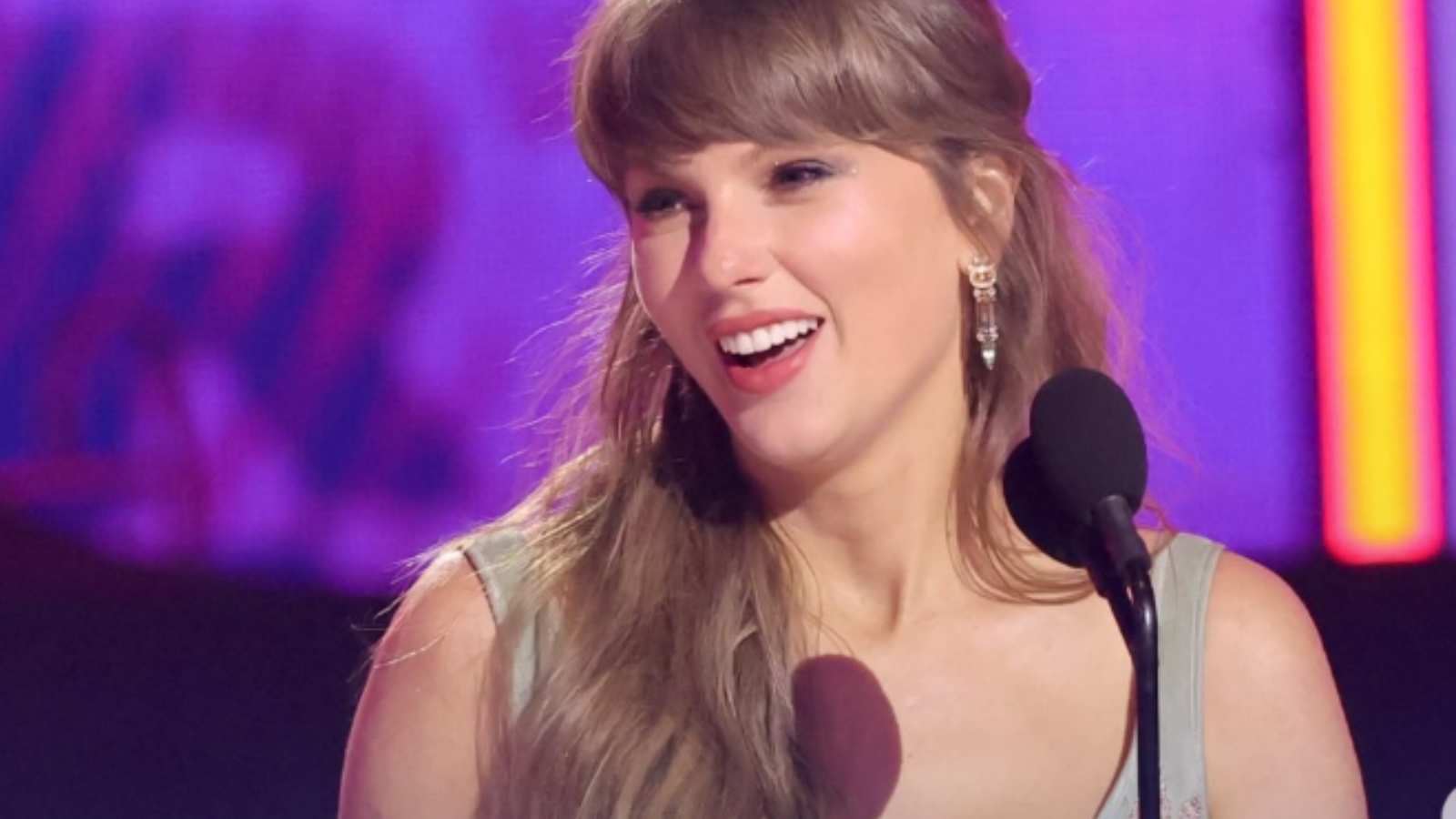
It’s the kind of image that feels less like a paparazzi snap and more like a cinematic climax. Taylor Swift, under the blinding stadium lights of an NFL arena or the shimmering rafters of the Eras Tour, is laughing.
Not the “carefully curated for a documentary” laugh, but a full-bodied, uninhibited roar of joy, usually directed at a 6’5″ tight end who looks like he just won the lottery. For a woman who spent six years in the “lavender haze” of a hyper-private, almost ghost-like romance with Joe Alwyn, this version of Taylor… loud, proud, and unapologetically attached, is a revelation.
But as the friendship bracelets settle and the “Tayvis” engagement rumors reach a fever pitch in early 2026, a quiet, almost sacrilegious question is beginning to circulate among the Swiftie faithful and cultural critics alike: In finding this new, exuberant confidence through Travis Kelce, has Taylor Swift traded her hard-won brand of “on-your-own-kid” independence for a joy that is entirely dependent on someone else?
The Architecture of a New Confidence
View this post on Instagram
To understand why this matters, you have to look at the math of Taylor’s public persona. For years, her narrative was built on the “solitary genius,” the girl in the room who writes the songs that make the whole world cry, often while navigating the icy waters of industry sexism and personal isolation.
Her relationship with Alwyn was described in her own lyrics as a “private world,” a “secret garden” that required her to shrink her public footprint to keep the peace. Then along came Travis.
Since mid-2023, we haven’t just seen a new boyfriend; we’ve seen a new Taylor. She is suddenly a regular at Kansas City dive bars, a yelling fan in the VIP suites, and a woman who lets her partner carry her off stage.
Psychological experts, including famed therapist Esther Perel, have noted the presence of “compersion” in their relationship, the ability to find genuine, ego-free joy in a partner’s success. Travis doesn’t just tolerate Taylor’s “The Man” energy; he soundtracks it.
“He can stand right beside her,” relationship expert Sabrina Bendory noted in a recent analysis. “He isn’t intimidated by her success; he’s in awe of it. This is huge for women who have been told they’re ‘too much.’”
This “out loud” love has undeniably boosted Taylor’s confidence. She’s taking risks she never took before, be it her political outspokenness during the 2024 election cycle or the experimental, raw vulnerability of The Tortured Poets Department and her 2025 follow-up, The Life of a Showgirl. She seems lighter. She seems… safe.
The Data of the “Kelce Effect”

If you think this is just headline bait, the data suggests otherwise. The “Kelce Effect” has fundamentally altered how Taylor is consumed as a brand.
The Demographic Shift: According to consumer engagement data from the 2024-2025 NFL seasons, Taylor’s association with Kelce brought a 53% increase in viewership among teenage girls, but more importantly, it shifted her “relatability” metrics.
The Muse War: Interestingly, search trends for “Taylor Swift independence” spiked by 40% following the release of The Life of a Showgirl. While fans love the romance, a subset of the community is actively mourning the “Folklore” era Taylor, the one who found her strength in the woods, alone, rather than in the arms of a “golden retriever” boyfriend.
There is a fascinating, little-known ripple effect happening in youth sports, too. Across the U.S., “KC Swifties” flag football teams have cropped up, where young girls aren’t just wearing Swift’s lyrics on their jerseys; they are citing her “stadium-ready” confidence as their reason for playing. They are seeing a woman thrive in a male-dominated space (the NFL) by simply showing up and being herself.
Is “Tayvis” a Step Backward?

Now, allow me to play the devil’s advocate for a bit. While the world celebrates Taylor’s “fairytale ending,” there is a legitimate objector argument that this relationship represents a shift away from the radical independence that made Taylor a feminist icon.
For a decade, Taylor Swift was the patron saint of the “Single Girl’s Era.” She taught a generation that you could be “happy, free, confused, and lonely at the same time.” She proved that a woman’s worth wasn’t tied to the man on her arm. But now, the narrative has shifted to completion.
The “Alchemy” of it all… to use her own track title, suggests that she was “sleeping for twenty years” until Travis arrived to wake her up. Critics on platforms like Reddit’s r/travisandtaylor and cultural commentators have pointed out a worrying pattern: Taylor’s confidence seems increasingly tethered to Travis’s presence.
When he is in the tent, she performs with a different energy. When he isn’t, the “sad girl autumn” vibes return. There is a fine line between a supportive partnership and identity fusion, where a person’s sense of self-worth becomes a derivative of their relationship status.
If Taylor Swift, the most powerful woman in music, needs a man to feel “bejeweled,” what message does that send to the millions of young women looking to her for a roadmap of autonomy?
Is it possible that in her rush to escape the “prison” of her past relationship, she’s entered a new kind of cage? One made of gold, Super Bowl rings, and the crushing pressure to maintain a “perfect” public romance?
The “High School” Paradox

In her song “So High School,” Taylor sings about feeling like a teenager again. It’s sweet, it’s nostalgic, and it’s deeply relatable. But there’s a reason we leave high school.
The paradox of the Swift-Kelce union is that it is both the most “mature” relationship she’s had (in terms of mutual support and public transparency) and the most “juvenile” (in terms of the “cheerleader/captain” tropes).
While Travis is praised for being a “himbo” who lets her shine, some fans are beginning to miss the intellectual grit of her previous muses.
“Joe Alwyn was a partner in lyricality,” one viral fan essay argued. “Travis is a partner in celebrity. One made her look inward; the other makes her look at the cameras.”
What’s Next for the Eras?

As we move deeper into 2026, the “Quiet Questions” will only get louder. If the engagement leads to a wedding, Taylor Swift will enter a new “Era” entirely, one she hasn’t navigated since she was a teenager in Nashville: the role of a wife.
Can the woman who wrote “The Man” coexist with the woman who spends her Sundays in a Chiefs jersey? Can you be a symbol of fierce independence while being one-half of the world’s most codependent-looking power couple?
Taylor Swift has always been a master of the pivot. She turned a “Snake” reputation into a stadium tour and a “Serial Dater” label into a billion-dollar catalog. Her current “Joy” might be tied to someone else for now, but if history has taught us anything, it’s that Taylor Swift always keeps the receipts to her own soul.
She might be in her “Travis Era” today, but she’s always been the one holding the pen. The real test won’t be whether they stay together, but whether she can keep that “bejeweled” shimmer when the stadium lights go dark, and she’s finally, once again, on her own.