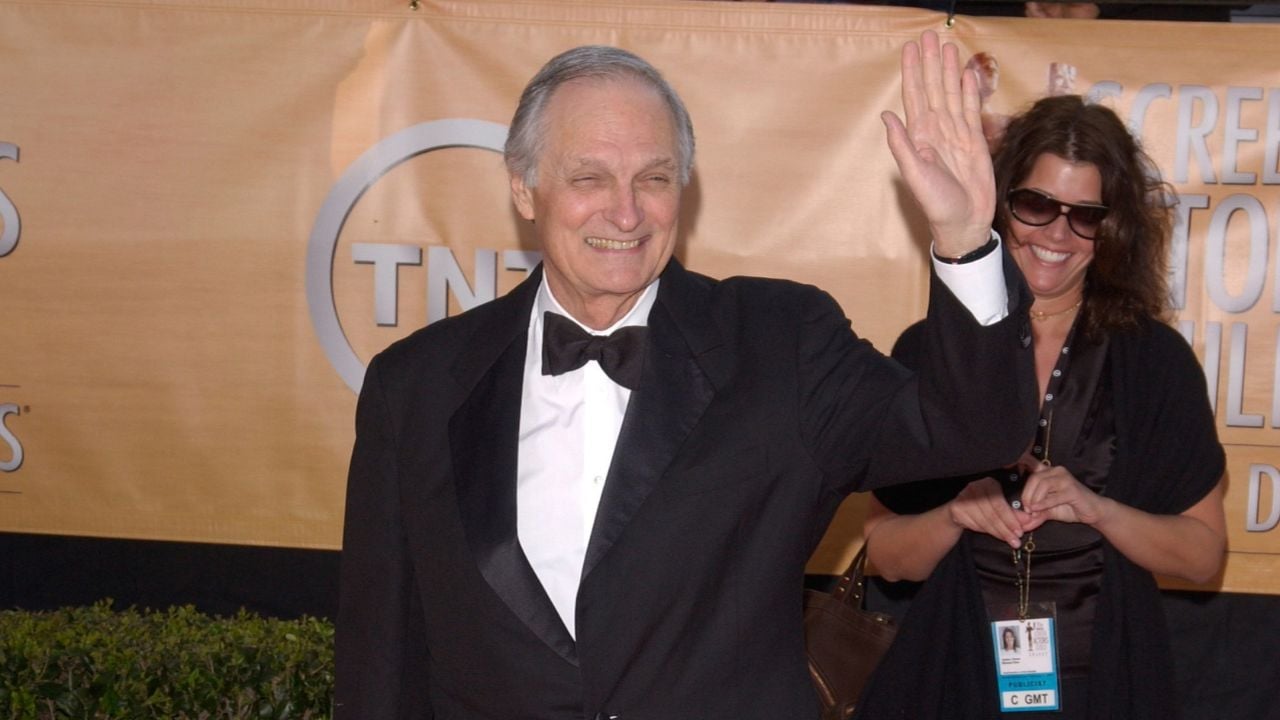
Alan Alda has lived publicly with Parkinson’s disease for eight years, but at 90 he still refuses to let the diagnosis become the defining fact of his life.
“It’s not who I am. It’s just a hobby,” the M*A*S*H star told Dr. Jon LaPook during a new CBS Sunday Morning interview.
Alda’s approach combines acceptance with a habit of looking for practical ways around whatever the disease makes harder. “I really think reality is my friend,” he said, explaining that he works from what is happening rather than wishing for a different set of circumstances.
He first disclosed his diagnosis in July 2018 after living with it privately for roughly three and a half years. The new conversation returns to the unusual symptom that initially sent him looking for answers and the ways Parkinson’s now enters ordinary parts of his day.
Alda’s First Clue Came From Physically Acting Out a Dream
Alda said he had none of the movement or voice symptoms he associated with Parkinson’s when he began investigating the possibility that something was wrong. He had instead noticed himself physically acting out a dream in which someone was attacking him.
In the dream, Alda threw a sack of potatoes at his attacker. In bed, he had actually thrown a pillow at his wife, Arlene. After reading that acting out dreams could be associated with Parkinson’s, he asked to be evaluated even though he had no tremor, twitch or voice problem at the time.
By July 2018, Alda had started noticing his thumb twitch during television appearances promoting his then-new Clear+Vivid podcast. He decided to reveal the diagnosis himself rather than wait for the visible movement to prompt speculation about his health. In his original CBS interview, he emphasized that the years since his diagnosis had remained active, including acting, public speaking and his science-communication work.
His view of the disease at the time was already centered on adaptation. Alda described each new difficulty as something to work around rather than evidence that the rest of his life had stopped.
Computer Mice, Shirt Buttons and Socks Have Become Problems to Solve
Using a computer can now become a struggle between what Alda wants his hand to do and where the cursor actually goes. He jokes about “Dr. Parkinson” taking control of the mouse, moving across the screen and occasionally deleting something he meant to keep.
Other difficulties frustrate him more. Arlene sometimes helps button his shirt in the morning, something Alda acknowledged that he hates needing. His response is to keep experimenting with different ways to complete the task himself and ask, “What haven’t I tried?”
Alda described finally managing to put on his socks by himself as something worth celebrating after the task had become increasingly difficult.
Humor remains one of the tools he reaches for when the frustration builds. Rather than pretending an obstacle is amusing when it is not, Alda looks for the part he can eventually laugh about and then takes the joke to Arlene.
Laughter has been part of their relationship from the beginning. Alda remembered becoming interested in Arlene after noticing her laughing at his jokes from the opposite end of a dinner table. The couple, who have three daughters and eight grandchildren, will celebrate their 70th wedding anniversary in March.
Alda Is Still Recording ‘Clear+Vivid’ and Working on Science Communication
Alda continues hosting Clear+Vivid, the interview podcast he launched in 2018. Recent guests have included Joy Behar, while earlier episodes have featured figures including Paul McCartney and Michael J. Fox.
Stony Brook University established what became the Alan Alda Center for Communicating Science in 2009, developing methods influenced by improvisation to help scientists and health professionals explain complex ideas more clearly to people outside their fields.
Alda’s connection to medicine also predates his own Parkinson’s diagnosis in the minds of generations of viewers. He won five of his six Emmy Awards for his work on M*A*S*H, where he played Army surgeon Benjamin Franklin “Hawkeye” Pierce through the show’s 11-season run.
Doctors still approach Alda to tell him that watching Hawkeye helped inspire them to enter medicine. More than four decades after M*A*S*H ended, he told CBS there is one response he still has not heard: nobody has ever told him the show inspired them to become an actor.