
Sitting at a desk with a phone propped on a stand, Bernie Sanders asked Anthropic’s AI chatbot Claude a direct question: what would surprise the American people about how their personal data is being collected?
The AI took about two seconds to start talking.
What followed was a three-minute conversation that has now been viewed 4.4 million times — not because the AI said anything new, but because it said it so plainly that it became impossible to ignore.
They Know How Long You Pause
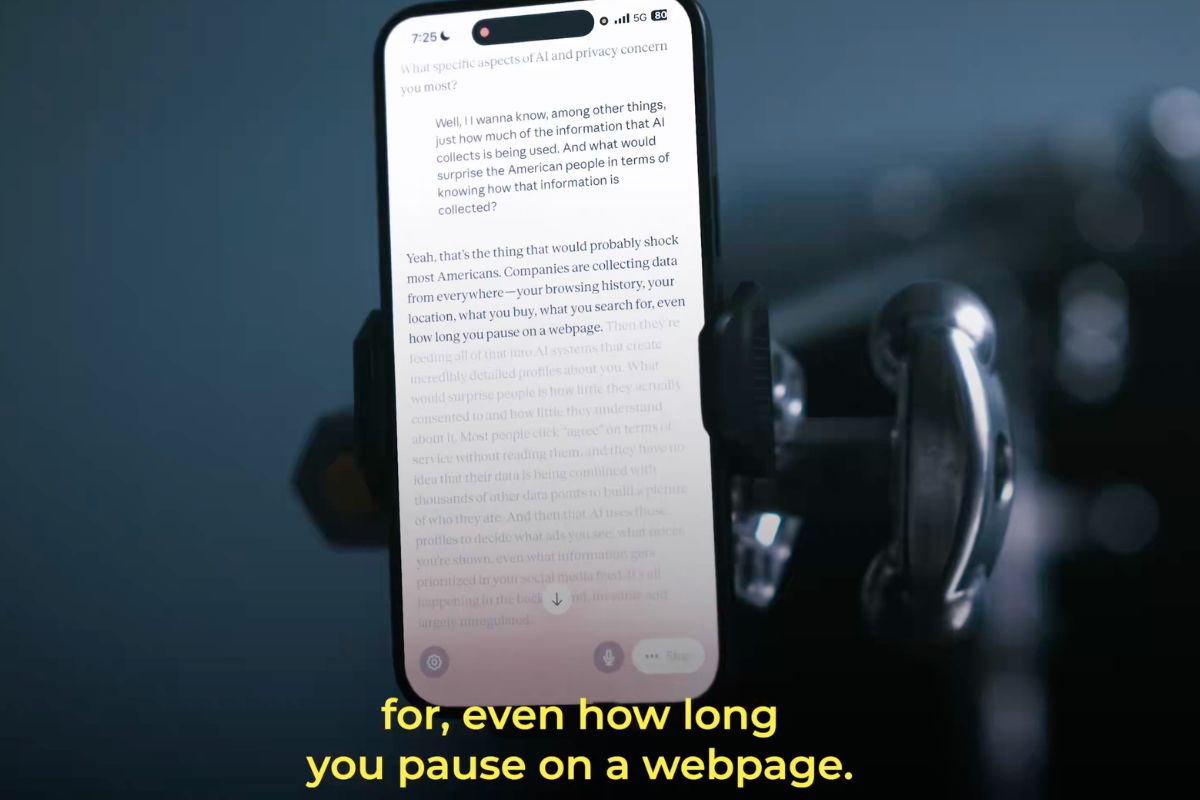
Claude told Sanders that companies pull data from practically everywhere — what you search for, where you go, what you buy, how you browse, and how long you linger on a single webpage.
That last one tends to stop people.
Not what you clicked. Not what you bought. How long you looked at something before deciding not to. That hesitation — the two seconds you spent hovering over a pair of shoes you didn’t buy, or a flight you almost booked — is a data point. It gets collected. It gets fed into AI systems. And it gets used to build what Claude described as “incredibly detailed profiles” about you as an individual.
I spoke to Anthropic’s AI agent Claude about AI collecting massive amounts of personal data and how that information is being used to violate our privacy rights.
What an AI agent says about the dangers of AI is shocking and should wake us up. pic.twitter.com/rUGwuZLAye
— Sen. Bernie Sanders (@SenSanders) March 19, 2026
Most of this happens without real consent. As Claude put it, people agree to terms of service they’ve never read — and have no understanding of how many data points are being stitched together behind the scenes. The average privacy policy among top U.S. websites runs nearly 7,000 words, according to a 2025 NordVPN study, written at a reading level most adults can’t comfortably follow. That’s not an accident.
The Same Product, Two Different Prices
Sanders asked Claude why all of this information is being collected. The AI gave a one-word answer: money.
AI allows companies to monetize that data at scale — predicting what you’ll buy, targeting you with ads calibrated to your psychological profile, and charging you a different price than the person next to you for the exact same product.
The Federal Trade Commission has a name for this: surveillance pricing. In January 2025, the agency found that companies use personal data — location, device type, browsing behavior, even mouse movements — to feed machine learning systems that adjust prices in fractions of a second. Two people. Same website. Same item. Different prices.
In December 2025, Groundwork Collaborative, Consumer Reports, and More Perfect Union tested this directly. They sent 437 shoppers into four cities and had them add the same items to their Instacart carts at the same time. The prices weren’t the same.
Nobody told the shoppers they’d be charged differently. Nobody had to. They’d already agreed to the terms of service.
It’s Not Just About Selling You Things
Halfway through the conversation, Claude shifted the frame. Political campaigns use the same data infrastructure — the same AI, the same profiling — to determine which messages will work on which people. Not broad demographics. Specific individuals.
Meanwhile, an entire industry of data brokers operates in the background, buying and selling personal information on millions of people who never agreed to any of it — turning attention, behavior, and choices into commodities traded on a market most people don’t know exists.
This is where a privacy concern becomes a democracy concern. A company charging you more for a plane ticket based on your data is a business model. A political operation using that same data to serve you a message designed to shift how you vote — without you ever knowing — is something else.
“Citizens Will Be on Their Best Behavior”
Sanders has been building toward this moment. At a Stanford town hall in February 2026, he warned that the American public is “very unprepared for the tsunami that is coming.”
But the most revealing statement on where this is headed came from Larry Ellison, co-founder of Oracle. Ellison has predicted an AI-powered surveillance state in which, as he put it, citizens will be on their best behavior — because everything is constantly being recorded and reported.
He didn’t say it as a warning. He said it as a feature.
Your Phone Is On Right Now

The video lasts three minutes. The data collection Claude described doesn’t need three minutes. It doesn’t need you to watch anything or click anything or agree to anything you understand. It runs in the background of every app, every search, every scroll. It builds a profile you’ll never see, owned by companies you’ve never heard of, sold to buyers you’ll never meet.
Claude told Sanders that privacy isn’t just a personal issue — it’s a democracy issue. When companies and governments hold detailed profiles on millions of people, they hold power over those people. The power to manipulate choices, predict behavior, and shape what someone believes without them ever knowing.
The conversation ended with Sanders thanking the AI for its help.
The AI said, “Thank you, Senator.”
Then the screen went dark. The data collection didn’t.