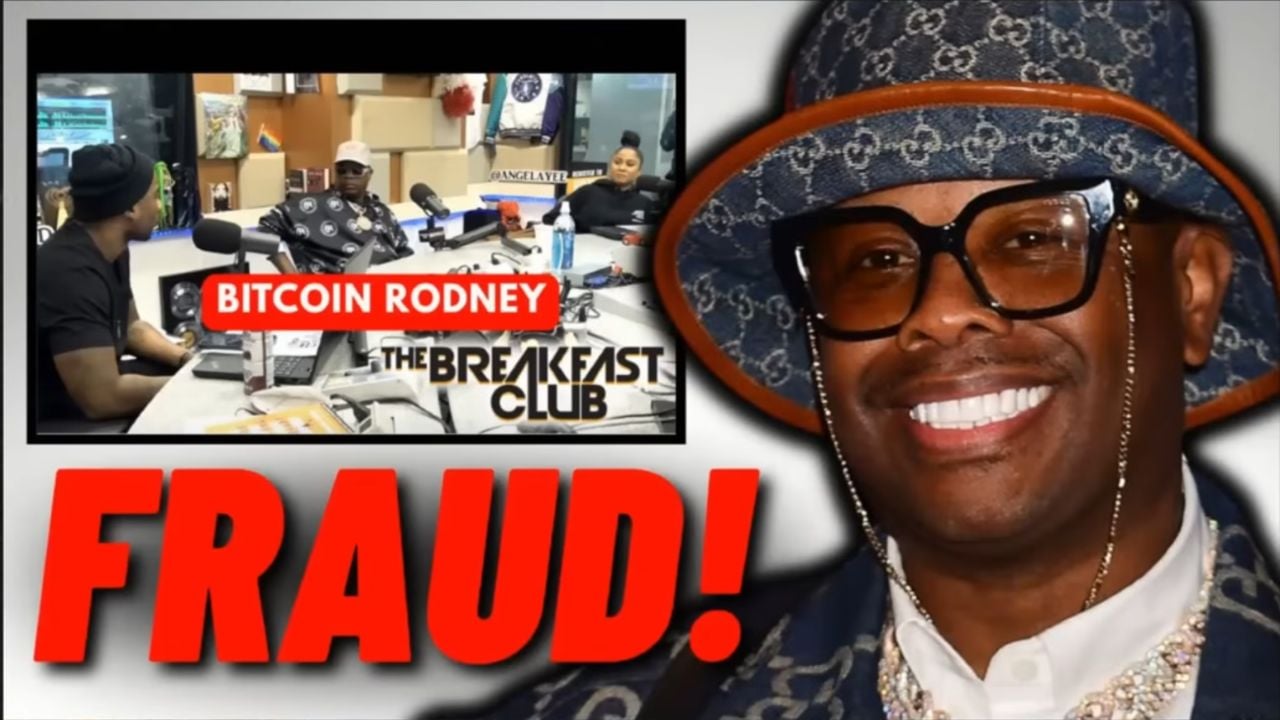
A Miami crypto promoter known as “Bitcoin Rodney” has pleaded guilty in federal court in connection with HyperFund, a cryptocurrency investment scheme prosecutors say took $1.8 billion from victim-investors worldwide.
Rodney Burton, 56, of Miami, also has a residence in Prince George’s County, Maryland, according to the U.S. Attorney’s Office for the District of Maryland.
Burton pleaded guilty to conspiracy to operate an unlicensed money transmitting business. Prosecutors said the charge stemmed from his role as a promoter of HyperFund, which sold “memberships” to investors while promising daily passive rewards.
Burton admitted to the conspiracy count tied to unlicensed money transmission, and he now faces up to five years in federal prison.
The Crypto Pitch Promised Daily Passive Rewards
DOJ said HyperFund presented itself as a legitimate cryptocurrency investment platform. Promotional materials claimed investors who bought HyperFund “memberships” would receive between 0.5% and 1% in daily passive rewards until the platform either doubled or tripled the investor’s initial investment.
The company claimed it could generate those returns through revenue from large-scale crypto-mining operations. Prosecutors said those operations did not exist.
The Securities and Exchange Commission previously described HyperFund as a crypto asset pyramid scheme and said investors were no longer able to make withdrawals after the scheme collapsed in 2022.
Investor Withdrawals Began Getting Blocked
According to DOJ’s HyperFund case page, HyperFund, also known as HyperTech, HyperCapital, HyperVerse, and HyperNation, was promoted to the public from June 2020 to November 2022.
DOJ said the platform began blocking investor withdrawals in at least July 2021. The promised daily rewards only mattered if investors could actually get their money out.
Federal prosecutors described HyperFund as a global wire-fraud scheme that obtained $1.8 billion from victim-investors worldwide.
Burton Personally Received At Least $7.85 Million, Prosecutors Said
According to the plea agreement described by DOJ, Burton conspired from June 2020 to January 2022 to provide unlicensed money transmitting services to promote HyperFund. Prosecutors said he controlled several companies that appeared to offer consulting services but were actually unlicensed money transmitting businesses.
DOJ said Burton personally received at least $7,851,711 in proceeds from the operation of the unlicensed money transmitting business, including money from HyperFund victim-investors in Maryland.
That figure is separate from the larger $1.8 billion loss figure prosecutors used to describe the overall HyperFund scheme.
People Who Put Money Into HyperFund Still Have A DOJ Contact
DOJ’s HyperFund case page says victims can submit a victim impact statement before sentencing by emailing VictimAssistance.fraud@usdoj.gov. The page also lists a toll-free Victim Assistance Line at 888-549-3945 for questions about the case.
The SEC separately says HyperFund victims can contact HyperFundVictims@sec.gov. The agency also directs investors to Investor.gov, where people can search for investor alerts and resources on pyramid schemes before putting money into a platform promising fixed daily rewards.
For crypto investment pitches, the part to check is not only the app, website, or promoter’s social media following. Investors can look for registration, enforcement history, and public investor alerts through SEC and Investor.gov resources before sending money to a platform that promises passive returns or blocks withdrawals.
The Case Also Involves Other HyperFund Figures
The Justice Department’s broader HyperFund case page lists related cases against Sam Lee, Brenda Chunga, and Burton.
Lee, of Dubai, United Arab Emirates, was charged in 2024 with one count of conspiracy to commit securities fraud and wire fraud for allegedly orchestrating a $1.89 billion cryptocurrency fraud scheme. DOJ said Lee allegedly co-founded HyperFund and that Burton and Chunga were promoters.
Chunga, known as “Bitcoin Beautee,” pleaded guilty in 2024 to conspiracy to commit securities fraud and wire fraud for her role as a promoter of HyperFund.
Sentencing Is Scheduled For July
Burton faces a maximum sentence of five years in federal prison for conspiracy to operate an unlicensed money transmitting business.
His sentencing is scheduled for July 23 at 11 a.m. before U.S. District Judge Richard D. Bennett in Maryland. Any sentence will be decided by the judge after reviewing the plea agreement, federal sentencing guidelines, and statutory factors.
The investigation involved IRS Criminal Investigation and Homeland Security Investigations. Assistant U.S. Attorney Christina A. Hoffman is prosecuting Burton’s federal case.