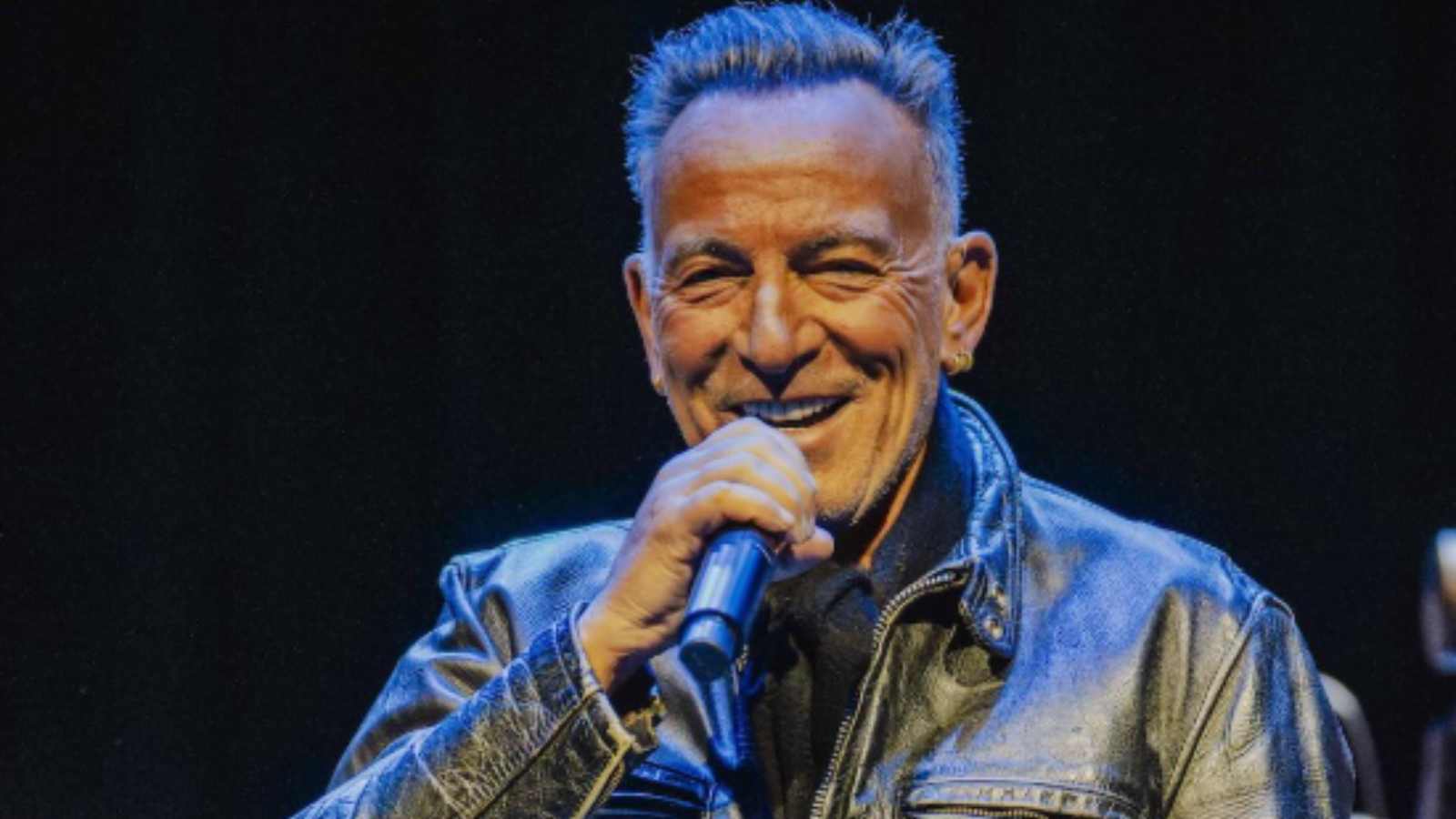
The roar of the crowd at the Kia Forum wasn’t just the sound of seventy-six-year-old rock and roll history being made; it was the cracking hum of a country straining against its own seams.
Bruce Springsteen stood at the center of that stage in Los Angeles, sweat dripping from his brow, his guitar a tether to a version of America that feels increasingly like a ghost story told in fading ink.
There is a weight that settles on the E Street Band when the Boss speaks, a silence that commands more authority than any stump speech or soundbite. In recent weeks, whispers have begun to circulate, trailing behind him like a restless shadow.
Some corners of the internet, amplified by the predictable, biting back-and-forth of our current political circus, have started to murmur that Springsteen is “softening.”
They suggest that the man who once famously embodied the working-class struggle has perhaps retreated, tempering his stance after the escalating, sometimes vitriolic, clashes with the White House and the Trump administration’s aggressive, pun-laden public retorts.
It is a narrative that feeds on our collective need for a clear-cut hero or a fallen icon, painting the complex arc of an artist’s late-career evolution as a surrender.
View this post on Instagram
Yet, to watch him now, standing in the white heat of the spotlight, his voice worn but unwavering, is to realize that what some mistake for a retreat is actually something far more dangerous to those who wish to see him silenced: he is becoming more precise.
The Myth of the Muted Voice
The allegation that the Boss has turned down the volume on his political convictions is a curious artifact of our time, born from the strange expectation that artistic resistance must always exist at a fever pitch, a constant, screaming crescendo of outrage.
When we look at the timeline of the past year, the “Land of Hope and Dreams” tour kickoff in Minneapolis, the fiery dedications at the Kia Forum, and the biting, searing prose of his latest compositions, the evidence of “softening” simply vanishes into the ether.
Perhaps the confusion stems from the nature of his critique. During the George W. Bush years, or even earlier in the Trump presidency, his barbs were often direct, headline-grabbing, and explosive. Today, they are intertwined in his performances.
He isn’t just shouting at the rain anymore; he is documenting the storm. By focusing on the structural erosion of democracy, the sanctity of the vote, and the human cost of the current administration’s policies, he has moved beyond the reactive impulse of the Twitter-verse and into the realm of the historical record.
His songs now serve as a mirror, and for those who demand that he simply play the hits and keep his mouth shut, that reflection is undoubtedly uncomfortable.
The claim that he has softened is a projection; it assumes that true protest must always be unrefined, rather than the calculated, powerful, and deeply human indictment he is delivering.
A Different Kind of Resistance
To understand why this narrative of “softening” has gained any traction at all, one must examine the specific friction between Springsteen and the current administration.
When the White House press apparatus, led by senior communications directors, decided to turn the machinery of the state against a seventy-six-year-old singer-songwriter, the goal was never to engage in a debate about policy.
It was to diminish him, to paint his legacy as “glory days” long passed, and to dismiss his concerns as the product of “Trump Derangement Syndrome.” This is the classic playbook of the modern political machine: when the message is too powerful to refute, attack the messenger’s age, his relevance, and his sanity.
For some observers, the fact that Springsteen doesn’t jump into the mud every single time a derogatory statement is flung his way is interpreted as weakness. But look closer at the tour. He hasn’t pulled back; he has widened his scope.
He isn’t just responding to the noise; he is addressing the machine that generates it. By framing the current administration’s actions as a fundamental threat to the American experiment, he is positioning his concerts not as simple rock shows, but as town halls for a nation in crisis.
The “softening” that people think they see is, in reality, a disciplined, seasoned artist recognizing that the loudest voice isn’t always the one that carries the most weight.
The Danger of Nuance
Bruce Springsteen addressed last nights White House Correspondents Dinner shooting in his opening speech tonight in Austin. He toned back his original scathing message of the President.
Good on you, Bruce.
Video: Richard Schwartz pic.twitter.com/G1oWtpOEyI
— Bruce Springsteen: Blog It All Night (@blogitallnight) April 27, 2026
There is a sharper, perhaps more uncomfortable truth beneath this entire discourse: we, as a culture, are losing our ability to process nuance, and we are punishing artists who refuse to flatten their art into political bumper stickers.
The prevailing narrative around this “Springsteen is softening” debate ignores a darker reality: the people complaining are the ones who have actually become the most rigid. They demand that he be a caricature, the permanent, angry rebel, and when he shows the complexity of a man who loves his country enough to be devastated by its current trajectory, they call it a lack of commitment.
That backlash started in earnest when Bruce Springsteen made a powerful statement on stage following the assassination attempt made on Donald Trump. He offered a “prayer of thanks” that no one was injured, noting that “We can be critical of those in power… but there is no place in any way, shape, or form for political violence of any kind in our beloved United States.”
This isn’t just about politics; it’s about the narrow corridor we allow our icons to walk in. If he were to scream every night about the latest headline, he would be a pundit, not a poet. By choosing to weave his critiques into the setlist, by letting songs like “Long Walk Home” or his newer, searing protest tracks do the heavy lifting… he is forcing his audience to sit with the weight of their own convictions.
He isn’t softening; he is demanding more from his listeners. He is saying that we can draw the line between being critical of those in power and wishing them dead. He is asking us to hold two contradictory thoughts in our minds at the same time: that we can feel deeply betrayed by the institutions of our country and yet still fight for the soul of the nation.
Looking Ahead at the Costs
As the “Land of Hope and Dreams” tour winds its way toward a dramatic conclusion in Washington, D.C., in late May, the question isn’t whether Springsteen has lost his edge.
The question is whether the country has the stomach for the edge he is still sharpening. He has made it clear that he expects the blowback. He has made it clear that he knows the risks of alienating a portion of his audience, an audience that spans generations, geographies, and political divides.
He has navigated the treacherous waters of celebrity advocacy for 5 decades, and he knows exactly where the rocks lie. The irony is that the administration he opposes inadvertently validates the necessity of his voice whenever they lash out.
By making him a target, they have confirmed that they understand exactly what he represents: a link to an American identity that they are currently trying to redefine.
Springsteen’s refusal to be baited into a petty, headline-driven spat and his decision to focus on long-term, systemic issues might be interpreted by some as a retreat.
But in the long run, when historians look back at this period of deep polarization, they will likely see his efforts not as a softening but as the only appropriate response for a musician who understands that songs are, at their best, the final line of defense against the forgetting of our better selves.