
A Circle K employee in South Carolina allegedly scratched and redeemed lottery tickets he had not paid for, with store surveillance footage recording the activity, according to a state arrest warrant.
Joseph Antoniyo Waller, 19, of Spartanburg, is accused of taking South Carolina Education Lottery scratch-offs from the convenience store at 2195 East Main Street in Duncan on Sept. 29, 2026.
The South Carolina Law Enforcement Division charged Waller on Oct. 8 with intent to defraud involving lottery game tickets. A separate misdemeanor breach-of-trust allegation is documented in Spartanburg County Magistrate Court records.
The state lottery requested SLED’s investigation and the agency publicly announced the arrest on Oct. 12. The warrant describes the conduct detectives say was recorded, but gives neither the number of tickets involved nor the value of any prizes obtained.
Warrant Says Security Cameras Recorded Unpaid Ticket Redemptions
The arrest warrant released by SLED identifies Circle K store No. 2723294 and alleges that Waller obtained South Carolina Education Lottery tickets without providing payment. Its affidavit says surveillance showed him scanning, scratching and redeeming them while he was employed at the store.
Circle K management identified Waller from the recording, the warrant states. SLED investigator Ronald P. Raines supplied the sworn account, and a Spartanburg County magistrate issued the warrant on Oct. 8. The document bears the identifier 2026A4210203173.
Court Confirms a Second Charge and $2,000 Recognizance Bond
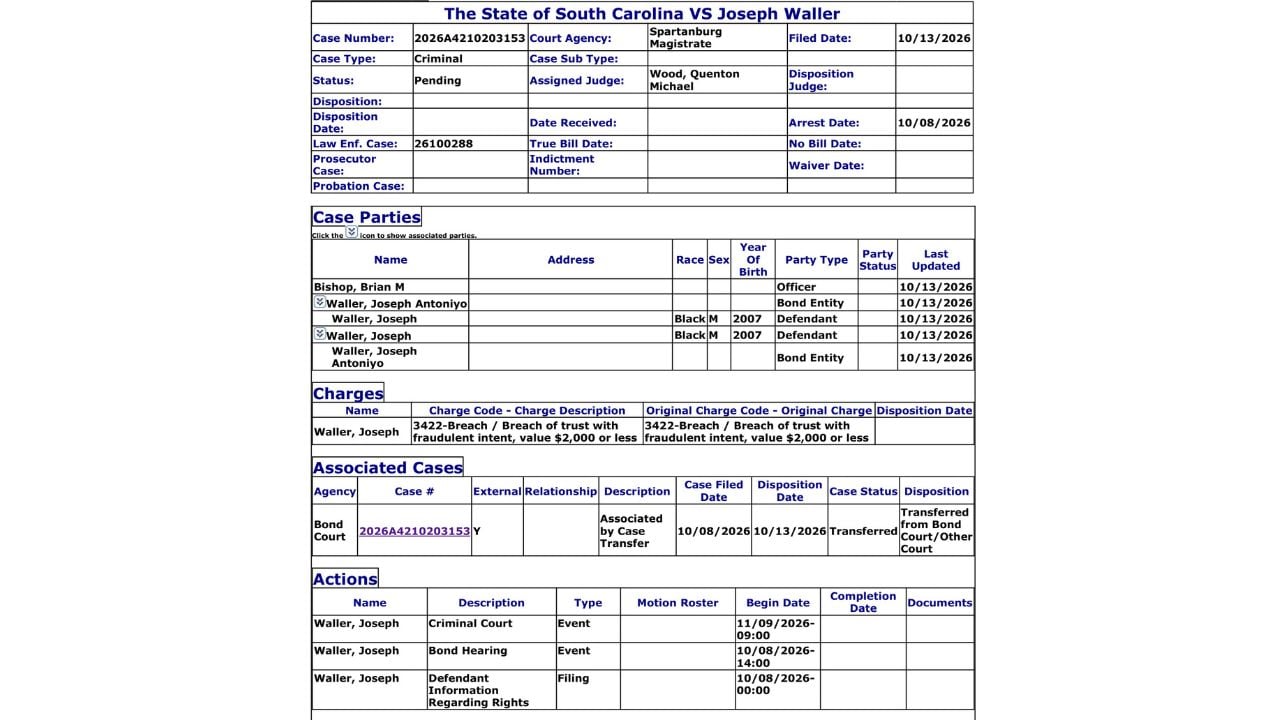
A Spartanburg County court record identifies a separate misdemeanor charge of breach of trust with fraudulent intent involving property valued at $2,000 or less. The case, 2026A4210203153, lists Waller’s arrest on Oct. 8 and was filed with Spartanburg Magistrate Court on Oct. 13. Its status is pending.
The case record schedules a court appearance for Nov. 9 at 9 a.m. It also lists a $2,000 personal-recognizance bond dated Oct. 8 and recorded as posted that day. Personal recognizance does not establish that $2,000 in cash was paid. The value threshold in the breach-of-trust count does not establish the cost of the tickets or the winnings allegedly collected.
In its October 12 release, SLED separately announced the felony lottery-fraud charge and said the 7th Circuit Solicitor’s Office would handle the prosecution. The lottery warrant bears the different identifier 2026A4210203173. Earlier court reporting lists Dec. 17 for that charge. Waller has not been convicted of either offense.
Lottery Fraud Law Covers More Than Physically Counterfeit Tickets
The charge named on Waller’s warrant is “intent to defraud, counterfeit game tickets,” but that statutory description does not necessarily mean a suspect printed imitation scratch-offs. Section 59-150-260(A) of South Carolina’s lottery law also prohibits knowingly passing or altering lottery tickets with the required intent to defraud.
A conviction under that provision can carry up to five years in prison, a fine of up to $50,000, or both. The factual allegation in Waller’s warrant concerns taking tickets from the store’s inventory and redeeming them without paying, rather than producing fake ticket stock.
The separate breach-of-trust offense falls under Section 16-13-230. When the amount involved is $2,000 or less, the statute classifies it as a misdemeanor with a maximum punishment of 30 days in jail or a $1,000 fine. The two reported offenses have distinct elements and maximum penalties.
Another Circle K Worker Faced Separate Lottery Allegations in August
The Spartanburg County investigation follows an unrelated case involving another Circle K employee. In August, SLED charged Jayda Delise Norton, 18, of Inman, with lottery fraud and breach of trust involving more than $2,000 but less than $10,000. Investigators alleged she took scratch-off tickets from a Circle K at 1812 East Main Street in Spartanburg and redeemed some for cash.
Norton’s allegations concern transactions between June 9 and June 26 and a different store from the one in Waller’s case, according to WYFF. SLED has not identified a connection between the two defendants or said the alleged conduct was coordinated.
Stolen Ticket Rules Can Leave Retailers Responsible for Missing Packs
South Carolina law gives lottery retailers specific reporting duties when instant tickets are stolen. Under Section 59-150-220, stores must notify both local law enforcement and the lottery’s security division. The financial treatment depends in part on whether the stolen ticket books had been activated or tickets from those books had been sold.
For activated books, the retailer may be charged a net sales amount adjusted for qualifying unpaid low-tier prizes. The statute establishes conditions and deadlines for reporting a police case number and receiving credit for recovered tickets. It expressly denies credit for recovered tickets already validated, while requiring the lottery to flag reported stolen books to prevent later validation and payment.
These rules explain why a ticket shortage can create an accounting problem even beyond the missing paper. The public warrant does not establish what Circle K was charged, credited or reimbursed in Waller’s particular case.
Lottery Tells Stores to Track Packs and Preserve Surveillance
The South Carolina Education Lottery’s retailer guidance recommends securing ticket packs until they are ready for sale and keeping shift-by-shift inventory logs with game, pack and beginning and ending ticket numbers. It also advises retailers to review surveillance footage regularly and retain video for at least one week.
When tickets are missing, stores should promptly notify police and call the lottery’s 24-hour security hotline at 1-866-269-5668. The lottery asks for ticket-identification information, the date and time of the suspected theft, the responding agency and the police case number. Its guidance says employees should not confront people with suspicious tickets and should preserve available video and transaction evidence for investigators.