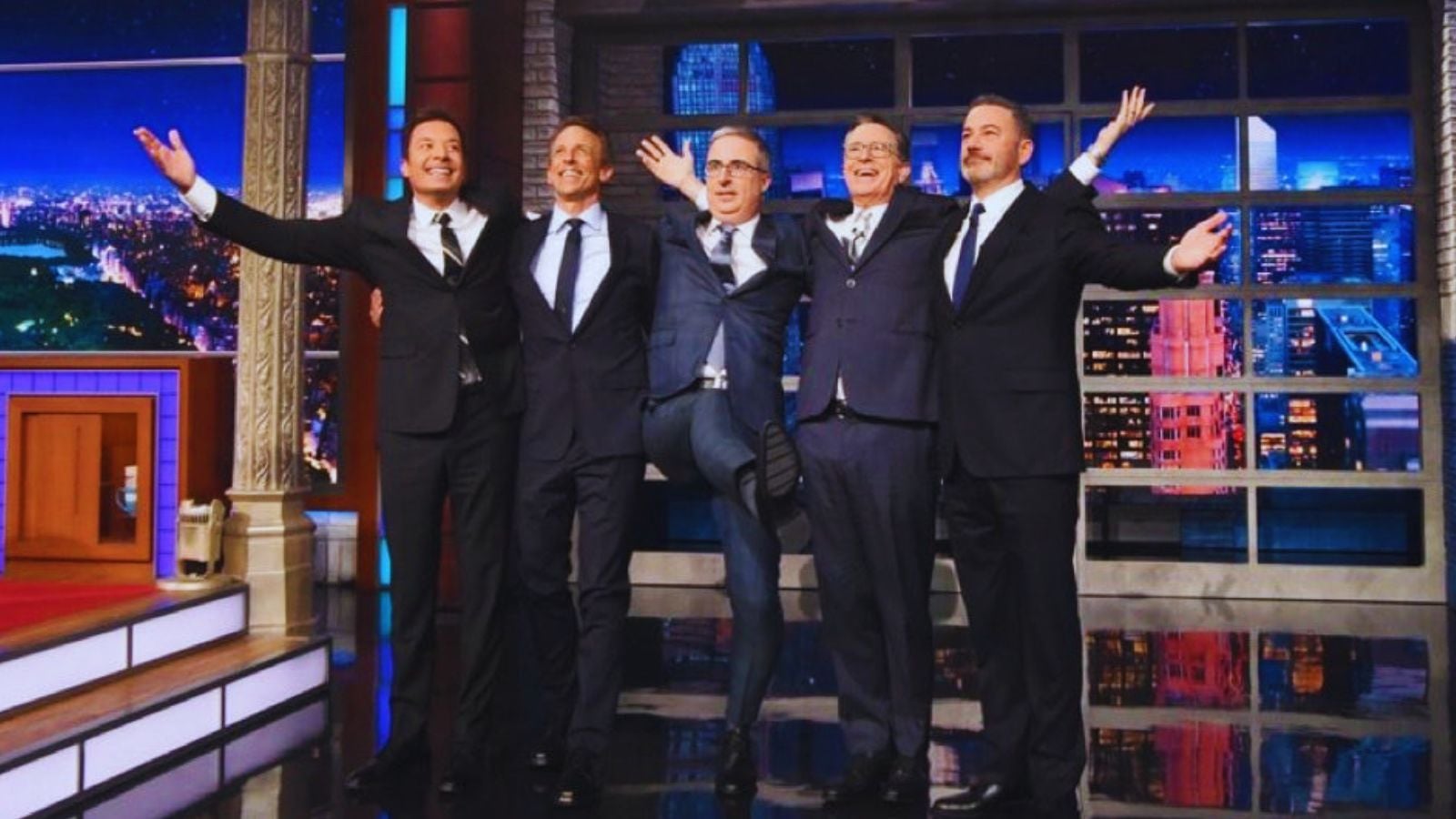
If you watched late-night TV on May 11, 2026, you witnessed something that rarely happens. Stephen Colbert pulled off what felt like a reunion nobody knew they needed, bringing Jimmy Kimmel, John Oliver, Seth Meyers, and Jimmy Fallon together on his stage for what was essentially a farewell gathering.
His final broadcast is scheduled for May 21, 2026, and CBS has been very clear that the decision to end his run is purely financial, tied to parent company Paramount’s ongoing merger with Skydance and the cost-cutting that comes with it. But sitting there watching five of the biggest names in late-night television share one couch, you got the sense that this was about a lot more than budget lines and corporate strategy.
The whole thing carried this much weight because everyone in that room knew the industry they’d built their careers in was shifting beneath their feet. Linear television is under pressure, its audiences are fragmenting across platforms, and the political environment has turned its nightly monologues into something that feels almost dangerous.
As a story lover, watching this play out felt like catching the final scene of a long-running series you have been following for years, where all the characters finally end up in the same room before everything changes.
The Audience of One
The conversation on stage moved quickly toward something genuinely surreal about the current media moment. These hosts revealed that Donald Trump regularly watches their shows and reacts to their monologues in real time on Truth Social, while the broadcasts are still airing.
Seth Meyers said, with what sounded like genuine amusement, that he actually appreciates that Trump is tuning into linear television, because if he were to ‘make my case for late-night,’ it’s that leaders of the free world are watching it when it airs.
That is not a small thing to sit with. These men spend their nights writing jokes and crafting monologues, and somewhere across town, or across the country, the most powerful person in the room is watching and firing off posts before the credits roll.
Meyers framed it as ironic validation, and the panel seemed to agree that this strange feedback loop has turned the late-night monologue into something closer to a live conversation with the very subjects being discussed. It is flattering and unsettling at the same time, and none of them seemed entirely sure which feeling wins.
The Melania Dispute and Administrative Pressure
Kimmel’s hateful and violent rhetoric is intended to divide our country. His monologue about my family isn’t comedy- his words are corrosive and deepens the political sickness within America.
People like Kimmel shouldn’t have the opportunity to enter our homes each evening to…
— First Lady Melania Trump (@FLOTUS) April 27, 2026
Jimmy Kimmel’s segment of the conversation was where things got genuinely tense. When Colbert asked whether any of them expected their careers to stir this level of reaction from an actual sitting president, Kimmel pointed to the deeply personal turn his situation has taken, saying there is something truly strange about doing a job that the First Lady has strong feelings about.
He was referring to the fallout from his April 23, 2026, appearance on Jimmy Kimmel Live!, where he parodied the White House Correspondents’ Dinner and joked that Melania Trump had “a glow like an expectant widow.”
Two days later, on April 25, a gunman attacked a security checkpoint at the dinner venue, and an attempted-assassination charge followed. Trump then publicly linked Kimmel’s joke to the attack, with no evidence, calling it a “despicable call to violence” and demanding that ABC and its parent company Disney fire Kimmel immediately.
Kimmel went on air after all of it and clearly condemned the shooting, while also refusing to apologize for the joke itself. He described the “expectant widow” line as a light roast about age difference, and insisted it was not, by any stretch, a call to violence.
The situation has since moved into regulatory territory, with the FCC ordering an early review of ABC’s broadcast licenses shortly after Trump’s complaints, framing it as part of a broader DEI inquiry, while ABC argues the move is a direct threat to its free speech rights.
This is no longer just a feud between a comedian and a politician. The joke, the shooting, the licensing investigation, all of it has collapsed into one very uncomfortable legal and political situation that nobody in late-night has had to navigate before.
The YouTube Migration and the Corporate Ledger
While the Kimmel drama gave the panel its sharpest edge, the conversation happening underneath it all was about money and survival. Jimmy Kimmel acknowledged that their audience has largely migrated to digital platforms. “People watch us on YouTube now. People have a lot of different options and they keep coming to us”.
That migration is precisely why CBS cited financial reasons when it announced in 2025 that Colbert’s show would end. The metrics that once justified a flagship late-night slot on a major network are now harder to sustain in a market where the audience is spread across a dozen platforms. Some observers have asked whether political pressure played any role in the timing, given how loudly and consistently Colbert has clashed with Trump, but the reporting so far points to finances and corporate strategy as the driving factors.
What the panel made clear, sitting together on that stage, is that these shows are performing for two completely different audiences simultaneously: the millions of people watching clips on social media, and the small group of executives holding the spreadsheet that determines whether the show continues to exist.
The Final Week of the Linear Era
The presence of Fallon, Meyers, Oliver, and Kimmel on Colbert’s stage ten days before his finale felt like something deliberate. They were closing ranks around one of their own, yes, but they were also marking a moment that all of them seem to understand is significant beyond just one man’s exit.
They may be the last generation of hosts who hold this specific kind of cultural power, where a joke lands at 11:30 PM and by midnight, the president of the United States has posted about it.
Late-night comedy has become a genuine battleground for the bigger debate about speech, corporate responsibility, and who gets to decide when a joke goes too far. When Colbert walks off that stage on May 21, he leaves behind an industry compressed from two directions at once: technology pulling the audience away and political pressure that has turned a comedy show into something with actual legal and regulatory consequences.
Meyers finds it amusing that the free world’s leaders are watching linear television, and honestly, that is one way to look at it. The other way is to recognize that every punchline these men write now carries a kind of weight that nobody who sat in those chairs ten years ago ever had to think about.