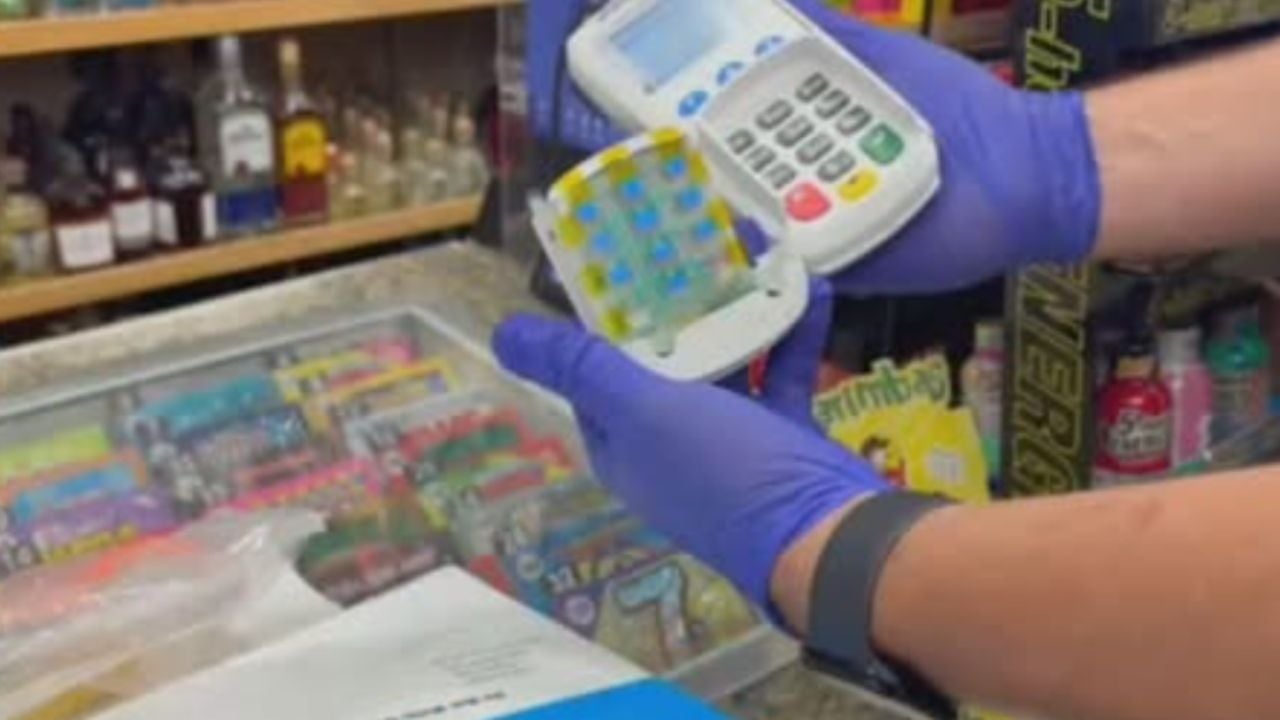
A customer can swipe a card at what appears to be an ordinary checkout terminal and unknowingly give criminals the information they need to steal money from the account.
Hidden skimming devices installed on payment terminals, ATMs and gas pumps can capture card information as customers use the machines. Some also collect PIN numbers, while others can transmit stolen information wirelessly without requiring criminals to return and retrieve the device.
The FBI estimates that card skimming costs financial institutions and consumers more than $1 billion every year. The U.S. Secret Service says law-enforcement agencies have seen skimming activity increase as organized groups target both traditional payment cards and government-benefit accounts.
CBS News accompanied Secret Service agents during a Los Angeles operation as investigators inspected hundreds of businesses for the devices, giving a close look at how easily a fraudulent reader can be concealed on equipment customers use every day.
A Skimmer Can Secretly Copy Every Card That Gets Swiped
Skimmers can be installed over or inside legitimate card readers, allowing the real terminal to continue processing transactions while the hidden equipment copies information from cards used on the machine. At an ATM or point-of-sale terminal, criminals can also add a hidden camera or false keypad overlay to capture the PIN entered by the customer.
The FBI says some ATM skimmers are inserted directly into the card reader, while others fit over the legitimate reader or are attached to exposed wiring. Point-of-sale skimmers used against EBT and other cards are often designed as overlays that closely resemble the terminal underneath them. The FBI says some devices store data for later collection, while others have wireless capabilities that can transmit stolen information in real time to a nearby device.
Once criminals obtain card information and a PIN, they can encode the stolen data onto another magnetic-stripe card and use it for unauthorized purchases or withdrawals. The victim may not realize anything happened at the original checkout terminal because the legitimate purchase can still go through normally.
Some Skimmers Can Be Installed in Seconds
One reason skimming is difficult for stores and customers to prevent is the speed with which a device can be installed. The FBI says a criminal may need only seconds to attach a skimmer to a point-of-sale terminal, sometimes distracting a cashier while an accomplice places the device.
Modern skimmers can also be made to fit tightly over legitimate equipment. During the Secret Service operation observed by CBS News, investigators encountered devices that were difficult enough to remove that agents had to pry them from terminals.
That can make the fraudulent equipment difficult to distinguish from the machine underneath it. A customer who sees an apparently normal keypad, display and card slot may have no reason to suspect another layer has been placed over the terminal.
Secret Service analyst Vince Porter told CBS News that there can also be no easy way to determine how long a discovered skimmer has been operating. Every additional day potentially exposes more cards and PINs to the people controlling it.
One Device Can Potentially Produce About $1 Million in Fraud
A device positioned at a busy grocery store, ATM or other frequently used terminal can collect information from a large number of cards before anyone discovers it. Porter told CBS News that Secret Service officials estimate a single skimmer can potentially generate as much as $1 million in stolen funds.
The agency used a similar estimate when calculating the potential losses prevented through its nationwide enforcement operations. That figure represents potential fraud rather than a guarantee that every device will actually steal $1 million.
The amount criminals obtain depends on factors including how long the device remains in place, how many cards are compromised and how quickly banks, benefit agencies or victims detect the fraudulent transactions. The FBI currently estimates that skimming costs financial institutions and consumers more than $1 billion annually.
Secret Service Teams Removed 411 Skimmers in 2025
The Secret Service has responded with coordinated inspections involving federal, state and local law-enforcement agencies around the country. During 2025, the agency and its partners conducted 22 skimming operations and visited more than 9,000 businesses. Investigators inspected nearly 60,000 point-of-sale terminals, ATMs and gas pumps and removed 411 illegal skimming devices.
Using its estimate of the potential loss associated with each device, the Secret Service calculated that removing those skimmers prevented approximately $428.1 million in potential fraud. The agency has said those operations are only part of the broader effort.
Investigators are also pursuing the criminal organizations behind the devices rather than limiting enforcement to removing skimmers from individual stores. CBS News reported that its investigation identified 32 active federal skimming investigations across 15 states, reflecting how widely the activity has spread.
Agents Found 16 Skimmers During the Los Angeles Operation
During the California operation observed by CBS News, agents visited 328 businesses and examined 1,749 payment devices. They discovered 16 illegal skimmers. The Secret Service estimated that removing those 16 devices prevented approximately $16.6 million in potential fraud.
CBS News reported that similar operations have been conducted in dozens of cities. Secret Service officials told the network that major metropolitan areas such as Los Angeles can be particularly active locations for skimming, although the devices are not limited to large cities.
The agency’s 2025 nationwide operations included locations ranging from Los Angeles and New York to San Antonio, Atlanta, Tampa, Boston, Miami, Pittsburgh and other communities.
One Mother Said Her Benefits Simply Disappeared
Government-benefit recipients can be especially exposed because many Electronic Benefits Transfer cards still depend on magnetic-stripe transactions rather than the chip technology found on most modern debit and credit cards. The FBI says EBT data has been a significant target for skimming groups since at least 2021.
The FBI says criminals often time their withdrawals or fraudulent purchases around the periods when benefits are added to accounts. EBT cash benefits can be targeted shortly after monthly funding arrives, while stolen SNAP credentials can be used for bulk purchases of products that criminals can resell.
CBS News spoke with Mary Bowen, a mother of six who relies on government assistance and said her benefits had recently been stolen. Bowen said the theft left her unable to pay rent or buy groceries and forced her to rely on friends for food.
Tap-to-Pay Can Avoid the Magnetic-Stripe Swipe
For consumers whose cards and payment terminals support it, Secret Service officials recommend avoiding the magnetic-stripe swipe whenever another secure payment method is available. Special Agent Michael Peck told CBS News that tap-to-pay is the best option consumers can use to protect themselves from the type of skimming the agency was targeting.
Chip-enabled cards also provide better protection against traditional magnetic-stripe cloning. The FBI says there are fewer devices in the United States designed to steal chip data than magnetic-stripe data, although the magnetic stripe on the back of a chip card can still be vulnerable when it is swiped.
Check the Reader Before Putting Your Card Into It
The FBI recommends looking closely at ATMs, gas pumps and checkout terminals before using them. Anything loose, crooked, scratched, damaged or inconsistent with the rest of the machine can indicate that an additional device has been attached.
Consumers can gently pull at the edges of the keypad or card reader before entering a PIN. A legitimate part of the terminal generally should not shift or separate easily, while an overlay may move when pressure is applied. Covering the keypad with the other hand while entering a PIN can also prevent a hidden camera from recording the number.
Debit-card users should be particularly careful when the card provides access to multiple linked accounts. EBT users should regularly check balances, especially around the time monthly benefits are deposited, and change the PIN quickly if anything suspicious appears.
Anyone who finds what appears to be a skimmer should stop using the terminal and alert the store, bank or gas-station operator. Suspected skimming and resulting fraud can also be reported through the FBI’s Internet Crime Complaint Center.