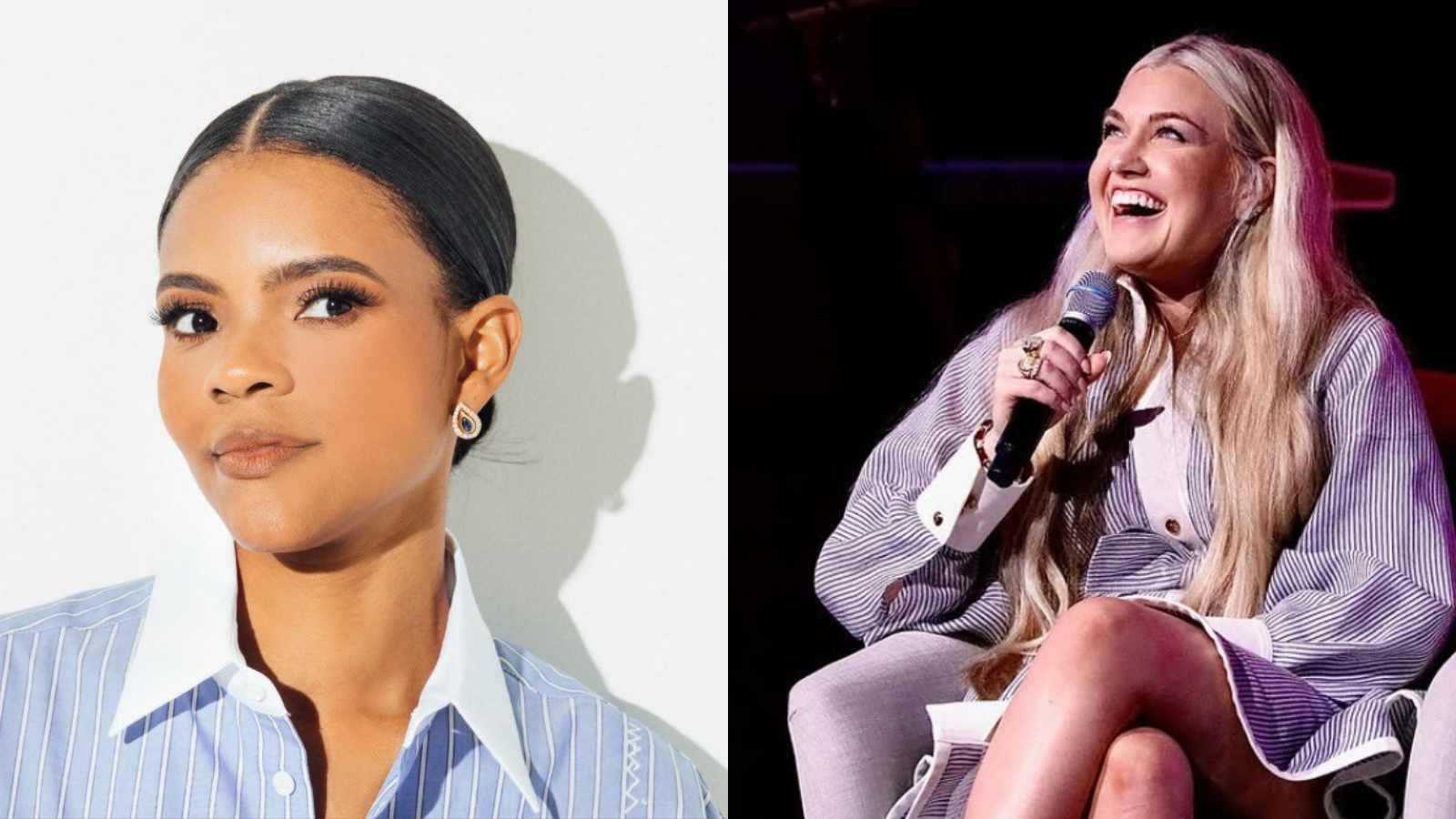
Less than seven months after the assassination of her husband, Turning Point USA founder Charlie Kirk, Erika Kirk is back in the headlines, and not in the way anyone would hope.
Now serving as CEO of TPUSA, she was set to appear alongside Vice President JD Vance at a high-profile campus event at the Akins Ford Arena in Athens, Georgia. Then, just before the event, she pulled out.
The official reason was “serious threats” against her safety, according to TPUSA spokesman Andrew Kolvet. But here is where it gets messy. The arena, which holds about 8,500 people, looked roughly 25 percent full during Vance’s appearance.
And just like that, what should have been a straightforward security decision turned into a full-blown public spectacle. Because once those empty seats hit the timeline, the narrative stopped being about safety and started being about something else entirely.
Candace Owens Did Not Come to Play Nice
Candace Owens saw the moment and did not hesitate. She posted on X, calling the situation “exhausting” and directly accusing Kirk of pulling out because of “bad ticket sales”, not safety concerns. She argued that if there had been a real threat, the Vice President would not have gone ahead with the event.
Stop. This is exhausting. You pulled out because of bad ticket sales. For the same reason TPFaith had to “reschedule” the Pastor’s Summit and various other events quietly.
People don’t believe you and don’t line up for you because you struggle to tell the truth about even the… https://t.co/5MWC9SOZo5— Candace Owens (@RealCandaceO) April 14, 2026
To be clear, that claim is unverified. No ticketing data or financial figures have been released to support it. What does exist are images and videos showing large sections of empty seats in a venue built for thousands. And with the internet economy, optics travel faster than facts.
This clash did not come out of nowhere either. Owens and TPUSA have been circling each other for months, especially after Charlie Kirk’s assassination in September 2025. Owens has pushed conspiracy theories, referenced alleged leaked audio, and even challenged the organization’s audience numbers tied to major events.
So when this moment arrived, it did not feel random. It felt like the next episode in a long-running political reality show that nobody signed up for, but everyone is now forced to watch.
Grief Is Not Supposed to Be a Group Sport, and Yet Here We Are
JD Vance did not ignore the noise. He walked straight into it. Speaking onstage in Athens, he defended Erika Kirk in unusually direct terms, saying “everyone is attacking her over everything” and calling the situation “disgraceful”.
He made it clear he was not even sure the event would happen, admitting he was worried it might be canceled because of how distressed she was. Then he addressed the deeper issue. The criticism of how she is grieving her husband.
Vance called that line of attack “preposterous” and told critics to stay in their lane, reminding the audience that “grief is complicated”.
Because this has not just been about one canceled appearance. Since Charlie Kirk’s death, Erika has faced nonstop speculation about her personal life, including rumors about her relationship with Vance himself. Second lady Usha Vance shut that down bluntly, calling it a “fever dream” and pointing people back to reality.
Erika responded in her own style, brushing off one wave of criticism by saying anyone hating on a hug probably needs one themselves.
At some point, the conversation stopped being political and turned deeply personal.
The Brand Says Empire. The Arena Said Otherwise
Turning Point USA seems to have misestimated crowd size for Vance. Akins Ford Arena less than 25% filled for the vice president. pic.twitter.com/K2SnkmuATh
— Jake Traylor (@jake__traylor) April 14, 2026
TPUSA positions itself as a political machine with massive campus presence and a growing national influence. On paper, it is a powerhouse. Which is why the Athens turnout hit differently.
A co-headlined event featuring the sitting Vice President, drawing roughly 2,000 people in an 8,500-seat arena, creates a visual that is hard to ignore. Not definitive, but definitely loud.
And that is the problem. It does not prove Owens was right about ticket sales, but it gives her argument something to stand on. In a media environment where perception often becomes reality before facts catch up, a half-empty room can overshadow any official explanation.
This is the tightrope TPUSA is now walking. Maintaining the image of a massive movement while navigating moments that suggest a gap between online influence and real-world turnout.
What Happens When the Right Turns on Its Own
There is a bigger story unfolding here, and it is not just about one event in Georgia. Conservative media, like every high-engagement ecosystem, has developed a habit of turning inward. The same energy used to build influence can be quickly redirected against its own players.
Erika Kirk stepped into leadership under impossible circumstances. Seven months after losing her husband in a violent attack, she is running a national organization, making media appearances, hosting town halls, and even meeting privately with critics like Owens in what she described as “productive conversations”.
She has also tied TPUSA’s future closely to JD Vance, pledging strong support for a potential 2028 presidential run.
And yet, every move she makes gets dissected. A canceled appearance becomes a scandal. A hug becomes a headline. A safety concern becomes a conspiracy theory. So yes, this is no longer just politics. It is performance, and the audience is grading every second.
I was so looking forward to tonight’s event at the @universityofga with our Vice President @JDVance, but after all our family has been through, I take my security team’s recommendations extremely seriously. Thank you to our amazing Georgia chapter for your support. God bless you… https://t.co/f2rBre9ArJ
— Erika Kirk (@MrsErikaKirk) April 14, 2026
Searching for the Truth Behind the Security Gate
One question still lingers over everything, and that is, what exactly were the threats?
TPUSA and Vance have both confirmed that security concerns were real and serious. But there have been no detailed reports, no arrests, and no public evidence released so far.
That gap leaves space for speculation, and speculation is exactly where this feud thrives. Without hard data, the story splits into two competing versions. One is a widow prioritizing her safety after a traumatic loss. The other is a public figure stepping back from an event that may not have been performing well.
Right now, both narratives are running simultaneously, and the internet is choosing sides in real time.
What Happens When the Spotlight Never Turns Off?
Zoom out, and this moment feels bigger than Erika Kirk or Candace Owens. It is about what happens when politics fully merges with influencer culture. Every decision becomes content. Every reaction becomes part of the story. And there is no off switch.
The empty seats in Athens might fade from the timeline, but the deeper tension will not. So the question is: Who controls the narrative? Who gets believed? And how much of a public figure’s personal life is fair game for debate?
For Erika Kirk, the challenge now is not just leading an organization. It is holding onto her own story in a space where everyone else is trying to rewrite it in real time. Because in this version of the spotlight, even stepping back becomes a headline.