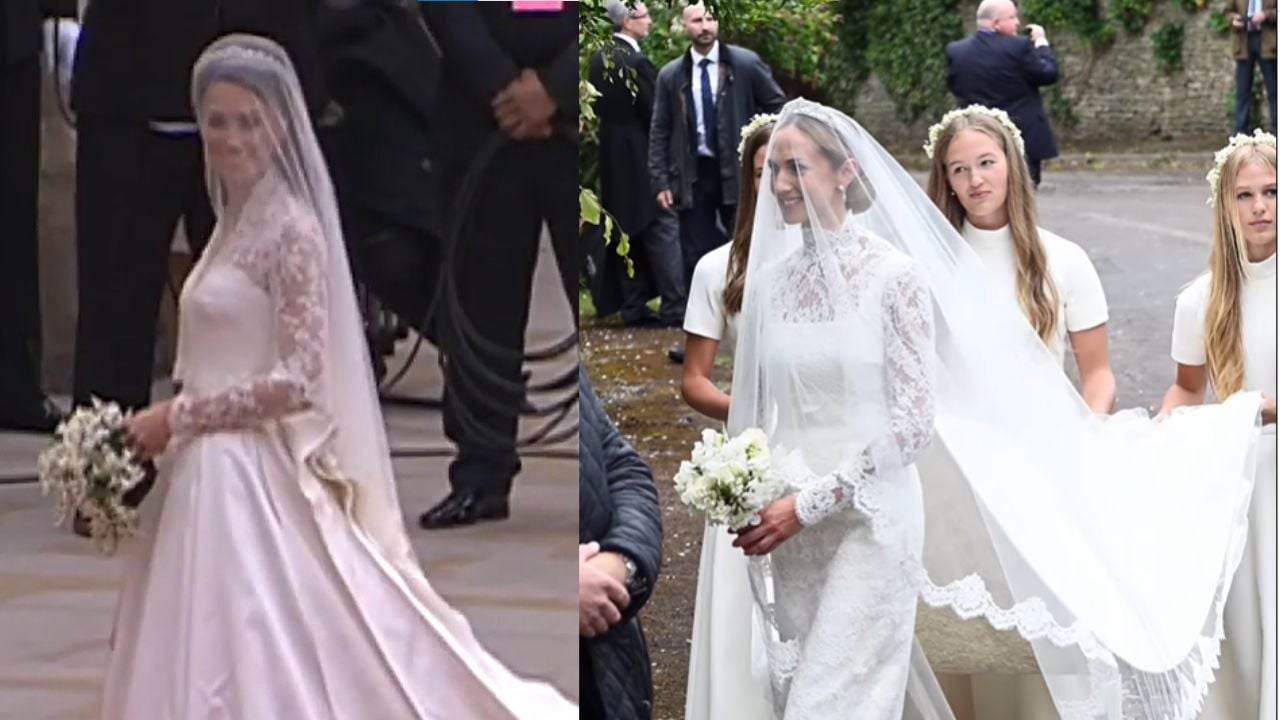
Harriet Sperling’s royal wedding dress carried an unmistakable Princess Kate connection, but not because it copied the Princess of Wales’ famous 2011 gown.
When Sperling married Peter Phillips at All Saints’ Church in Kemble, Gloucestershire, on June 6, she chose Emilia Wickstead, a designer long associated with polished royal dressing and frequently worn by Kate. People reported that Sperling’s custom gown blended traditional bridal formality with Wickstead’s clean, modern lines, creating a look that felt royal without looking like a direct remake of another royal bride’s dress.
The Kate Connection Started With the Designer
Wickstead has become one of Kate’s most reliable fashion choices, especially for sharp coat dresses, refined tailoring, and formal daytime looks. That made Sperling’s choice of designer immediately notable for royal watchers.
British Vogue described Wickstead as a favorite of the royal family and noted that the Princess of Wales has worn the designer on many occasions. Vogue reported that Kate wore a royal-purple Emilia Wickstead coat dress in 2025 to mark the 80th anniversary of VE Day in London.
Sperling’s Dress Was Traditional, but Not Old-Fashioned
View this post on Instagram
The gown was built around a square-neck column underdress, a delicate lace overjacket, and a dramatic three-metre train. Wickstead told Vogue that she and Sperling aligned on something “authentic, traditional and modern.”
Peter Phillips is not a working royal, but he is Queen Elizabeth II’s eldest grandchild and Princess Anne’s son, so the ceremony still called for formal bridal dressing. Sperling’s gown delivered that through lace, a train, a veil, and a tiara, while Wickstead’s column shape kept the silhouette clean rather than heavy.
The Lace Echoed Kate’s Bridal Language
The most obvious visual link to Kate’s 2011 wedding look came through the lace. Kate’s Alexander McQueen gown by Sarah Burton became one of the defining royal bridal images of the modern era, with its lace bodice, long sleeves, and formal silhouette.
Sperling’s dress did not duplicate that design, but the lace overjacket, high neck, transparent sleeves, and long veil naturally called Kate’s bridal style to mind. People noted that the lace bodice and flowing veil evoked Kate’s wedding gown, while also emphasizing that Sperling’s dress came from Wickstead, not Alexander McQueen.
The Wildflower Details Made the Dress Personal
Vogue reported that the lace detailing on Sperling’s gown and veil nodded to wildflowers native to Gloucestershire, where both the bride and groom grew up. That gave the dress a local meaning beyond royal fashion references.
The lace itself used a prairie-flower motif dating back to the early 1900s, while the gown was crafted from Italian ivory crepe. Those details helped keep the dress from feeling like a generic royal wedding uniform. It was formal, but it also had a quiet connection to place.
Her Accessories Added Royal Drama
Sperling completed the look with a lace veil, custom ivory satin Jimmy Choo heels, and a tiara and earrings by Pragnell. The tiara choice stood out because modern royal second weddings have not always included one.
Princess Anne skipped a tiara when she married Sir Timothy Laurence in 1992, and Queen Camilla chose headpieces rather than a tiara for her 2005 wedding events. Sperling’s Pragnell tiara gave the ceremony a more classic bridal finish while keeping the jewelry separate from Princess Anne’s own tiara collection.
The Bridesmaids Connected the Look to Both Families
Wickstead also designed the dresses for Sperling’s three bridesmaids: her daughter Georgina, and Phillips’ daughters Savannah and Isla from his previous marriage to Autumn Kelly. Vogue reported that their dresses were made from the same Italian crepe used for Sperling’s gown.
The shared fabric gave the bridal party a subtle visual link. It also made the fashion story part of the family story, with all three girls dressed in a way that connected them to the bride without copying her gown.