
A Florida man accused of posing as a Connecticut public school employee to redirect the worker’s paycheck was identified after police sought records tied to the bank account provided in the alleged payroll scheme.
Jack Hennel Hawkins, 33, of Milton, Florida, faces third-degree identity theft and attempted fifth-degree larceny charges. Plainfield police say someone impersonated an active employee and contacted the Plainfield Public Schools payroll department about changing that worker’s direct deposit instructions.
Investigators obtained a warrant for financial records associated with the account named in the request, then worked with the Santa Rosa County Sheriff’s Office in Florida to identify a suspect. Hawkins was taken into custody in Florida on September 25, 2026, before Connecticut investigators brought him back on October 14.
Police announced the case October 15, when Hawkins was scheduled to appear in a Connecticut court on a $5,000 bond. Authorities have described an attempted theft, not a completed diversion of wages, and the allegations have not resulted in a conviction.
Someone Posing as a School Employee Contacted the Payroll Office
Plainfield Public Schools contacted police in January 2026 after discovering a suspected attempt to divert an employee’s earnings. According to WFSB, which reported the department’s statement, the individual was posing as a current school employee while asking the payroll office about changing the employee’s bank information. The report prompted an inquiry by Plainfield’s Special Investigations Unit.
Direct deposit instructions determine which account receives a worker’s wages. If an employer accepts a request from an impersonator, the next paycheck can be deposited into an account the legitimate employee never authorized.
Bank Account Information Helped Investigators Identify Hawkins
Plainfield investigators applied for a search and seizure warrant in Connecticut’s Judicial District of Windham to obtain financial records associated with the bank account number used in the attempted payroll change. A judge granted the request, allowing police to pursue the account information through legal process.
Investigators said the financial inquiry, combined with assistance from the Santa Rosa County Sheriff’s Office, helped identify Hawkins as a suspect. Connecticut authorities then obtained an arrest warrant charging him with third-degree identity theft and criminal attempt to commit fifth-degree larceny, according to Patch.
Florida Jail Records Confirm September 25 Arrest and October 14 Release
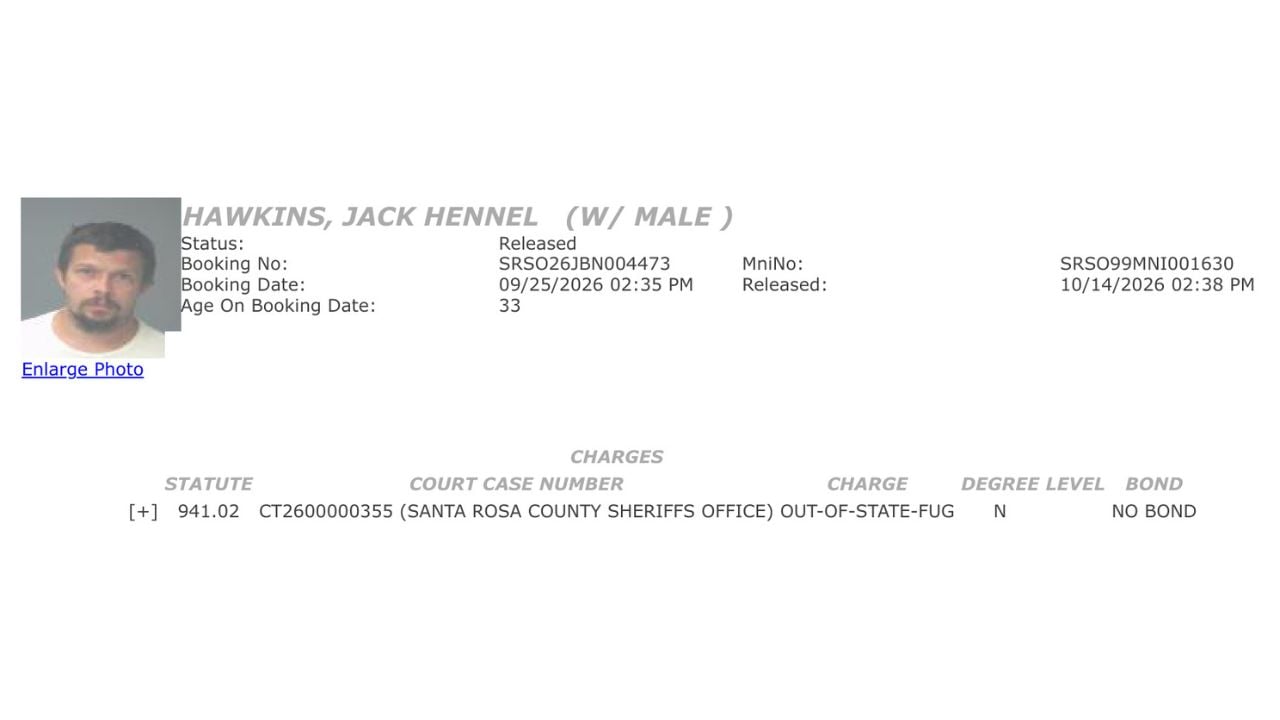
An official Santa Rosa County Sheriff’s Office jail record independently lists Hawkins’ booking on September 25, 2026, at 2:35 p.m. The booking was recorded as an out-of-state fugitive matter, under booking number SRSO26JBN004473.
The same record shows his release from the Florida jail on October 14 at 2:38 p.m. Plainfield police said members of its Special Investigations Unit traveled to Florida that day, took custody of Hawkins and flew him to Connecticut.
After being processed at the Plainfield Police Department, Hawkins was held on a court-set $5,000 bond. Police said he was scheduled to appear before a judge in the Judicial District of Windham on October 15.
Identity Theft and Attempted Larceny Are Separate Charges
Under Connecticut law, third-degree identity theft is a Class D felony. The offense concerns unauthorized use of another person’s identifying information to obtain or attempt to obtain money, property or other benefits.
The other accusation involves a criminal attempt to commit fifth-degree larceny. Fifth-degree larceny is a Class B misdemeanor generally involving property or services valued above $500. That threshold describes the legal category, not the value of a paycheck established in this case.
How Payroll Departments Can Stop Fake Direct Deposit Requests
The FBI’s Internet Crime Complaint Center has warned that criminals sometimes impersonate employees when approaching payroll or human resources departments and ask for new direct deposit accounts. That is different from gaining access to an employee’s own payroll account and changing the banking information there.
In an unrelated April 2026 advisory, Connecticut’s state payroll operation directed agencies to verbally verify employees’ requests to change direct deposit information to Green Dot Bank accounts.
Employers can independently contact employees through telephone numbers or secure channels already on file before approving banking changes. Workers should review payroll change notices and check that wages reach their expected accounts. If a paycheck goes missing or an unauthorized change appears, contact the employer and bank immediately and report suspected internet-enabled fraud to the FBI at IC3.gov.