
Ilhan Omar is not a millionaire. That is what her office says, and the amended congressional financial disclosure filed this week appears to back it up. The filing, reviewed by The Wall Street Journal, puts her and her husband Tim Mynett’s shared assets between $18,004 and $95,000 — a long way from the earlier disclosure that listed their holdings as high as $30 million.
The millionaire headline is dead. A harder and more durable question survived it.
How the $30 million story got on paper
When Omar filed her annual congressional 2024 financial disclosure in May 2025, the numbers were startling. She and Mynett reported assets between $6 million and $30 million — a roughly 3,500 percent jump from the year before. The spike was entirely due to two businesses tied to her husband: Rose Lake Capital, a Washington, D.C.-based venture capital firm valued at between $5 million and $25 million; and eStCru, a Santa Rosa, California winery valued at between $1 million and $5 million.

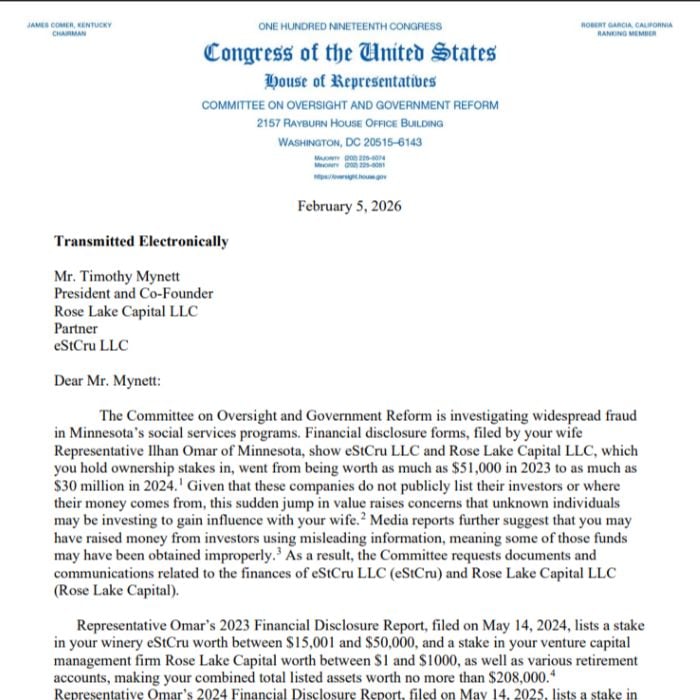
Those figures drew immediate and sustained scrutiny, and not just from Republicans. The year before, in her 2023 financial disclosure, Rose Lake Capital had been listed as worth between $1 and $1,000. The winery had been valued at no more than $50,000 in 2023. Then, in a single year, both businesses appeared to surge into the millions on paper.
House Oversight Committee Chairman James Comer formally raised concerns in February 2026, writing directly to Mynett and asking how the companies had accumulated so much value so quickly. His letter flagged the jump and said it “raises concerns that unknown individuals may be investing to gain influence” with Omar. Omar’s office called the inquiry a political stunt, and AP noted the move was unusual because ethics panels usually handle allegations involving lawmakers and their family members. In March, the nonpartisan Office of Congressional Conduct sent its own letter requesting additional information. The amended disclosure followed.
The assets vanished. The income didn’t
The amendment zeroed out both businesses entirely. Rose Lake Capital: no net value once liabilities are taken into account. EStCru: same. The couple’s total assets dropped from as high as $30 million to between $18,004 and $95,000. Omar’s office called it a voluntary correction made as soon as the error was identified.
But the amended filing did not zero out the income.
The same disclosure that erased the asset values still reports between $102,503 and $1,005,200 in 2024 income tied to those same businesses. That includes $213,200 in documented distributions from Rose Lake Capital and $3,000 from the winery. Those are real dollars, not accounting phantoms, and they are part of the story that still bites.

This is where the explanation runs thin. A partnership can, under certain accounting structures, distribute cash to its owners while showing little or no net equity once loans and liabilities are taken into account. That is a legitimate accounting outcome. But Omar’s attorney and accountant submitted letters stating that the original filing was an unintentional error — and, according to the Journal, neither document publicly spelled out which accounting mechanism caused the asset values to collapse to zero. The public has an “accounting error” label and a correction. It does not yet have the specific math.
Omar’s spokesperson, Jacklyn Rogers, told the Journal the matter is now resolved: “The amended disclosure confirms what we’ve said all along: The congresswoman is not a millionaire.” There is no allegation of fraud, and the Associated Press reported no evidence of wrongdoing. The Office of Congressional Conduct, which prompted the amendment, is a nonpartisan body. The correction was made.
The filing changed. The questions didn’t
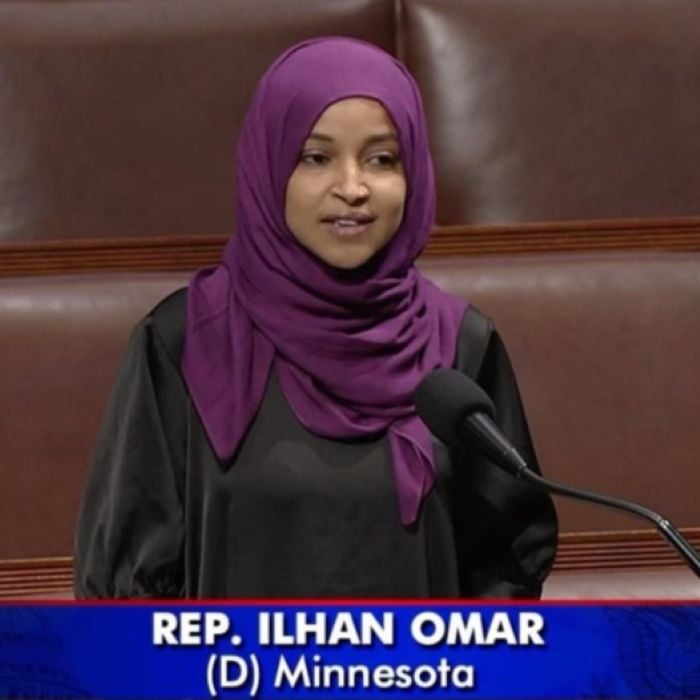
Congressional financial disclosures use broad value ranges rather than precisely audited figures. They are, by design, imprecise instruments. But a swing from $30 million to under $100,000 is not a rounding issue. It is a correction of such magnitude that it raises a legitimate question about the disclosure system itself — regardless of Omar’s politics, regardless of Comer’s motives, regardless of who is scoring points off this story.
If the original values were that far off, and the public explanation from professionals was “accounting error” without further technical detail, the system failed its most basic function. Voters should be able to look at these forms and understand what their representatives own and earn. The amended filing answers the “is she a millionaire” question. It does not answer why businesses once disclosed in the tens of thousands suddenly appeared in the millions, or exactly how and why they became nothing again once liabilities were counted.
Omar may be right that she is not a millionaire. The amended filing successfully rescued her from that headline.
It did not rescue the math from the questions it left sitting there.