
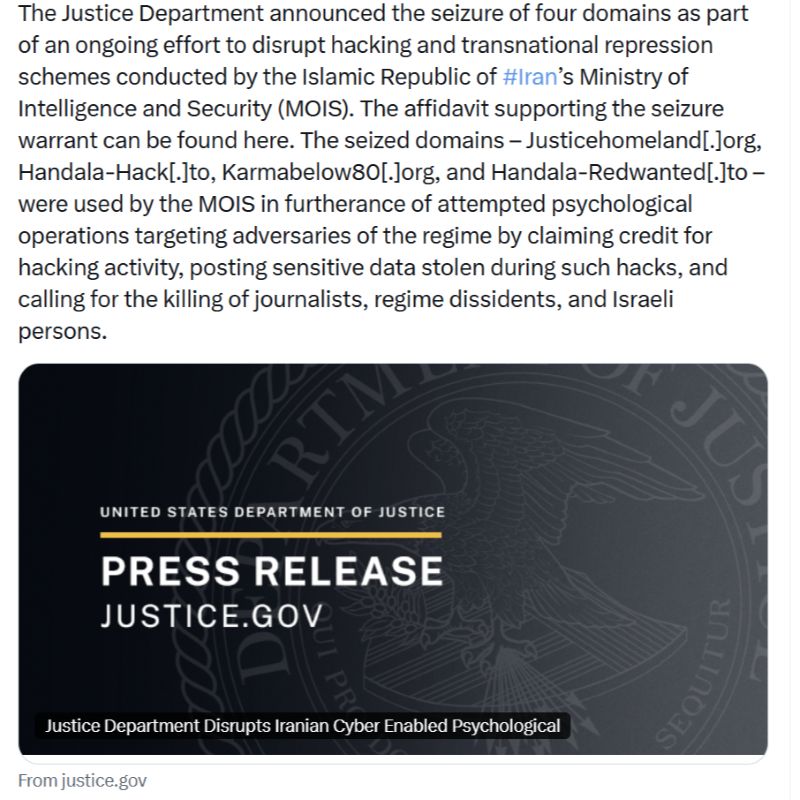
About a week ago, FBI Director Kash Patel stood behind the Justice Department’s announcement that it had seized four internet domains belonging to Handala, an Iranian-linked hacking group the DOJ tied to Iran’s Ministry of Intelligence and Security. The domains, the DOJ said, were used to claim credit for cyberattacks, post stolen data, and call for the killing of journalists, regime dissidents, and Israeli persons.
Patel’s statement was not modest. “Iran thought they could hide behind fake websites and keyboard threats to terrorize Americans and silence dissidents,” he said. “We took down four of their operation’s pillars and we’re not done. This FBI will hunt down every actor behind these cowardly death threats and cyberattacks.”
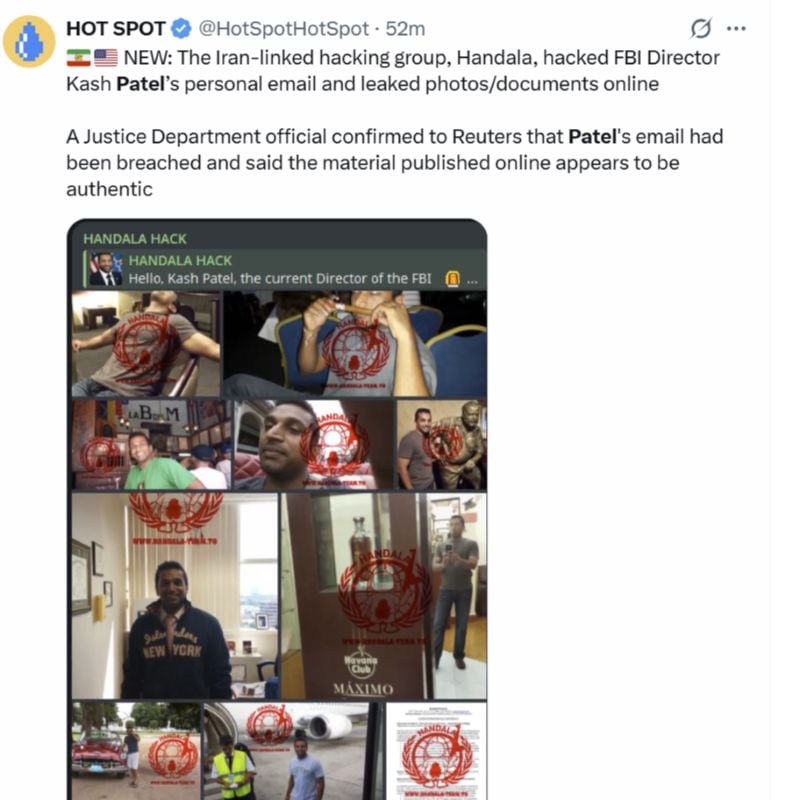
On Friday, Iran-linked hackers claimed they had breached Patel’s personal email account. A Justice Department official told Reuters the material published online appeared authentic. The group posted photographs of the FBI director and other documents. Its message, posted on its website, taunted him by name.
The pillars did not stay down.
The Timeline That Writes Itself
March 19: The Justice Department seizes four Handala domains, and Patel says the FBI took down “four pillars” of the operation.
March 20: Reuters reports that the group’s website is back up a day after the seizure.
March 23: At a White House event in Memphis, Trump turns to Patel and says “Kash, see if you can top that,” referring to Stephen Miller’s praise. Patel responds: “Mr. President, thank you for delivering the safest country on God’s green Earth.”
March 27: The same Iranian hacking group whose websites Patel said he had knocked out breaches the personal email of the man who said he had knocked them out. Handala taunts him by name. The FBI did not immediately respond to a request for comment.
Eight days. That is how long the victory lap lasted.
The Part That Makes It Worse
Earlier this month, MSNOW reported that Patel’s latest round of FBI firings had ousted agents and staff from a unit with expertise on Iran. House Democrats pointed to that reporting in a March 4 letter, warning that firing counterespionage personnel with Iran-specific knowledge just days before Trump ordered strikes on Iran raised questions about the FBI’s ability to identify and counter Iranian operations on U.S. soil.
According to those reports, Patel fired people who understood the threat. Then he declared victory over the threat. Then the threat came for him personally.
Handala is not a minor operation. The Justice Department said the group carried out “faketivist” psychological operations using stolen data, offered a $250,000 bounty for the execution of dissidents, and claimed credit for a destructive malware attack against a U.S.-based multinational medical technologies firm. According to the DOJ, Handala is one of several personas used by a hacking unit operating under Iran’s Ministry of Intelligence and Security.
“The Safest Country on God’s Green Earth”
That quote deserves a moment. Four days before the breach became public, Patel told Trump at a White House event in Memphis, on camera, “Mr. President, thank you for delivering the safest country on God’s green Earth.”
This is the same FBI director who has spent his tenure firing career agents and delivering the kind of praise that got mocked online. The job of the FBI director is not to flatter the president. It is to protect the country. And right now, the country’s top law enforcement official could not keep his own personal inbox safe from the same group he publicly taunted days earlier.
What the Hack Actually Says
The breach itself may turn out to be limited. A personal email account is not the same thing as classified systems. The FBI has not described the scope of the compromise, and Handala’s claims should be treated with the skepticism any adversarial intelligence operation deserves.
But the damage is not really about what was in the inbox. It is about what the sequence reveals. Patel declared a public victory using language designed to project dominance — “four pillars,” “hunt down every actor,” “cowardly.” That language invited a response. And the response came in the most humiliating form available: the enemy didn’t issue a press release. They hacked the man who issued one.
Seizing websites is not the same as neutralizing a threat. Declaring victory is not the same as achieving it. And calling your country “the safest on God’s green Earth” while reports say the people you fired included experts on the threat that just hit you personally — that is not security. That is performance.
So the question is straightforward: if the FBI director’s own email is not safe from the group he said he hit, what exactly did he hit?