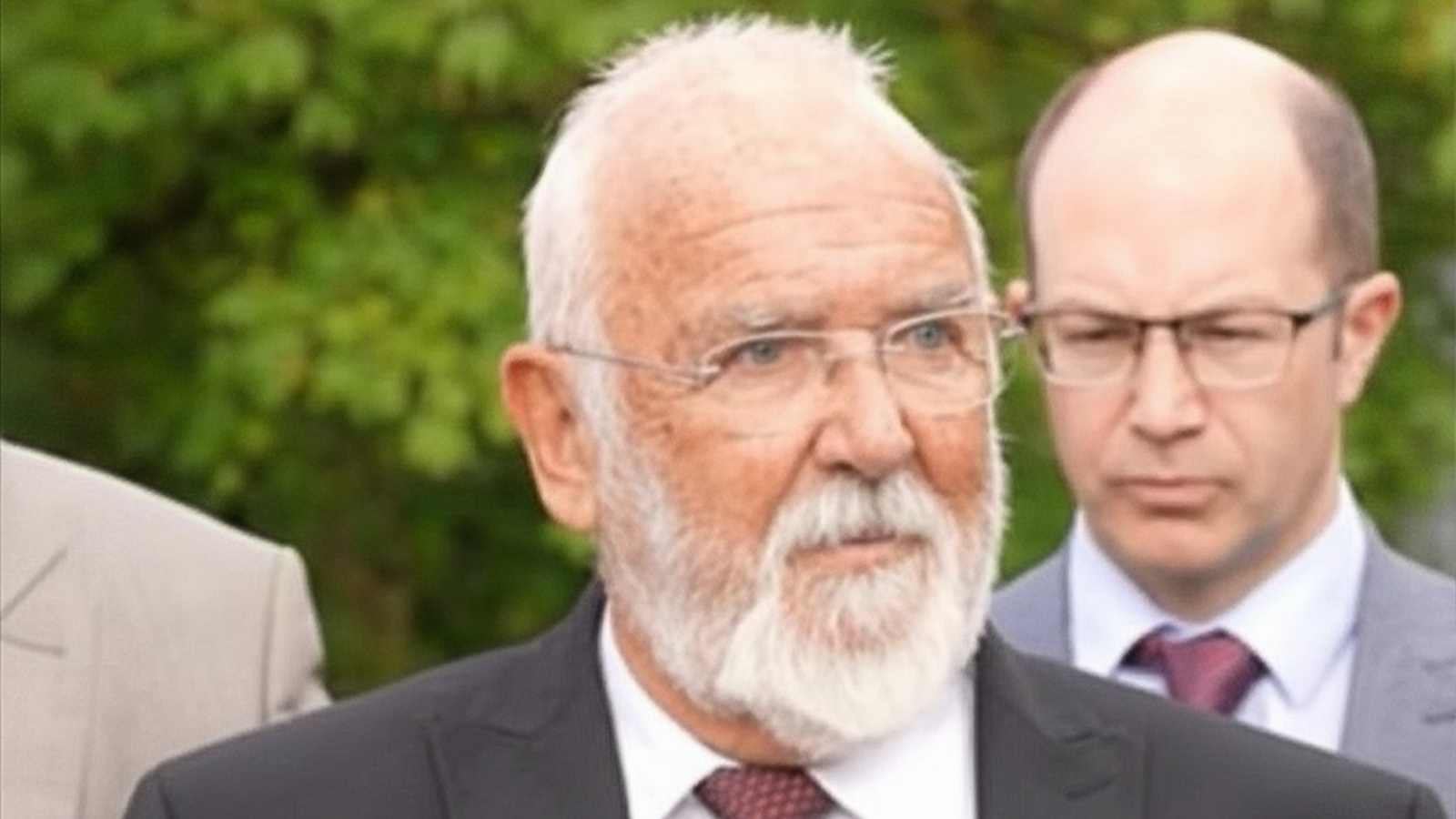
A grandfather of seven stood outside a courthouse in Coleraine, Northern Ireland, on May 7, 2026, with a criminal conviction hanging around his neck for the first time in his 78 years on earth. Zero fraud. Zero violence. No theft at all.
His crime, according to the court, was reciting John 3:16, one of the most recognizable sentences in the entire Christian Bible, on a public pavement on a quiet Sunday afternoon.
“We held a small, open-air Sunday service near a hospital,” Clive Johnston said after the verdict. “We made no reference whatsoever to the issue of abortion. And yet the buffer zones law is so broad that holding a Sunday service has been found to be a criminal offense. And at 78 years of age, I find myself, for the first time, convicted of a crime.”
Let that sit with you for a second.
A retired Baptist pastor, a former president of one of Ireland’s most prominent Christian associations, a man who has spent decades shepherding congregations, walked out of a magistrates’ court as a convicted criminal because he quoted scripture in the open air.
It doesn’t matter whether you are deeply religious, casually spiritual, or have not seen the inside of a church since your last friend’s wedding. Something about that should make you stop and ask a very serious question about where the line between protecting people and policing thought actually sits in modern Britain.
The Day That Changed Everything for Pastor Johnston
Clive Johnston, 78, from County Tyrone, shared the message of John 3:16 opposite Coleraine’s Causeway Hospital in July 2024.
The former President of the Association of Baptist Churches in Ireland was found guilty of two charges under the Abortion Services (Safe Access Zones) Act: of “conducting a protest” which could be “influencing a protected person” in a buffer zone, and failing to comply with a direction to leave.
The verse he preached, for anyone who needs the reminder, reads: “For God so loved the world that he gave his one and only Son, that whoever believes in him shall not perish but have eternal life” John 3:16.
Not a word about abortion. No one was holding a placard. No megaphone was pointed at anyone walking in. Just a man, his Bible, and a small Sunday gathering on a public street. District Judge Peter King at Coleraine Magistrates’ Court handed down the conviction, and a £450 fine was imposed covering both counts.
Johnston may be the first person prosecuted under the law for preaching a sermon that did not mention abortion, according to the faith-based advocacy group the Christian Institute, which supported his legal case.
That detail alone is what makes this story more than a religious freedom debate. It is a legal precedent. And precedents, as any lawyer will tell you, have a way of growing legs and walking into territory nobody originally planned for.
“God So Loved the World” Is Now Evidence of a Crime
Johnston warned that convicting a person for publicly preaching one of the most well-known Bible passages sets a troubling precedent for religious liberty and free speech in the United Kingdom.
“It effectively redefines peaceful Christian witness as a form of unlawful ‘influence,’” he told Fox News Digital. “If simply reading the Bible, praying, and preaching on God’s love can now be considered harmful because someone might overhear it within a certain area, then we have crossed a very serious line.”
His legal backers at the Christian Institute were equally pointed in their response. Christian Institute Director Ciarán Kelly said Johnston’s conviction is a misuse of UK law.
“Despite assurances to the contrary when this legislation was being considered, we now see that an already controversial and deeply unjust law has now been selectively applied to criminalize Gospel preaching,” Kelly said.
“This is creeping censorship. If the ruling stands, it will represent a shocking new restriction on freedom of religion and freedom of speech, so we will be helping Clive to consider the options for appeal.”
Simon Calvert, deputy director of The Christian Institute, speaking before the verdict, said that John 3:16 “is a wonderful, famous verse and everyone knows it says nothing about abortion.”
He accused the police and Public Prosecution Service of “overstepping the mark” and said that preaching the Gospel should not be conflated with protesting against abortion.
“Prosecuting Pastor Johnston for preaching ‘God so loved the world’ near a hospital on a quiet Sunday is a shocking new attempt to restrict freedom of religion and freedom of speech in a part of the world where open-air Gospel services are a part of the culture.”
Washington Is Watching
Here is where this story takes a turn that most people have completely missed. This is not just a Northern Irish legal squabble that will quietly disappear into an appeals court.
The U.S. State Department weighed in, with a spokesperson stating: “The United States is still monitoring many ‘buffer zone’ cases in the UK, as well as other acts of censorship throughout Europe.
The UK’s persecution of silent prayer represents not only an egregious violation of the fundamental right to free speech and religious liberty, but also a concerning departure from the shared values that ought to underpin U.S.-UK relations.”
When the U.S. State Department starts framing a retired pastor’s conviction in Northern Ireland as something that threatens the foundation of transatlantic relations, you know the story has moved well beyond a local courtroom. This is now a diplomatic flashpoint dressed in a clerical collar, and both governments know it.
Johnston is not an isolated case either. Scottish grandmother Rose Docherty was arrested twice for holding a sign offering conversation in a protected zone before charges were dropped. Others in the UK have been charged and fined for silently praying in these zones. Read that again.
Silently praying. Just a person standing still with their thoughts, convicted under a law designed to stop harassment. The Christian Institute has raised the question of whether UK law is seeking to impose “Christianity-free zones” around hospitals, asking: “Could somebody attending the hospital wearing a cross necklace be accused of influencing? What if somebody were to pray silently for a sick relative?”
The Other Side of the Argument
Now, before the comments section becomes a warzone, here is where we have to be honest about the much fuller picture, because Johnston himself admitted something that deserves attention.
The court was told Johnston “was motivated by two reasons: to test the legislation and to influence anyone who heard him towards the Bible and the Christian message generally.” They alleged that he walked into that zone knowingly and intentionally to challenge the law.
The judge noted that Johnston knowingly positioned himself within the restricted zone without verifying whether abortion services were operating that day.
So while the optics of a 78-year-old grandfather being handed a criminal record for quoting scripture are genuinely alarming, the court claimed the pastor was not simply a confused elderly man who wandered into the wrong postcode. He went there to make a point.
Safe access zone legislation across all three UK jurisdictions was designed in direct response to frequent and widespread anti-abortion protests outside premises providing abortion services, protecting people accessing healthcare from behavior that can feel deeply coercive.
The law did not emerge from nowhere. It stemmed from documented, repeated incidents of people being followed, photographed, and verbally confronted outside clinics.
The question the courts now have to wrestle with is whether a law written to protect vulnerable patients from targeted harassment can, or should, extend to a sermon about God’s love that never once references the very thing the law was written to protect against.
That is not a settled question. And depending on which side of it you land, you are either watching the slow erosion of religious freedom or the necessary enforcement of boundaries that keep healthcare accessible without intimidation. Both cannot be fully right. Both cannot be fully wrong.
What Comes Next
Johnston is currently considering appealing his conviction. “My encouragement to fellow Christians is not to give in to fear or discouragement. We have good news to share. We must continue to respond with grace, peace, and courage, never with anger or hostility, but with firm conviction,” he said.
Johnston asked the question that is now echoing through churches, courtrooms, and conversations across the United Kingdom: “John 3:16 is one of the most well-known and hope-filled verses in the Bible, a message about God’s love and salvation. If even that can be criminalized because of where it is spoken, then how can any public expression of Christian belief be truly safe from restriction?”
That question does not yet have a clear answer. But a 78-year-old grandfather now carries a criminal record because of where he stood and what he said on a Sunday afternoon, and a courtroom in Coleraine has set something in motion that will not quietly settle. The appeal, if it comes, will matter enormously. And far beyond Northern Ireland, people are paying very close attention.